

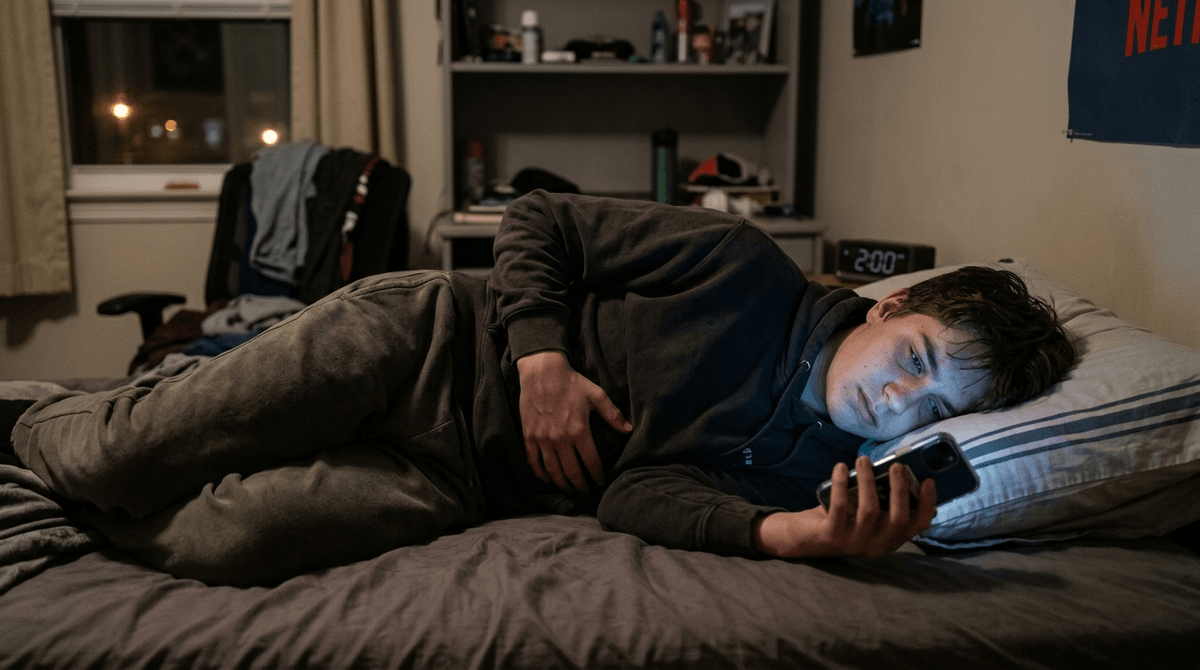
Social media use and poor sleep are fueling chronic stomach pain in teenagers, creating a cycle where digital habits exacerbate physical symptoms. For teens with recurring gut issues, the phone in their hand may be just as relevant as the food on their plate.
Teens with unexplained chronic stomach pain struggle significantly more with social media addiction and poor sleep than their healthy peers. These lifestyle factors act as predictors for functional abdominal pain, suggesting that digital habits are a physical health risk, not just a behavioral one.
Recurring stomach aches often lead parents down a rabbit hole of expensive specialist visits, invasive tests, and restrictive diets. If the root cause is actually "digital stress" or sleep deprivation, those medical interventions won't provide lasting relief.
Understanding this link allows you to treat a physical ailment by adjusting a lifestyle habit. Managing screen time for a child with chronic pain isn't about discipline or "being strict"—it's a targeted medical intervention designed to settle a hyper-reactive gut-brain axis.
Pediatricians have noted a rise in functional abdominal pain disorders (FAPD)—pain that has no obvious structural or biochemical cause—alongside the rise of the "always-on" digital generation. Researchers suspected that the stress of social media and the resulting lack of sleep were the hidden triggers for these gut-brain issues. By comparing healthy teens to those with diagnosed pain, they aimed to see if digital addiction scores could actually predict who gets sick.
Social media addiction and sleep quality are inextricably linked to pediatric gut health. The researchers found that adolescents with chronic pain reported significantly worse sleep quality, with a median score of 7.0 compared to just 4.0 in healthy controls (where higher scores indicate more disruption).
- Addiction scores were higher. Teens in the pain group scored a 14.0 on social media addiction scales, while the healthy group scored a 12.0.
- The "dose-response" was clear. There is a direct correlation between high social media use and poor sleep specifically among those suffering from chronic pain.
- Falling asleep is the hurdle. Teens with gut pain took much longer to fall asleep and reported lower overall subjective sleep quality compared to their peers.
- A new tool is coming. Researchers developed "ChARMS," a screening tool to help doctors assess how media and sleep impact a child’s gut health during standard check-ups.
The gut and the brain are connected by the vagus nerve, often called the "gut-brain axis." When a teen is addicted to social media, they are in a state of constant dopamine seeking and "digital stress." This stress, combined with the blue light that suppresses melatonin and delays sleep, keeps the nervous system in a state of high alert.
A "stressed" brain sends signals to the gut that can manifest as real, physical pain. For these teens, the stomach isn't the problem—it's the messenger. The study implies that without addressing the "posts" and the "sleep," the "pain" is unlikely to resolve, regardless of what the teen eats.
This study was cross-sectional, meaning it captured a snapshot in time. It proves a strong link, but it cannot definitively prove that social media causes the stomach pain. It is possible that a teen who is already in pain spends more time on their phone as a way to distract themselves from the discomfort, which then ruins their sleep. Additionally, the sample of 241 adolescents is moderate, and because it relies on self-reported data, teens may have under-reported their actual screen time or addiction levels.
- If your teen complains of chronic, unexplained stomach pain, audit their nighttime phone use for two weeks before committing to invasive GI testing or "elimination" diets.
- If your child is using social media late into the night, move the charging station out of the bedroom to ensure they achieve the deep sleep required for the body to regulate gut-brain signals.
- If your teen uses their phone to "distract" themselves from physical pain, replace the screen with a high-quality audio book or a guided meditation, which provides the distraction without the blue light and dopamine spikes that disrupt sleep.
- If you are seeing a specialist for your child’s gut issues, bring up their sleep quality and social media habits proactively, as these are often overlooked in traditional GI evaluations.
Managing your teen's digital boundaries is a physical necessity, not just a parenting preference. Improving sleep hygiene and reducing social media dependency can directly reduce the severity of chronic stomach pain by calming the gut-brain axis.
Sandal S, Baldassarre A, Boluk O et al. (2026). The 3P cross-sectional study: pain, posts, and poor sleep as predictors of functional abdominal pain in the digital generation. European journal of pediatrics. doi:10.1007/s00431-026-06984-6 — https://pubmed.ncbi.nlm.nih.gov/42059984/