

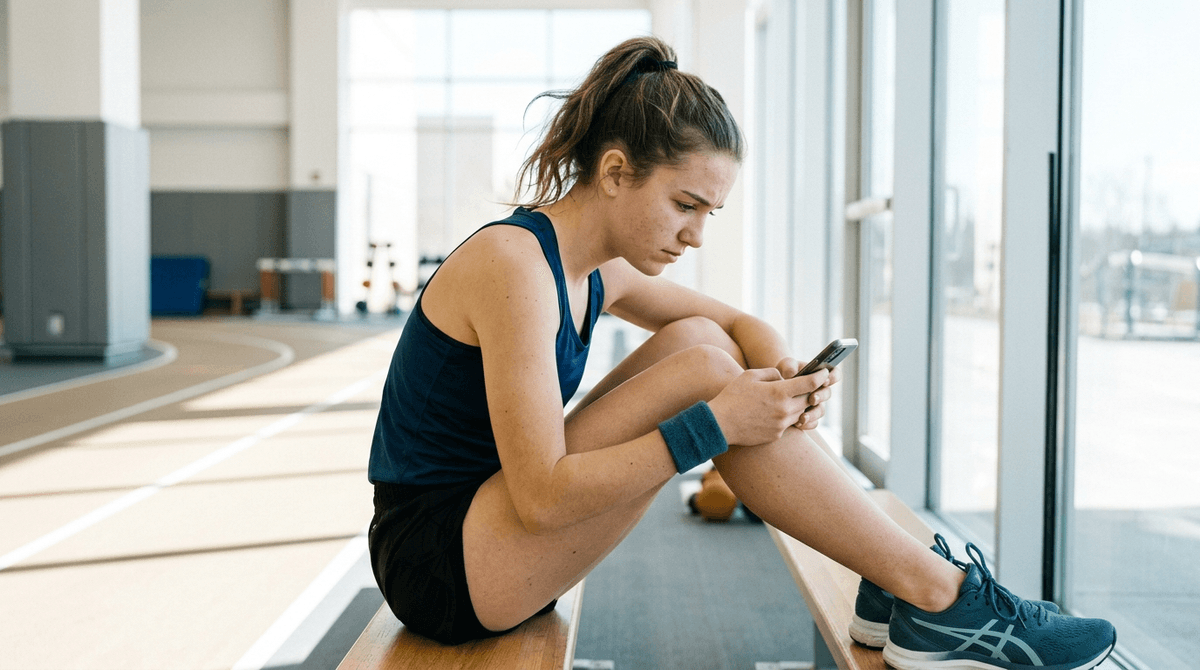
For young athletes, caring deeply about appearance-focused social media content creates a direct psychological pipeline to performance anxiety on the field, especially during the high-sensitivity window of the mid-teens.
Adolescent athletes aged 14–16 are nearly twice as susceptible to appearance-based social media pressure as older teens, causing a chain reaction that damages body image and spikes competitive anxiety. Managing how a child feels about digital feedback is more important than simply counting their minutes of screen time.
This research flips the script on how we manage digital habits for student-athletes. We often treat phones as a "distraction" or a "sleep killer," but the real danger is the "appearance-anxiety loop." When a 15-year-old athlete ties their self-worth to digital feedback on their physique, they arrive at the starting line already defeated by their own body image.
For parents, this means a bad "digital day" can lead to a bad "game day." The psychological labor of maintaining a curated athletic image on Instagram or TikTok consumes the mental energy required for focus and resilience during competition. If we want kids to be "clutch" in sports, we have to look at the pressure they are absorbing from their feeds.
Researchers have long known that social media can hurt body image, but they haven't always understood how that translates to the specific world of competitive sports. They wanted to see if the pressure to look like an "elite athlete" online actually creates anxiety that hinders physical performance.
By tracking athletes over a full year, the authors aimed to find the specific "vulnerability window." They suspected that as kids move through puberty, the way they process social feedback shifts. This study was designed to bridge the gap between digital habits, psychological health, and athletic results.
The data shows that psychological investment—worrying about likes, comments, and appearance feedback—is the primary driver of body dissatisfaction, whereas total time spent on the app had no significant effect.
- The 14–16 age gap: Younger athletes were significantly more vulnerable. The statistical link between social media use and body image issues was nearly double in the 14–16 age group (β=0.22) compared to the 17–18 group (β=0.13).
- The anxiety bridge: For these younger athletes, body dissatisfaction mediated 61% of the relationship between their social media habits and their performance anxiety. By the time they hit 17 or 18, that mediation effect dropped to 30%.
- Aesthetic sports carry higher risk: Athletes in sports that prioritize lean physiques or "looks"—such as gymnastics, cheerleading, or wrestling (with weight classes)—reported higher levels of body dissatisfaction across the board.
- The internal shift: The researchers found that once an athlete is dissatisfied with their body, it triggers "competitive anxiety," a state of worry that specifically targets their ability to perform in front of others.
The "developmental window" is the most critical takeaway. At 14, an athlete is still constructing their identity through peer validation. They are essentially "outsourcing" their self-esteem to their followers. By 18, many athletes have developed a more stable "athletic identity" that relies on performance stats and internal markers rather than digital likes.
This implies that we shouldn't treat all teenagers the same way when it comes to social media monitoring. The early high school years are a high-stakes period where digital interactions have a disproportionate impact on physical confidence.
The findings are based on a study of 356 Chinese student-athletes. Cultural factors, including different societal pressures regarding body weight and academic-athletic balance, may influence how these teens perceive social media. Additionally, the data relies on self-reported surveys. Teens might under-report their anxiety or over-estimate their social media use. Finally, while the study followed these kids for a year, it is observational; it shows that these factors move together, but it cannot definitively prove that a specific post caused a specific spike in anxiety.
- If your 14-to-16-year-old athlete is showing unusual pre-game nerves, look at their recent social media engagement and whether they’ve been seeking validation for their "look" online.
- If your child is in an aesthetic sport like gymnastics, cheer, or wrestling, proactively discuss "body functionality"—praising what their muscles do rather than how they look in a photo—to buffer the pressure of digital comparison.
- If you are setting digital boundaries, focus on "emotional investment" rather than just time. Ask your child how they feel after posting a photo or how much they worry about the "likes" it receives, as this worry is what actually correlates with anxiety.
- If your older teen (17+) seems less affected by social media, it may be because they’ve built a more resilient athletic identity. Use this as an opportunity to have them mentor younger siblings or teammates on how to ignore the "digital noise."
Young athletes are most vulnerable to the digital "comparison trap" between the ages of 14 and 16, where vanity on the screen translates directly into insecurity on the field. To protect their performance, focus on building an appreciation for their body’s capabilities rather than its appearance.
Zhang W, Duan R, Li H et al. (2026). A developmental perspective on appearance-related social media use, body dissatisfaction, and competitive anxiety among Chinese adolescent athletes: a three-wave longitudinal study. Frontiers in psychology. doi:10.3389/fpsyg.2026.1805798 — https://pubmed.ncbi.nlm.nih.gov/42077299/