

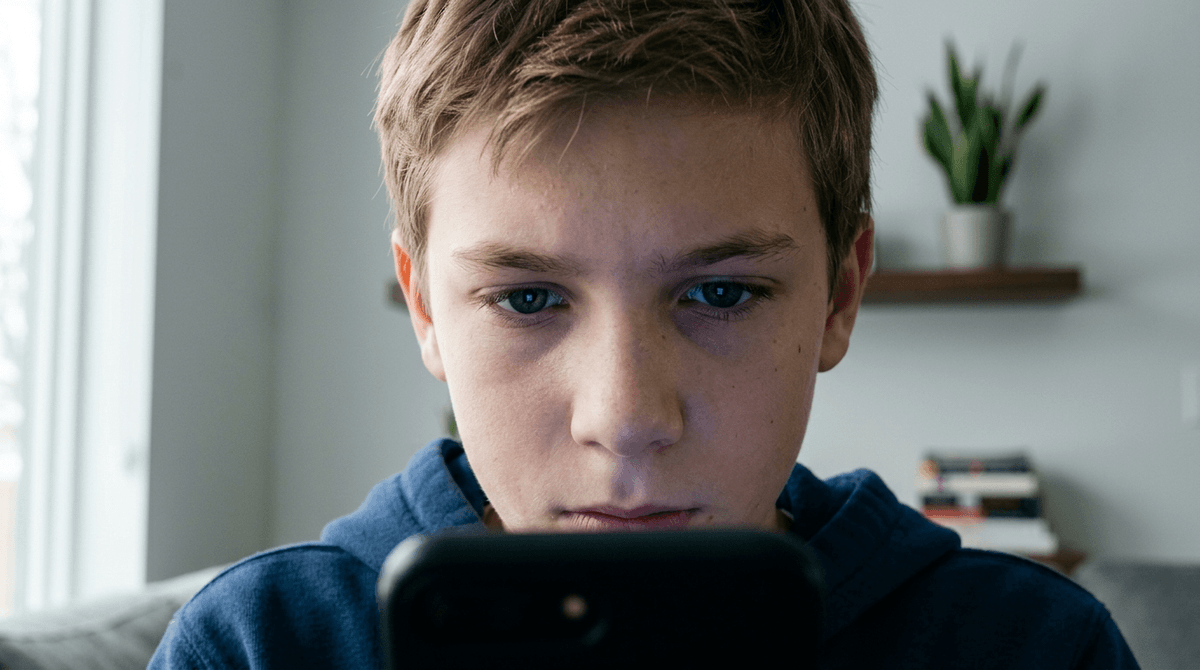
Kids who spend more than two hours a day on smartphones are depleting their eyes' natural defense against blue light. The more time they spend staring at the screen, the thinner their internal "sunglasses" become.
Excessive smartphone use erodes the density of macular pigments—the internal filters that protect a child's retina from high-energy light. Staying under the two-hour daily limit is the primary way to preserve these biological shields.
Smartphone screens sit closer to the face and emit more concentrated blue light than televisions or monitors. Because children have clearer lenses than adults, their retinas are significantly more vulnerable to light-induced damage.
This isn't just about "digital eye strain" or tired eyes. These pigments (lutein and zeaxanthin) are the eye's only physical shield against oxidative stress. When these levels drop, the eye loses its ability to filter out the most damaging wavelengths of light, potentially setting the stage for long-term vision issues. This finding provides a biological "why" behind the standard two-hour screen time recommendation.
Researchers wanted to move beyond behavioral surveys and look at the physical impact of screens on eye anatomy. While the link between screens and sleep is well-documented, the impact on Macular Pigment Optical Density (MPOD) in developing eyes was a "black box." As smartphone adoption reaches younger and younger children, understanding how digital habits change the literal structure of the eye has become an urgent health priority.
Children using smartphones for more than two hours daily had significantly lower protective pigment levels than those who stayed under the limit. The association was strikingly linear: as screen time went up, pigment density went down across every age group from 8 to 18.
- The "Gold Standard": The highest protection levels (0.77 units) were found in 13-to-15-year-olds who used phones for less than one hour a day.
- The Urban Penalty: Children in urban areas had lower pigment levels (0.48) than rural children (0.57). This gap was directly tied to higher total screen time in cities.
- Weekend Spikes: Screen usage was significantly higher on weekends, suggesting that "binge" behavior may contribute more to pigment depletion than steady, moderate use.
- Age and Exposure: The study found that even in older teenagers, the two-hour threshold remained the critical tipping point for eye health.
Low pigment levels in the eye are often a "canary in the coal mine" for the brain. Because the eye and the brain both rely on lutein and zeaxanthin for protection and performance, thin eye filters often signal lower levels of these nutrients in the brain. This suggests that the same kids losing their eye protection might also be missing out on the cognitive benefits these pigments provide for memory and attention.
Furthermore, the rural-urban divide implies that "green time" acts as a natural buffer. It isn't just that rural kids are away from screens; it’s that their environments may encourage the types of outdoor light exposure and dietary habits that support pigment density.
The sample size was small, with only 57 participants. While the correlation between screens and pigment is statistically significant, a group this small makes it harder to apply the findings to every child globally.
The study is also observational, meaning it can’t definitively prove that the smartphone caused the pigment to disappear. It is possible that children who spend more than two hours on phones also have different diets or spend less time in the sun, which could also influence pigment levels. Finally, the measurement technique (Heterochromatic Flicker Photometry) is subjective—it relies on a child accurately reporting when they see a light flicker, which can introduce "noise" into the data.
- If your child is routinely exceeding two hours of smartphone use... implement a "hard stop" at the 120-minute mark to protect the physical thickness of their macular pigment.
- If you want to rebuild their eye's internal blue-light filter... increase their intake of "eye foods" like spinach, kale, eggs, and orange peppers, as the body cannot produce these essential pigments on its own.
- If your child’s screen time spikes on Saturdays and Sundays... prioritize "analog mornings" to delay the onset of blue light exposure and reduce the total weekend "dose."
- If you live in a dense urban environment... make a conscious effort to swap 30 minutes of screen time for 30 minutes of outdoor play, mirroring the protective patterns seen in the rural study group.
The two-hour screen time limit is more than a parenting suggestion; it appears to be a biological threshold for eye health. To keep a child's "internal sunglasses" intact, parents must balance the digital load with specific nutrients and outdoor time.
Hopîrcă L, Țîpcu A, Hapca MC et al. (2026). Variations in Macular Pigment Optical Density in Children and Adolescents Depending on Time Spent on Smartphones. Vision (Basel, Switzerland). doi:10.3390/vision10020030 — pubmed.ncbi.nlm.nih.gov