

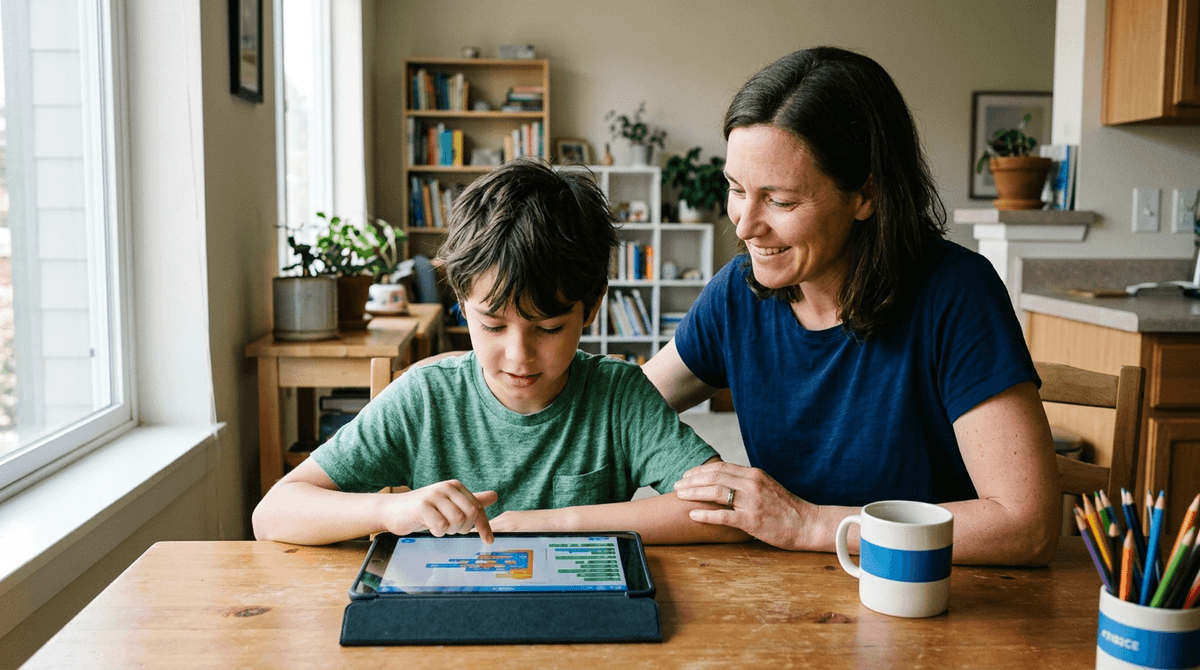
For families managing tight budgets and limited help, screens function as a vital educational and structural support system rather than a source of guilt.
Screen time for preschool-age children in low-income households functions as a deliberate parenting tool for school readiness and household management, shifting the priority from "how much" to "what" and "why."
Standard parenting advice often treats screen time as a luxury or a vice, but for many, it is a utility. Understanding this shift allows parents to ditch the guilt of the "digital babysitter" and focus on making that tool as effective as possible.
When childcare is unavailable or the neighborhood is unsafe for outdoor play, the tablet becomes the "safe" space. For parents in these environments, the focus isn't on the clock—it’s on the content and the quiet it provides to get through the day.
Most research on screen time focuses on middle-class families where parents have the resources to set strict timers and provide alternative activities. This study filled a gap by looking at how mothers facing structural constraints—like limited financial resources or the need to juggle work and chores solo—actually navigate technology.
Researchers wanted to understand the logic behind high usage rates in lower-income demographics. They found that what looks like "passive" parenting from the outside is often a calculated strategy to keep kids safe and learning while parents manage the demands of poverty.
Content quality consistently beats the clock in the eyes of these mothers. The study found that parents were far more concerned with what their kids watched than how long they watched it.
- Curated Autonomy: Mothers favored "restrictive mediation," which means they locked down specific apps or YouTube Kids settings but let children choose what to watch within those boundaries.
- The Emotional Regulator: Screens serve as a functional resource for "emotion regulation," helping kids calm down so parents can complete chores or paid work without interruption.
- School Readiness: Most mothers viewed screens as a teaching tool. They intentionally selected content to teach the alphabet, numbers, and colors, viewing the device as a bridge to formal schooling.
- Absence of Stigma: Unlike trends in higher-income circles, these mothers reported little shame regarding high screen use. Some reported up to ten hours of daily use, viewing it as a practical necessity rather than a failure of parenting.
The "digital divide" is evolving into a "judgment divide." While public health experts preach "zero screens," they often ignore the reality of parents who don't have a backyard, a playroom, or a second caregiver to step in while they cook dinner.
The study implies that "good parenting" in these contexts is defined by the ability to curate a safe digital environment. If a child is learning their ABCs and staying safe inside while the parent works, the mother views the screen as a success, not a compromise.
The sample is small, consisting of only 63 mothers from New Orleans and the Twin Cities. This means the findings might not represent the experiences of rural families or different cultural groups.
Crucially, the data relies on self-reports rather than objective device tracking, which can lead to inaccuracies in total hours. The study also did not measure actual developmental outcomes or "brain effects," only how the mothers perceived the benefits of the technology.
- If you need a screen to manage a high-stress time of day—like cooking dinner or a work call—practice curated autonomy by locking the device to a pre-approved educational app or playlist so your child has freedom of choice within a safe "walled garden."
- If your goal is school readiness, select interactive educational apps (like Khan Academy Kids) over passive scrolling to better align with the "learning tool" strategy identified in the research.
- If you feel guilty about high usage hours due to a lack of childcare, pivot your focus to content safety and restrictive mediation rather than the total time on the clock.
- If you are choosing content for a preschooler, prioritize "prosocial" and academic videos that teach colors, numbers, or social skills to ensure the screen time serves a functional developmental purpose.
For parents operating under heavy structural pressure, screens are a legitimate resource for both education and household survival. You have permission to trade strict time limits for rigorous content control if it helps your family function and prepares your child for the classroom.
Flanagan E, Halpern-Meekin S, Hoiting J et al. (2026). Views of preschool-age children's screen time among mothers with low incomes. Journal of family psychology : JFP : journal of the Division of Family Psychology of the American Psychological Association (Division 43). doi:10.1037/fam0001483 — pubmed.ncbi.nlm.nih.gov