

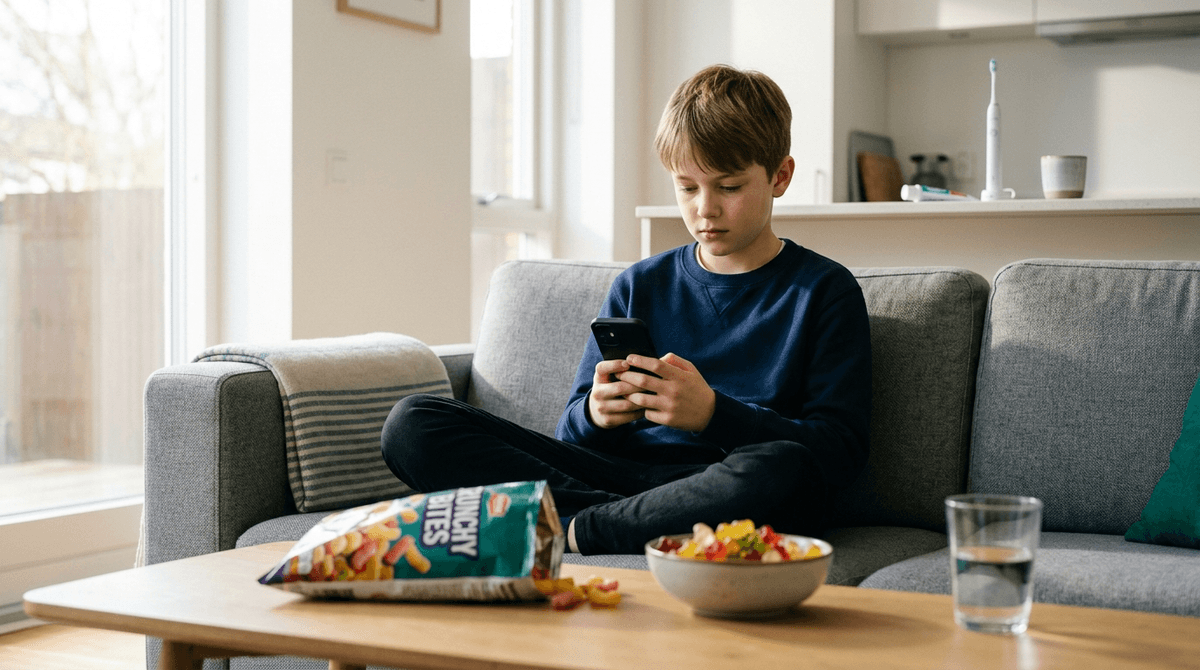
High screen time is a direct risk factor for your child's dental health, primarily because it fuels mindless sugar consumption and causes kids to skip their bedtime brushing.
Limit screen time to protect your child’s teeth, as excessive device use is linked to higher rates of cavities and gum disease through mindless snacking and neglected hygiene routines.
Cavities aren't just about candy; they're about the environment in which we eat. If a tablet is present at every snack, the risk of tooth decay spikes regardless of what is on the plate. This finding moves the screen time debate from "eyes and brains" to "teeth and gums," giving you a concrete physical health marker to monitor when deciding on device limits.
Dental professionals are seeing a rise in "distracted eating" among children, where devices serve as a catalyst for poor oral habits. Researchers reviewed a decade of data to determine if digital devices were merely a distraction or a systematic driver of pediatric oral health issues. They found that the behavioral shifts caused by screens are more damaging than the devices themselves.
Children with heavy screen habits are significantly more likely to suffer from dental caries (cavities) and high plaque levels.
- Devices act as a "snack trigger," encouraging kids to consume starchy or sugary foods while their attention is focused elsewhere.
- Late-night screen use often leads to exhaustion, which results in the two-minute brushing routine being rushed or skipped entirely.
- Heavy device users report higher levels of dental anxiety and more behavioral challenges, making actual visits to the dentist more combative and difficult.
- The link between screens and cavities is often a proxy for lower parental oversight; when a screen is the primary "babysitter," oral hygiene often falls by the wayside.
The "distraction factor" is the primary culprit for dental decay. When a child eats while watching a screen, they lose the ability to regulate intake and often keep food in their mouth longer, allowing sugar to sit on the enamel for extended periods. Furthermore, the correlation with dental anxiety suggests that kids who spend more time in high-stimulation digital environments may have a lower threshold for the sensory discomfort of a dental office.
The review relies on cross-sectional studies, which show a connection but do not prove that screens cause the cavities—it is equally possible that families with less structured routines have more of both. The data also relies on self-reported screen time, which is frequently underestimated by both parents and children. While physiological impacts like reduced saliva flow are possible, they remain unconfirmed by the current data.
- If your child snacks while using a tablet, enforce a "screens-off for snacks" rule to break the link between digital use and mindless sugar consumption.
- If your child is on their device until bedtime, require a "tech-to-toothbrush" transition where devices are docked 15 minutes before hygiene starts to ensure they aren't too tired to brush properly.
- If your child experiences high anxiety at the dentist, audit their daily screen use to see if digital overstimulation is making it harder for them to handle the sensory environment of the dentist's chair.
- If you find yourself using a tablet to keep your child occupied while you handle chores, set a recurring phone alarm for brushing times so that the screen doesn't cause you to forget the hygiene routine.
Your child's dental health is as much about their digital habits as it is about their sugar intake. Breaking the link between screens and snacking can save you money and stress at the dentist. Treat the "screen snack" as a high-risk dental event and prioritize the bedtime brush over the final YouTube video.
Kengadaran S, Divvi A, Babu Nair A et al. (2026). A narrative review of screen time as a behavioural determinant of paediatric oral health. European archives of paediatric dentistry : official journal of the European Academy of Paediatric Dentistry. doi:10.1007/s40368-026-01228-5 — https://pubmed.ncbi.nlm.nih.gov/42176160/