

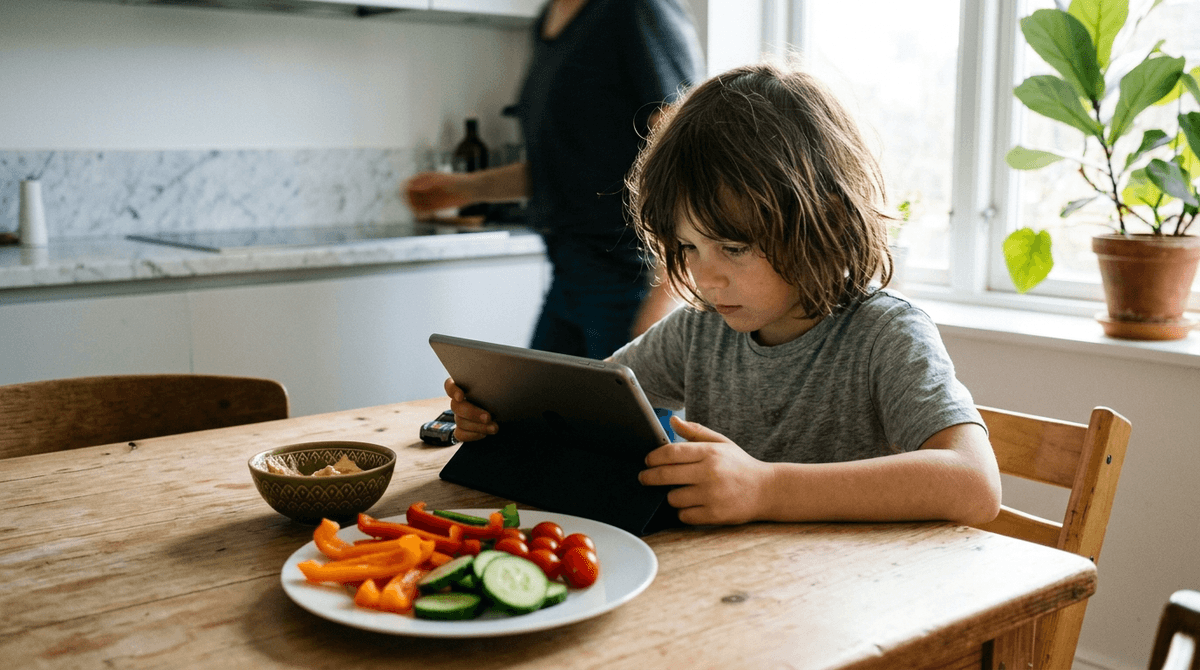
Excessive screen time and maternal health are the primary indicators of a "beige diet" in preschoolers, with more than one-third of children failing to meet basic nutritional variety targets.
Limit daily screen time to under 60 minutes and establish a fixed seat at the dinner table to ensure children consume more than just starchy staples and dairy.
Preschool is the critical window for palate development that dictates lifelong eating habits. If a child doesn't regularly consume at least five of the nine major food groups between ages 3 and 7, they are at higher risk for micronutrient deficiencies that can stall brain development and growth. This research shows that dietary variety isn't just about "picky eating"—it is heavily influenced by the digital and physical environment parents build at home.
Researchers wanted to determine why nearly 40% of children in rapidly modernizing regions are failing to achieve dietary diversity despite food being plentiful. By looking at 3,700 families, they sought to identify which specific lifestyle "levers"—like sleep, outdoor play, and screen use—actually move the needle on what a child is willing to eat.
About one-third of the children studied lived on a limited rotation of four or fewer food groups. While almost every child ate rice or bread (96%) and most drank milk (78%), the "missing middle" of the pyramid was stark.
- The most neglected foods: Only about 20% of kids were eating fish, seafood, beans, nuts, or tubers like sweet potatoes.
- The screen threshold: Watching more than one hour of screens per day was a significant predictor of a narrow diet.
- The maternal link: Mothers with a BMI over 28 were significantly more likely to have children with low dietary variety, suggesting that household eating patterns are shared.
- Protective factors: Children who slept 9–13 hours and had a "fixed seat" for meals were much more likely to eat a diverse range of foods.
The link between screens and poor diet is likely rooted in "appetite displacement" and sensory distraction. When a child eats while watching a tablet, they miss the sensory "training" of smelling, touching, and seeing new foods, which is necessary to overcome neophobia (the fear of new things). Furthermore, screen time often replaces the outdoor physical activity that naturally regulates a child's hunger cues and interest in varied fuel sources.
This study was observational and relies on self-reported data from parents, which often leads to underreporting screen time and overreporting healthy habits. Because the research focused on urban Wuxi, China, the specific food gaps (like the lack of legumes or fish) might vary in Western contexts where different cultural staples dominate. However, the biological links between sedentary behavior and appetite remain universal.
- If your child is a "grazer" who wanders the house during meals... Establish a permanent, fixed dining seat for every meal to create a psychological association between sitting down and focused eating.
- If you are looking for the most impactful foods to introduce... Prioritize fish, beans, and sweet potatoes, as these are the three nutrient-dense groups most likely to be missing from a preschooler's rotation.
- If your child is currently watching more than an hour of media daily... Redirect the final 20 minutes of screen time toward outdoor play, as physical activity was statistically linked to a more adventurous palate.
- If you are working on your own health goals... Model variety on your own plate first, as the data shows a mother’s BMI and a child’s dietary diversity are closely tethered through shared household habits.
You cannot nag a child into a diverse diet, but you can curate an environment that makes variety inevitable. By capping screens at an hour and making the dinner chair a non-negotiable, you create the sensory space a child needs to move beyond bread and milk.
Guo B, Jiang L, Jiang X (2026). Dietary diversity status and influencing factors among children aged 3-7 in China. Frontiers in nutrition. doi:10.3389/fnut.2026.1797862 — pubmed.ncbi.nlm.nih.gov