

Look, we all want our kids reading more and staring at screens less. But here's the thing—when you're competing with YouTube shorts and Roblox, handing them a book about a girl and her horse isn't always going to cut it.
Enter science fiction. Robots. Time travel. Alien worlds. Kids piloting spaceships. Dystopian futures where teens have to outsmart authoritarian governments. This is the genre that makes reading feel less like homework and more like the best movie that hasn't been made yet.
Science fiction books for kids range from picture books about friendly robots to dense young adult novels exploring AI ethics. They span every reading level and interest—space adventures, time loops, genetic engineering, climate futures, first contact with aliens, you name it. And unlike a lot of "educational" content that feels like eating vegetables, good sci-fi sneaks in critical thinking, scientific concepts, and ethical questions while kids are just trying to figure out if the protagonist survives.
Kids are drawn to science fiction for the same reason they love building elaborate worlds in Minecraft—it lets them imagine possibilities beyond their current reality.
The power fantasy is real. In sci-fi, kids aren't just kids. They're the ones who figure out how to communicate with aliens, hack the system, save Earth, or discover they have abilities no one else has. They're not waiting for adults to fix things—they're the ones with agency.
It scratches the same itch as gaming. Complex world-building, clear stakes, level-ups in knowledge or ability, and often a quest structure. A kid who loves Zelda or Hades will recognize the narrative structure of a good sci-fi novel.
It makes STEM concepts actually interesting. Instead of "here's how photosynthesis works," it's "here's a planet where plants are sentient and humans have to negotiate with forests." Science becomes story, not textbook.
Ages 5-8: Picture Books and Early Readers
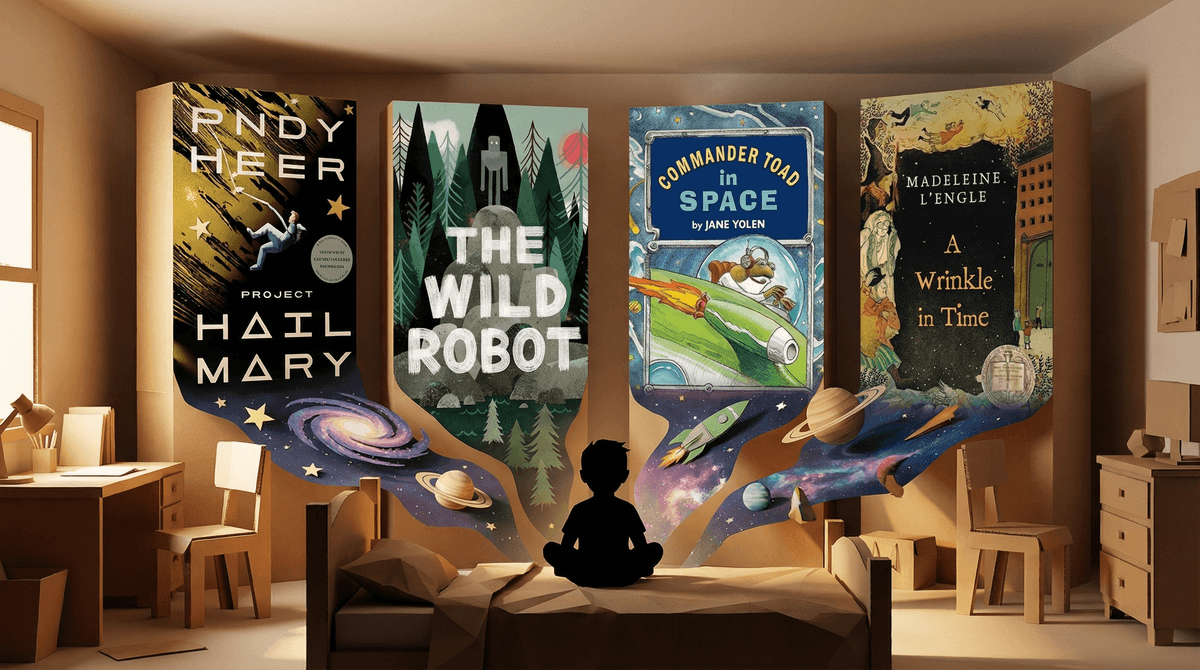
Start with books like The Wild Robot by Peter Brown (yes, there's a movie now, but the book is better—more time to sit with the ideas). Ada Twist, Scientist by Andrea Beaty introduces scientific thinking through a curious kid. For something weirder, try Commander Toad by Jane Yolen—it's goofy space adventures with actual vocabulary building.
These books introduce sci-fi concepts—robots, space travel, invention—without the existential dread.
Ages 8-11: Middle Grade Magic
This is the sweet spot. A Wrinkle in Time by Madeleine L'Engle is the classic (though heads up—it's Christian allegory wrapped in space travel, which some families love and others find preachy). The Wild Robot series continues to be gold here. Hatchet isn't strictly sci-fi but has that survival/problem-solving energy.
For kids who loved Percy Jackson, try Artemis Fowl by Eoin Colfer—it's got that same "smart kid outsmarts everyone" vibe but with fairies and tech. The Last Kids on Earth series by Max Brallier is part graphic novel, part sci-fi apocalypse, and kids devour it.
Ages 11-14: The YA Gateway
The Hunger Games is the obvious one, and yes, it's violent—but it's also one of the smartest explorations of media manipulation, authoritarianism, and trauma written for this age group. If that feels too intense, try Ender's Game by Orson Scott Card (separate the art from the artist situation here—the book is brilliant, the author's politics are... not).
Scythe by Neal Shusterman explores mortality in a world where death has been "solved." The Giver by Lois Lowry is the gentler dystopia—less action, more philosophical.
For kids obsessed with AI and tech, Warcross by Marie Lu is Ready Player One but better and less libertarian.
Ages 14+: Real Deal YA and Adult Crossover
At this point, they can handle most adult sci-fi. The Martian by Andy Weir is basically a love letter to problem-solving and science (and has like two curse words, if that matters to you). Children of Time by Adrian Tchaikovsky if they're ready for something truly weird and brilliant. Project Hail Mary (also Weir) is a fantastic father-kid read-aloud if your teen still tolerates that.
Not all sci-fi is dystopian doom. Yes, the genre loves its apocalypses, but there's also hopeful sci-fi (sometimes called "solarpunk") that imagines better futures. A Psalm for the Wild-Built by Becky Chambers is cozy sci-fi—robots and tea and figuring out purpose.
Sci-fi is sneaky STEM education. Kids reading The Martian are learning orbital mechanics without realizing it. Ender's Game is a masterclass in strategy and leadership. These books build scientific literacy in a way that sticks because it's embedded in story.
It teaches critical thinking. Good sci-fi asks "what if?" and then follows the logic. What if we could edit genes? What if AI became conscious? What if we colonized Mars? These aren't just fun thought experiments—they're the ethical questions this generation will actually face.
The genre has diversity issues but is improving. Older sci-fi (Asimov, Clarke, Heinlein) is very white, very male. Newer voices—N.K. Jemisin, Nnedi Okorafor, Becky Chambers—are expanding what sci-fi looks like and who gets to be the hero.
If your kid is glued to screens, science fiction books are your secret weapon. They offer the same world-building, problem-solving, and power fantasies as video games, but with the critical thinking and imagination-building that screens can't replicate.
Start with one book that matches their current obsession. Loves Roblox and building? Try The Wild Robot. Obsessed with Fortnite battle royale? The Hunger Games is right there. Into AI and ChatGPT? Warcross or Ender's Game.
You're not trying to replace screens entirely (that's a losing battle). You're offering an alternative that's just as compelling—and building a reader in the process.
Find the right entry point. Get sci-fi book recommendations for your kid based on your kid's age, interests, and reading level.
Make it social. Start a parent-kid book club, even if it's just the two of you. Discussing The Giver over hot chocolate beats another argument about screen time.
Connect books to screens strategically. Finished The Martian? Watch the movie together and talk about what changed. Read A Wrinkle in Time and compare it to the Disney adaptation (spoiler: the book wins).
Science fiction isn't just entertainment—it's preparation. These books help kids imagine futures, question systems, and believe they can solve problems that don't have easy answers. And in 2026, that might be the most important skill we can give them.