

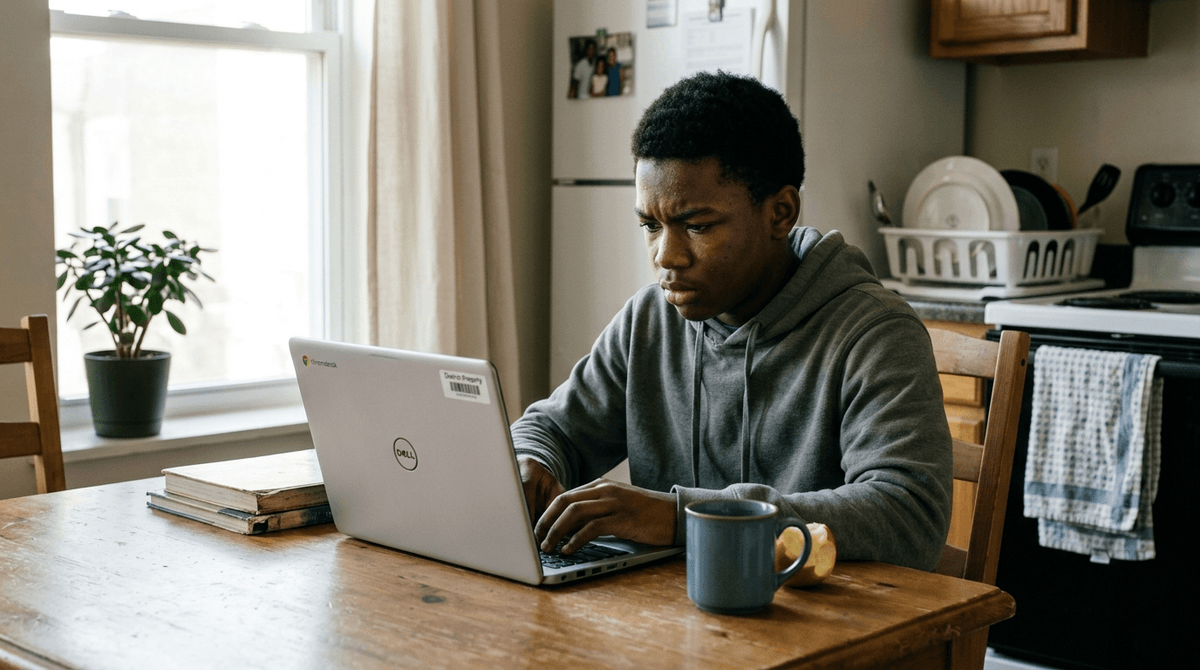
School-issued laptops are following your kids home, but the "safety" software installed on them is more likely to result in a detention than a mental health check-in. The tools marketed as a suicide-prevention net are functioning as a 24/7 surveillance system that hits marginalized students hardest.
Software designed to protect students flags their private behavior for disciplinary action instead of support, creating a surveillance web that follows children home and disproportionately targets minority and LGBTQ+ youth.
If your child uses a school-issued Chromebook for homework, their late-night searches and private messages aren't just seen by the school—they are often acted upon. For parents, this means the boundary between home and school has effectively vanished. Any mistake made in the privacy of a bedroom can now trigger a school disciplinary process before the first bell rings the next morning.
The "safety" label on these tools is often a Trojan horse. Instead of connecting a struggling teen with a professional counselor, automated alerts are frequently routed to administrators for disciplinary review or even to local law enforcement. This turns a potential cry for help into a police encounter or a permanent mark on a student’s record, fundamentally changing the relationship between the student and their place of learning.
The massive influx of federal funding and "1-to-1" device programs during the pandemic made school-issued laptops ubiquitous in American homes. To manage these millions of devices and comply with federal safety laws, districts turned to third-party monitoring companies that promised to use AI to prevent self-harm and school shootings.
Researchers launched this investigation to see if those promises were being kept. They found a massive gap between the marketing "safety" pitch and the reality of how teachers and administrators use the data on the ground. As schools struggle with post-pandemic behavioral issues, these surveillance tools have been repurposed as convenient digital hall monitors rather than the life-saving interventions they were sold as.
Monitoring software is increasingly a disciplinary tool masquerading as a safety net. The findings suggest that the technology is failing the very students it claims to protect.
- Discipline over safety: Teachers report using monitoring software to punish students for being "off-task" more frequently than they use it to intervene in mental health crises.
- The equity gap: Students from low-income, Black, and Hispanic families are the most vulnerable. They are significantly more likely to rely solely on school-issued devices for all their internet needs, meaning they are under constant surveillance while wealthier peers switch to private, unmonitored laptops.
- Outing students: Automated alerts for keywords related to gender identity or sexual orientation can "out" LGBTQ+ students to administrators or parents. This happens regardless of whether the student is ready to share that information, potentially creating dangerous situations at home.
- The chilling effect: When kids know they are being watched, they stop seeking help. Students are actively avoiding online mental health resources and self-expression because they fear a "trigger" will alert their principal or a police officer.
- Lack of training: Most teachers receive little to no training on how to handle the sensitive, private data these systems surface. This leads to privacy breaches and inconsistent handling of student crises.
This software creates a "permanent record" on steroids. In decades past, a moody poem written in a notebook might have stayed between the student and their paper. Today, an algorithm flags it instantly, forcing a bureaucratic response that neither the student nor the teacher may want.
There is also a hidden, permanent transfer of power happening. School districts are handing massive amounts of student data to private tech companies with very little oversight. Once a student is flagged as a "risk" by an algorithm, that label can follow them through their school career, coloring every interaction they have with staff and security.
The research relies on self-reported survey data from students, parents, and teachers. This means the data reflects what people perceive is happening, which can be influenced by personal bias or a lack of technical understanding.
Additionally, the Center for Democracy and Technology (CDT) is a policy and advocacy group focused on civil liberties. Their framing is intentionally designed to highlight privacy risks. While the data is credible, the report does not weigh these harms against potential "saves"—incidents where the software may have successfully prevented a tragedy—making it difficult to see the full cost-benefit analysis.
- If your child uses a school-issued device at home, assume that every keystroke, search, and chat message is visible to school administrators and potentially law enforcement.
- If your child needs to research sensitive topics like mental health, reproductive rights, or LGBTQ+ identity, direct them to use a personal device or a library computer not linked to their school account whenever possible.
- If your school requires the use of monitoring software, ask for a written policy that clarifies exactly who receives the alerts and whether that data is shared with local police departments.
- If your child is flagged by an automated system, insist on knowing whether the school’s response is focused on providing mental health support or imposing a disciplinary penalty.
"Safety" software is acting as a digital hall monitor that follows your child into your living room. Do not rely on school devices for private family conversations or sensitive health inquiries; the risk of a "safety" alert turning into a disciplinary headache is too high to ignore.
Unknown authors (n.d.). Report – Hidden Harms: The Misleading Promise of Monitoring Students Online. Center for Democracy and Technology. — cdt.org