

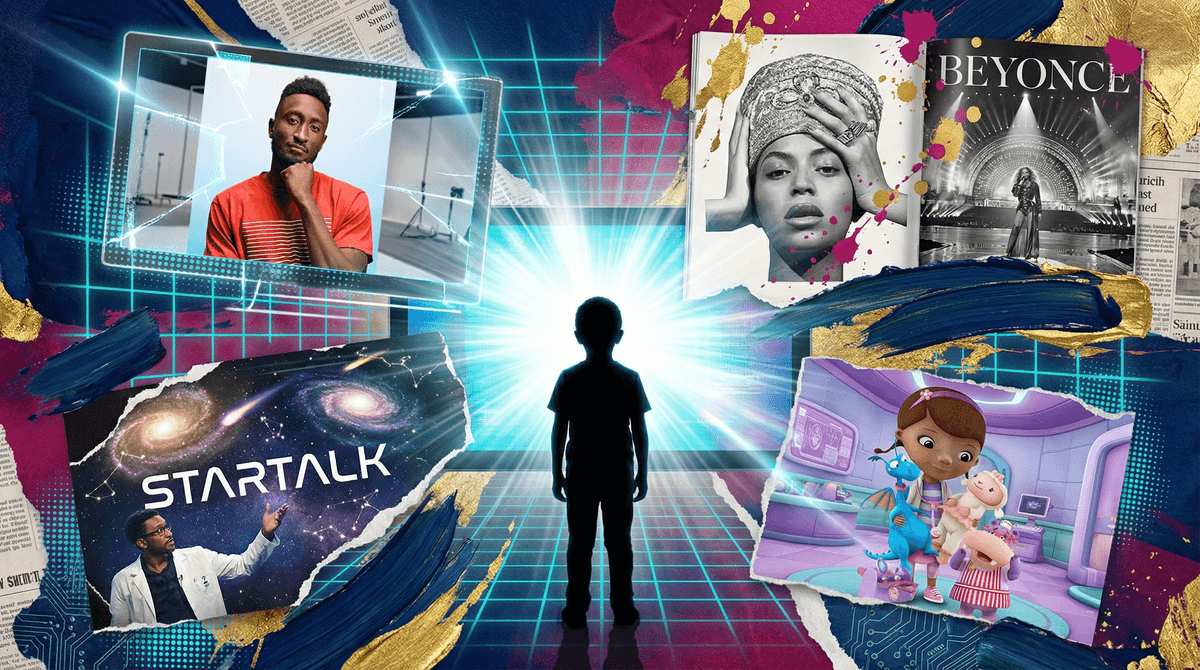
Let's be honest: Black History Month can feel like a weird disconnect for kids. They're learning about historical figures at school—Martin Luther King Jr., Rosa Parks, Harriet Tubman—while at home they're watching YouTube, scrolling TikTok, and gaming. Those February lessons can feel like they're happening in a completely different universe from the screens where kids actually spend their time.
But here's the thing: Black excellence isn't just history. It's happening right now, on the platforms your kids are already using. And if we're being real, kids are way more likely to be inspired by someone they see creating, competing, or building something in real-time than by another worksheet about the Montgomery Bus Boycott.
This isn't about replacing traditional Black History Month education—that matters. But it's about connecting those dots to the creators, athletes, entrepreneurs, and changemakers your kids are actually following. Because representation isn't just about the past; it's about showing kids what's possible right now.
Your kids are absorbing messages about who gets to be smart, funny, creative, athletic, and successful from every screen they touch. The algorithms are teaching them who matters, who's worth listening to, and who's "normal." And unless you're being intentional about it, those algorithms might be serving up a pretty narrow view of the world.
Research shows that kids who see diverse role models—especially in fields they're interested in—have broader ideas about what they can become. A kid who loves gaming and sees Valkyrae (Rachell Hofstetter, who's Filipino-American) or CoryxKenshin (a Black gaming creator with 17+ million subscribers) isn't just being entertained. They're seeing that gaming content creation isn't just for one type of person.
And let's talk about what kids are actually watching and playing. If your middle schooler is on YouTube, they might already know Mark Rober, but do they know Simone Giertz? Wait, wrong example—do they know Marques Brownlee (MKBHD), who's been reviewing tech since he was a teenager and now has 19+ million subscribers? That's a Black creator who built an empire doing something your kid might think is cool.
Here's where it gets practical. These are people your kids might already know, or should know, across the platforms they're actually using:
YouTube & Content Creation
-
Marques Brownlee (MKBHD) - Tech reviews that are basically the gold standard. Started in his dorm room, now interviews Elon Musk. Shows kids that being smart about tech is cool.
-
CoryxKenshin - Gaming content that's genuinely funny and family-friendly. He's open about his faith and taking mental health breaks, which is honestly refreshing.
-
Tabitha Brown - Started with vegan cooking videos, now she's everywhere. Her whole vibe is kindness and authenticity, which is a nice counter to a lot of YouTube drama.
-
Tiffany Alvord - Wait, scratch that. Let's go with Issa Rae, who started with her web series "Awkward Black Girl" on YouTube before creating Insecure. That's a creator-to-Hollywood pipeline story.
Gaming & Esports
- Tyler "Ninja" Blevins isn't Black, but Aydan Conrad is mixed race and—okay, better example: Look up Clix for Fortnite, but for Black representation in gaming, talk about professional esports players like those in the NBA 2K League or streamers like ImDontai who've built massive followings.
Actually, let's be more specific: If your kid plays Fortnite, they should know that Black creators and players are all over the competitive scene. If they're into Roblox, there are Black developers making serious money creating games within the platform—that's entrepreneurship in action.
Music & Creative Arts
-
Kendrick Lamar - Pulitzer Prize winner. Even if your kids are too young for his music, they should know that hip-hop is recognized as serious art.
-
Janelle Monáe - Genre-bending artist who's also an actress and activist. Her visual storytelling is next-level.
-
Kids' music creators like Alphabet Rockers who make hip-hop for kids about social justice and identity.
Sports (Because Your Kids Are Watching)
-
LeBron James - Obviously. But talk about his media company, his school, his activism. He's not just an athlete.
-
Simone Biles - Greatest gymnast ever, and she's been open about mental health, which matters.
-
Naomi Osaka - Tennis champion who's also talked about mental health and used her platform for activism.
STEM & Education
-
Neil deGrasse Tyson - Astrophysicist who makes science accessible and exciting. Has a podcast, shows up on YouTube, everywhere.
-
Simone Giertz - Wait, she's Swedish. Let's go with Ayanna Howard, robotics engineer and educator, though she's more LinkedIn than TikTok.
The honest truth? Black creators in STEM education content for kids are underrepresented on YouTube. That's worth acknowledging and something to actively seek out.
Ages 5-8: Focus on shows and content made for kids. Ada Twist, Scientist on Netflix features a young Black girl scientist. Alma's Way on PBS centers a Puerto Rican family, and while not Black-focused, shows diverse communities. Look for Doc McStuffins reruns—that show was groundbreaking for representation.
Ages 8-12: This is where YouTube gets big. CoryxKenshin is genuinely appropriate for this age. Marques Brownlee is educational and clean. If they're into sports, watch documentaries together about athletes who've made a difference beyond their sport.
Ages 13+: Teens can handle more complex conversations. Talk about Issa Rae's journey from YouTube to HBO. Discuss how Tyler, The Creator built a whole creative empire. If they're into fashion, talk about Virgil Abloh (who passed away in 2021 but whose influence is everywhere). Watch Beyoncé's Homecoming together and talk about the HBCU culture and artistry on display.
The algorithm isn't neutral. If your kid's YouTube recommendations are all white creators, that's not an accident—it's based on what they've been watching and what the algorithm thinks they want. You can actively diversify their feed by watching content together and engaging with creators from different backgrounds.
Representation in gaming is complicated. Yes, Roblox has Black developers making bank. But also, a lot of popular games have pretty homogeneous player bases and creator communities. Talk to your kids about who they're watching and following, and actively seek out diverse creators in the games they love.
Black History Month shouldn't be the only time. This is the big one. If you're only talking about Black excellence in February, you're doing it wrong. Make it ongoing. Subscribe to diverse creators. Buy books by Black authors. Watch shows created by Black writers and directors. Make it normal, not special.
Your kids might push back. If you're suddenly suggesting new creators or shows in February, older kids especially might see right through it. That's okay. Be honest: "I realized we've been watching a pretty narrow slice of content, and I want to change that. Not just this month, but in general. Here's someone I think you'd actually like..."
Black History Month is a starting point, not the destination. The goal isn't to check a box or make your kid watch "educational content" they'll resent. It's to expand their world so they see excellence, creativity, and innovation in all its forms—on the screens they're already using.
Your kid's favorite YouTuber, the athlete they idolize, the game developer whose work they love—these are the modern role models. Making sure those role models represent the full spectrum of humanity isn't about being politically correct or performative. It's about showing kids the truth: that brilliance comes from everywhere, and they should expect to see it everywhere.
-
Audit the feed. Spend 10 minutes looking at your kid's YouTube subscriptions, TikTok follows, or Twitch channels. What do you notice about who they're watching?
-
Watch something together. Pick one creator from this list (age-appropriate for your kid) and watch a few videos together. See if it clicks.
-
Make it a conversation, not a lecture. "Hey, I found this creator who does [thing you're interested in]. Want to check it out?" works better than "We need to diversify your media consumption."
-
Go beyond screens. Pair digital role models with books, museum visits, or community events. The Crossover by Kwame Alexander is fantastic for middle schoolers who love sports. Brown Girl Dreaming by Jacqueline Woodson is beautiful for tweens.
-
Keep going after February. Set a reminder for March 1st to check in: Are we still seeking out diverse voices, or did we slip back into old patterns?
The screens aren't going anywhere. Let's make sure what's on them reflects the world as it actually is—full of brilliant, creative, complicated people from every background imaginable.