

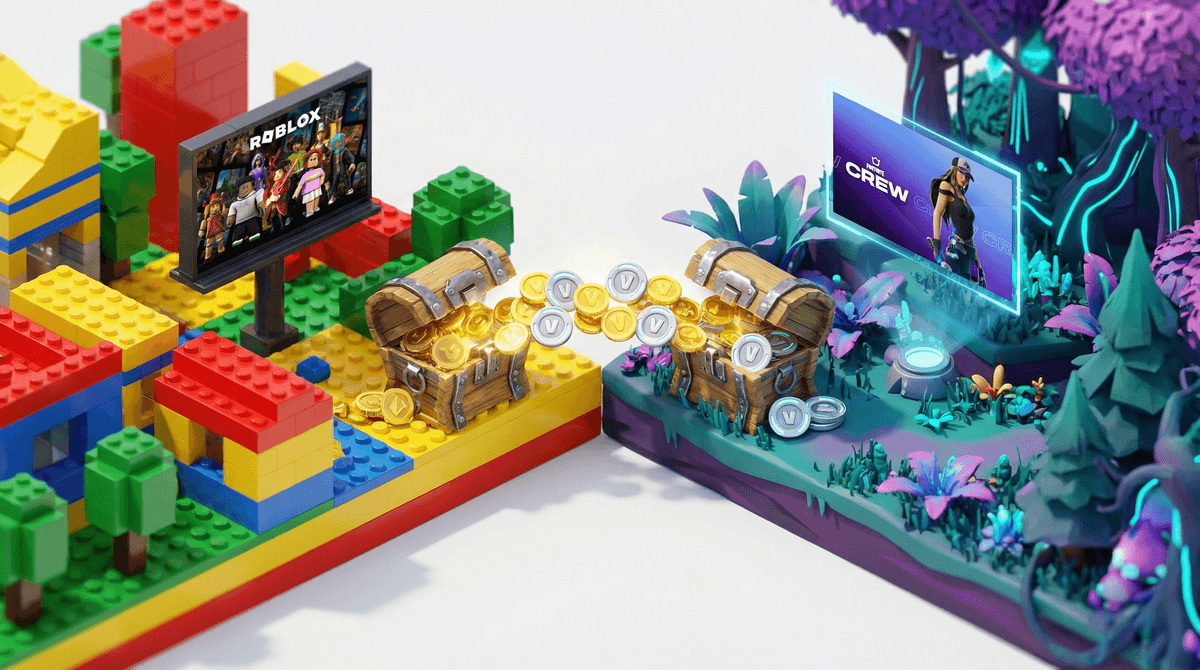
Let's start with the basics: Robux is the virtual currency in Roblox, and V-Bucks is what powers purchases in Fortnite. Both are essentially digital money that kids use to buy cosmetic items, accessories, and in-game perks. Neither currency gives players a competitive advantage in gameplay (well, mostly—we'll get to that), but they do make your kid's avatar look cooler, which is apparently worth its weight in gold to the under-13 set.
Here's the thing: if your kid plays either of these games, you've probably already been asked—no, begged—for one or both of these currencies. And if you're like most parents, you're wondering whether you're funding a harmless hobby or basically lighting money on fire while teaching terrible financial habits.
The short answer? It's complicated. The longer answer? Let's break it down.
Robux pricing:
- 400 Robux: $4.99
- 800 Robux: $9.99
- 1,700 Robux: $19.99
- 4,500 Robux: $49.99
- 10,000 Robux: $99.99
There's also Roblox Premium ($4.99-$19.99/month) which gives a monthly Robux stipend plus a 10% bonus on purchases.
V-Bucks pricing:
- 1,000 V-Bucks: $7.99
- 2,800 V-Bucks: $19.99
- 5,000 V-Bucks: $31.99
- 13,500 V-Bucks: $79.99
Fortnite also has a "Crew" subscription ($11.99/month) that includes 1,000 V-Bucks monthly plus the current Battle Pass.
At first glance, V-Bucks look slightly more expensive per unit, but here's where it gets tricky: what kids actually want to buy costs wildly different amounts in each game.
In Fortnite: A decent skin (outfit) runs 800-2,000 V-Bucks ($6-16). Emotes (dances, gestures) cost 200-800 V-Bucks. The Battle Pass—which is honestly the best value at 950 V-Bucks ($7.60)—unlocks a season's worth of cosmetics through gameplay. Most kids who play Fortnite regularly are asking for the Battle Pass each season (every 2-3 months) plus maybe one or two skins they "absolutely need."
Total realistic quarterly spend for an active Fortnite player: $25-50
In Roblox: This is where things get messy. Roblox isn't one game—it's a platform with millions of user-created games. Some are free to play completely. Others have "premium" features, game passes, or items that cost anywhere from 25 to 10,000+ Robux. A decent outfit for your avatar might cost 200-500 Robux, but then your kid wants a pet in Adopt Me (another 200-1,000 Robux), a VIP pass in another game (100-500 Robux), and suddenly you're hemorrhaging virtual currency across a dozen different experiences.
Total realistic quarterly spend for an active Roblox player: $30-100+
The key difference? Fortnite is contained; Roblox is a bottomless pit of micro-transactions. Learn more about how Robux spending can spiral .
.
Let's be real: neither of these purchases has actual value. Your kid isn't buying anything they can hold, trade (well, not officially), or resell. When they move on from these games—and they will—that money is just... gone.
But here's the counterargument: kids have always wanted to spend money on things that make them happy in the moment. Trading cards, toys, movie tickets, arcade games—none of that had lasting value either. The question isn't whether virtual currency is "worth it" in some objective sense, but whether it fits into your family's budget and values around spending.
That said, there are some meaningful differences:
Fortnite's V-Bucks are more transparent. You buy a skin, you get a skin. It does nothing except make your character look like Spider-Man or whoever. The Battle Pass is actually a decent value—you pay once and unlock tons of content through playing.
Roblox's Robux economy is more complex. Kids can spend Robux on avatar items, sure, but they're also spending it on game passes, private servers, and in-game advantages (yes, despite what anyone tells you, some Roblox games absolutely do sell competitive advantages). The decentralized nature of Roblox means it's harder to track where money goes and easier for kids to feel like they "need" to spend to keep up with friends across multiple games.
Both currencies come with intense social dynamics, but in different ways.
In Fortnite, skins are status symbols. Having the latest collab skin (Marvel, Star Wars, etc.) or a rare "OG" skin signals you've been playing a while or that you're willing to spend. But honestly? Most kids are fine with the Battle Pass skins, and there's less pressure because everyone's focused on gameplay, not just appearance.
In Roblox, the pressure is more insidious. Because Roblox is so social and creative, not having Robux can actually limit your kid's experience. They can't join certain games, can't customize their avatar beyond basic free items (which are often intentionally ugly), and can't participate in the "economy" of trading and creating. It's less about a single must-have item and more about feeling like a second-class citizen on the platform.
Here's where Roblox has a legitimate edge: kids can actually earn Robux. If your child creates games or items that other players purchase, they can earn Robux—and theoretically convert it to real money through the Developer Exchange program (though the conversion rate is terrible and requires 30,000 Robux minimum).
Some parents love this aspect. It teaches entrepreneurship, game design, and economic principles! Other parents see it as Roblox exploiting child labor while taking a massive cut of any earnings.
Both perspectives have merit. If your kid is genuinely interested in creating content and learning design skills, Roblox Studio can be educational. But if they're just grinding in someone else's game hoping to earn enough for a new hat? That's not entrepreneurship—that's just a job with worse pay than a lemonade stand.
Fortnite offers zero earning potential. It's purely consumption. Which is actually clearer and simpler, even if less exciting.
For younger kids (6-10): Both games are probably fine in moderation, but Roblox's open-ended spending can be harder for this age group to understand. If you're going with Roblox, seriously consider setting up parental controls and monthly spending limits. For Fortnite, the Battle Pass every few months is probably sufficient.
For tweens (11-13): This is peak age for both games. Social pressure is real. Consider giving a monthly allowance in either currency and letting them manage it—this can actually be a decent financial literacy lesson. Just be prepared for buyer's remorse when they blow it all on day one.
For teens (14+): Most teens are aging out of Roblox (though not all—don't shame them if they still love it). Fortnite remains popular across all teen ages. At this point, they should be managing their own spending with their own money or a clear allowance system.
The gift card trap: Both companies heavily market gift cards at retailers, which makes it easy for kids to ask grandparents, receive them as birthday gifts, etc. This can bypass your spending controls entirely. Make sure relatives know your family's policy.
The FOMO is designed in: Both games use limited-time offers, seasonal content, and artificial scarcity to drive purchases. Teach your kids to recognize these tactics. The "exclusive" skin will not actually change their life.
Subscription vs. one-time: For regular players, the subscription options (Roblox Premium or Fortnite Crew) are actually better value than one-off purchases. But they're also recurring charges that are easy to forget about.
The "everyone has it" argument: No, everyone doesn't. Plenty of kids play both games without spending a dime or with very limited spending. Don't let your kid gaslight you into thinking they're the only one without the latest skin.
If I had to pick one? For younger kids or families wanting simpler spending controls: Fortnite's V-Bucks are more predictable and contained. The Battle Pass every season ($7.60) is reasonable, and you can draw a hard line at additional purchases.
For older kids interested in creation and who can handle more complex economics: Roblox's Robux system offers more depth. But it requires more parental involvement and clearer boundaries.
Honestly, though, the "better" currency isn't really the question. The question is: what are your family's values around virtual spending? Some families have zero-spend policies and kids are fine. Some give $10/month and let kids choose. Some let kids earn virtual currency through chores or real-world entrepreneurship.
There's no right answer, but there is a wrong one: letting spending happen without any intentional conversation or limits. These games are designed to extract money. Your job isn't to say no to everything—it's to help your kids understand what they're actually buying, why they want it, and how to make intentional choices about their (and your) money.
- Set up parental controls in both Roblox and Fortnite to manage spending limits
- Have the conversation about wants vs. needs and artificial scarcity in games
- Consider a monthly virtual currency allowance that teaches budgeting
- Review purchases together periodically—what did they buy? Do they still use it? Was it worth it?
- Explore free alternatives if spending is becoming a problem—there are thousands of great free games out there
Want to understand more about in-game purchases and how to talk to kids about them? We've got you covered.