

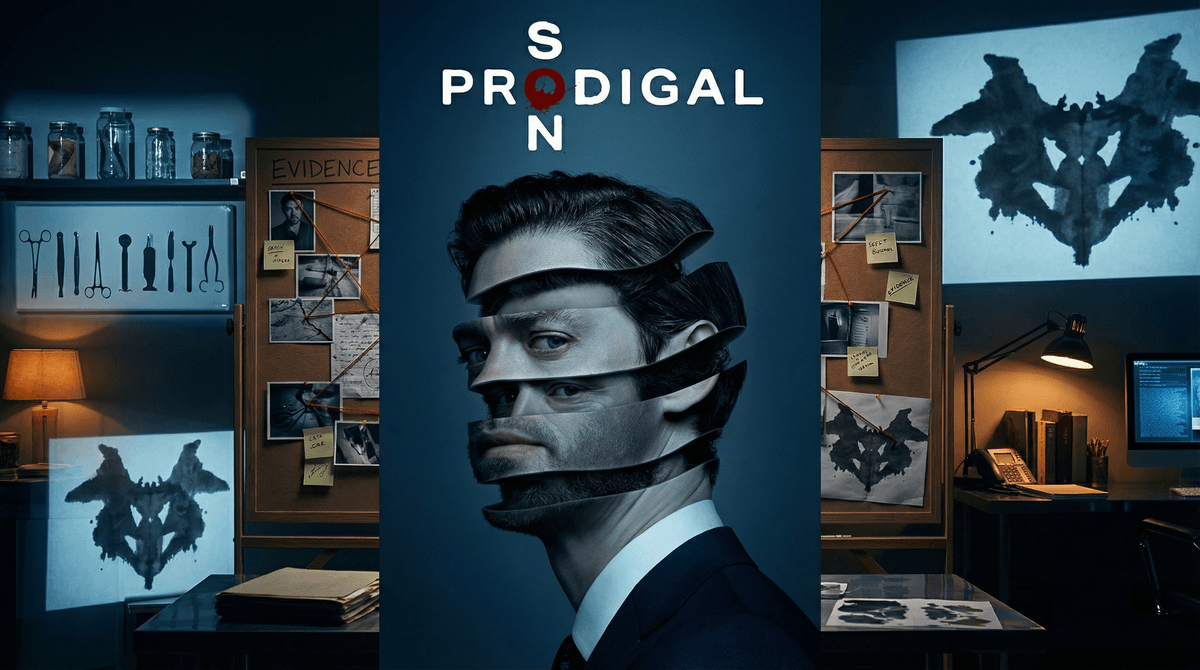
TL;DR: Prodigal Son is a dark, twisty, and often "unhinged" psychological crime drama. It’s essentially what happens if Sherlock Holmes had a serial killer father and a massive case of PTSD. It’s rated TV-14, but it’s a very hard TV-14. Think more Dexter than Law & Order. It’s great for adults and potentially mature 16+ teens who love a "tortured genius" vibe, but it’s way too intense for the middle school crowd.
Ask our chatbot if Prodigal Son is appropriate for your teen
The show follows Malcolm Bright, a brilliant criminal profiler who was fired from the FBI for being "unstable" and now consults for the NYPD. The catch? Malcolm’s father is Dr. Martin Whitly, a notorious serial killer known as "The Surgeon" who murdered 23 people before Malcolm turned him in as a child.
The series revolves around Malcolm using his unique—and frankly, traumatizing—insight into the mind of a killer to solve grizzly murders, all while navigating a deeply toxic relationship with his incarcerated father. It’s a mix of a "case-of-the-week" procedural and a long-form psychological study of whether "evil" is inherited or learned.
We’re living in an era where "true crime" is basically a personality trait for a lot of people, and that interest has trickled down to teens. If your kid has finished Wednesday or Stranger Things and is looking for something "edgier," Prodigal Son is often the next step they find on streaming platforms like Max.
It’s also worth noting that the show has a bit of a cult following because of its leads. Tom Payne (Malcolm) and Michael Sheen (Martin) have incredible chemistry. Sheen, in particular, plays the "serial killer dad" with a terrifyingly charming, "Best Dad Ever" energy that makes the show feel much more disturbing than your average police show.
If you’re trying to gauge if your teen is ready for this level of intensity, or if you’ve decided Prodigal Son is a "no" for now, here are some benchmarks:
This is the "safe" version. It has the brilliant, socially awkward lead solving impossible crimes, but without the "my dad is a cannibalistic surgeon" baggage. It’s a great litmus test for whether a teen enjoys high-functioning, fast-paced dialogue and complex mysteries.
If your teen can handle the darker episodes of Criminal Minds, they can probably handle Prodigal Son. Both shows deal with the psychology of killers, though Prodigal Son leans much harder into the personal trauma of the protagonist.
Malcolm Bright is very much in the vein of Gregory House—brilliant, self-destructive, and often the smartest person in the room. If they like the "damaged genius" trope, this is a classic choice with less gore.
The dynamic between Malcolm and his father is a direct homage to Clarice Starling and Hannibal Lecter. If you wouldn't let your kid watch this movie, you definitely shouldn't let them watch Prodigal Son.
Check out our guide on the best crime shows for teens
Let’s be real: the TV-14 rating on this show is doing a lot of heavy lifting. In many ways, it feels like it belongs on a premium cable network rather than a broadcast one.
Ages 0-13: Hard No
There is absolutely no reason for a middle schooler to be watching this. The show features "creative" body horror—think people being used as human taxidermy or elaborate traps—that can be nightmare fuel for younger kids. Plus, the central theme is a child’s betrayal of their father, which is heavy emotional lifting for a 12-year-old.
Ages 14-15: Use Caution
This is the "maybe" zone. If your teen is a horror fan or has a high tolerance for medical gore, they might be fine. However, the psychological elements are more intense than the physical ones. Malcolm suffers from severe night terrors, has to chain himself to his bed at night, and frequently hallucinates. For a teen struggling with their own mental health or anxiety, this could be a lot.
Ages 16+: Generally Okay
For older teens, Prodigal Son can actually lead to some really interesting conversations about nature vs. nurture, the ethics of the criminal justice system, and how trauma affects the brain.
This show is dark. It doesn't just solve murders; it revels in the weirdness of them.
- The Violence is Stylized but Graphic: We aren't just talking about a body on a floor. We're talking about surgical precision, jars of organs, and "The Surgeon" describing his kills with a disturbing amount of pride. It’s not "slasher" violence, but it is "clinical" violence, which can sometimes feel worse.
- Mental Health Depiction: Malcolm Bright is not "okay." He’s a mess. He has tremors, he’s medicated, he’s sleep-deprived, and he’s constantly on the edge of a breakdown. While it’s a compelling portrayal of PTSD, it’s also very intense and rarely "hopeful."
- The Gaslighting: The relationship between Malcolm and his father is a masterclass in emotional manipulation. Martin (the dad) constantly tries to convince Malcolm that they are exactly the same. For a parent, watching this can be uncomfortable because it’s a perversion of the parent-child bond.
- The "Ainsley" Factor: Malcolm's sister, Ainsley, is a journalist who starts off as the "normal" one but gets drawn into the family's dark legacy. Her arc is arguably darker than Malcolm's by the end of the series.
Learn more about how to talk to your kids about dark media themes
If your teen is already watching Prodigal Son, or if you’ve decided to let them start, here are some "non-preachy" ways to check in:
- "The Nature vs. Nurture Debate": Ask them if they think Malcolm is actually like his father, or if he’s just afraid he is. This is the core of the show and a great way to talk about identity.
- "The Ethics of Consulting": Malcolm gets away with a lot because he’s "brilliant." Talk about whether his methods (breaking into places, stealing evidence) are actually okay in the real world.
- "The Portrayal of Trauma": Malcolm’s night terrors and hand tremors are his body’s way of dealing with his past. It’s a good opening to discuss how people handle stress or "unprocessed" stuff in their lives.
- "The Surgeon's Charisma": Michael Sheen makes a monster look like a fun guy to have tea with. Talk about why that’s dangerous and how real-life manipulation works.
Prodigal Son is a high-quality, well-acted show, but it is not "comfort TV." It is designed to make the viewer feel a little bit off-balance.
If your family has a "no gore" rule, this is an easy skip. If you have a teen who is obsessed with Mindhunter or Hannibal, they’ve probably already seen clips of this on TikTok and are dying to watch it.
My advice? Watch the first two episodes yourself. If the scene where Malcolm has to cut off a guy's hand to save him from a bomb (yeah, that happens early on) makes you want to turn off the TV, then your teen probably shouldn't be watching it either.
- Check the Wise Score: Head over to the Prodigal Son media page to see how other intentional parents have rated the violence and "fear factor."
- Survey your teen: If they’re asking for it, ask where they heard about it. If it’s "TikTok edits," be aware they’re seeing the most intense, "badass" moments without the context of the emotional fallout.
- Look for alternatives: If it’s too much, check out our guide on alternatives to dark crime dramas.
Ask our chatbot for a curated list of mystery shows for 14-year-olds