

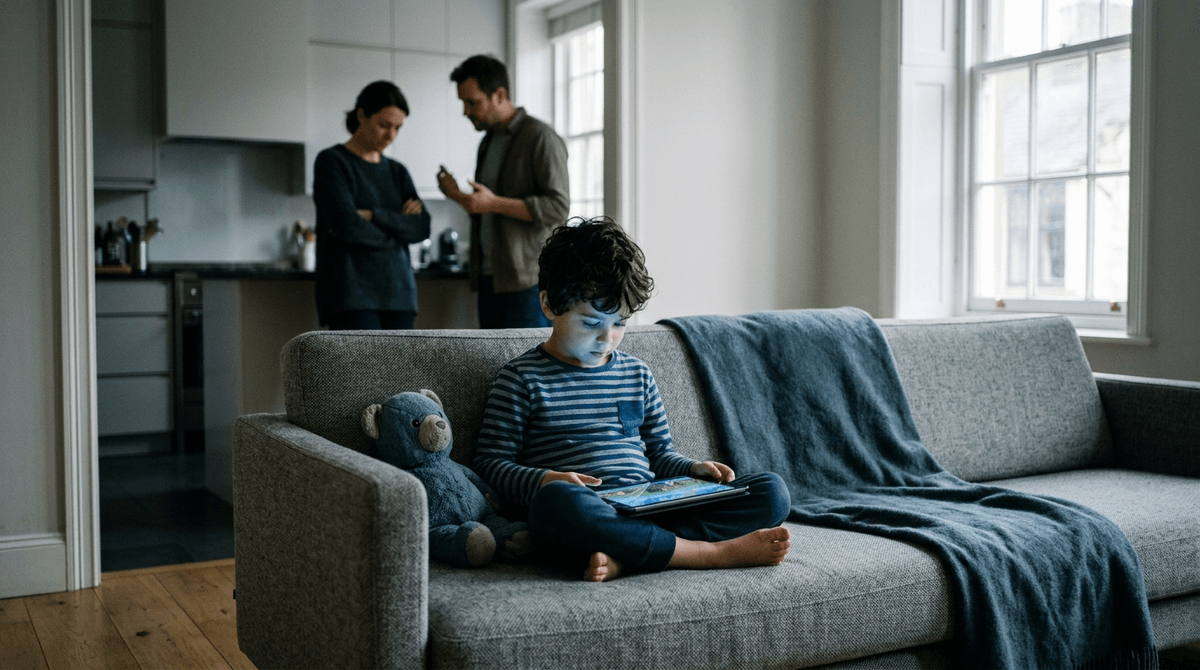
Household conflict pushes preschoolers toward screens, which then fuels anxiety and aggression—meaning the vibe at home matters as much as the minutes on the clock.
Conflict in the home drives preschoolers to screens as a coping mechanism, creating a cycle that increases anxiety and aggression. While a warm parent-child bond protects against behavior problems, it isn't enough to stop kids from reaching for tablets on its own; active boundaries are still required.
This finding changes how we view screen "addiction" in toddlers and preschoolers. It suggests that high screen usage is often a symptom of household tension rather than just a lack of discipline. If you are fighting a constant "screen battle" with a 4-year-old, the solution may lie in de-escalating the relationship and reducing friction at home rather than simply hiding the iPad.
Researchers wanted to know if screens are the root cause of behavior problems or just a middleman in a stressed-out home. They tracked over 500 families over an eight-month period to see how relationship quality, total screen minutes, and "internalizing" (withdrawing, anxiety) or "externalizing" (aggression, acting out) behaviors interact as children grow.
Conflict at the start of the study was a direct predictor of how much time a child would spend on screens four months later. That screen time, in turn, predicted an increase in behavioral issues by the eight-month mark.
- Screens are the "middle step." Increased usage explained why early relationship conflict led to more aggression and withdrawal later on.
- Warmth is a shield. Children with close, supportive parents had fewer behavioral problems overall.
- Love isn't a filter. Interestingly, even the warmest parent-child relationships did not naturally lead to less screen time. Happy families still logged high minutes if they didn't set specific limits.
- SES matters. Children from families with lower socioeconomic status exhibited significantly more behavioral struggles compared to those from higher-SES backgrounds.
Screens appear to serve as an "emotional regulator" for small children who lack the tools to handle a tense home environment. When the house is loud or the relationship with a parent is strained, the tablet offers a quiet, predictable refuge. This suggests that for some kids, screen time isn't just entertainment; it's an escape from a home environment they find overwhelming.
The data relies entirely on mothers' self-reports, which can be biased as parents often underestimate screen time or overestimate relationship quality to look better. The study also measured only the duration of screen time, not the content—there is a massive difference between a solo session of high-speed YouTube clips and watching an educational show with a parent. Finally, because the study was conducted in a single city in China, the findings may reflect specific cultural parenting styles that don't perfectly translate globally.
- If your child is showing increased aggression or anxiety... check the household "temperature" first. Reducing conflict between parents and children may be more effective for improving behavior than simply cutting off the Wi-Fi.
- If you have a warm, close bond with your child... don't assume they will naturally walk away from the screen. You still need to set active, firm boundaries on device usage, as a "good relationship" alone doesn't reduce screen minutes.
- If you are going through a high-stress period at home... be extra vigilant about "background" screen time. Kids often use the tablet to tune out domestic tension, which can lead to a cycle of withdrawal and behavior issues later.
You cannot solve a behavior problem by only looking at the screen. To lower a child's anxiety and aggression, focus on reducing friction in your relationship first. A peaceful home environment is a more powerful behavioral tool than any parental control app.
Ling X, Li M, Sun J (2026). A longitudinal study of parent-child relationship and behavioral problems in children aged 3 to 6: the mediating role of screen time. Frontiers in psychology. doi:10.3389/fpsyg.2026.1794353 — pubmed.ncbi.nlm.nih.gov