

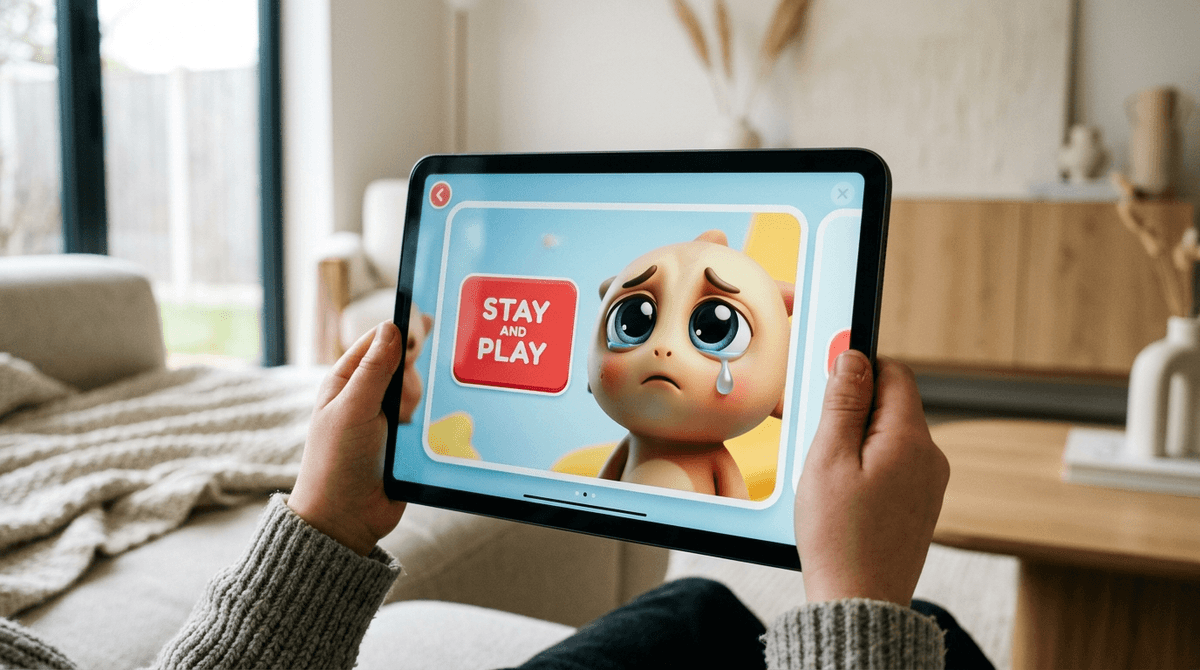
Your preschooler isn’t just addicted to their favorite app; the software is likely designed to guilt-trip and trap them. New research shows most "educational" games for young children use manipulative tactics to keep them glued to the screen and pressure them into spending money.
Most apps for preschoolers use "dark patterns"—design tricks like crying characters or hidden exit buttons—to keep kids playing longer or pressure them into making purchases.
A child's inability to stop playing a game is often a response to predatory design rather than a behavioral issue. Parents often blame themselves or their child's temperament when a tablet session ends in a meltdown, but this study proves the deck is stacked against families. Developers are intentionally building features that exploit a 3-year-old’s developing brain, which is not yet equipped to handle emotional manipulation or sophisticated sales pitches.
Recognizing these tricks allows you to shift from disciplining "bad behavior" to identifying bad software. When you understand that a game is actively working against your child's autonomy, you can make more informed choices about which developers deserve your time and money.
The digital marketplace for children has become a "wild west" where engagement metrics frequently override developmental needs. Because the "free" app market relies on constant usage and in-app spending to survive, researchers wanted to know how often developers use deceptive design—commonly called dark patterns—on children.
While adults might spot a hidden subscription button or ignore a countdown timer, a preschooler lacks the cognitive maturity to distinguish between a game and a sales pitch. Researchers sought to fill the gap in literature regarding how these manipulative features are specifically tailored to the preschool demographic, a group particularly vulnerable to emotional cues.
Eighty percent of the most popular apps for preschoolers contain at least one manipulative feature designed to prolong play or drive revenue. The tactics are not accidental; they are systematic efforts to bypass a child's natural stopping points.
- Parasocial pressure: One in four apps featuring characters used them to guilt the child. When a child tries to quit, the character appears sad, cries, or looks disappointed to manipulate the child into staying.
- Navigation roadblocks: Nearly half of the apps (46%) made it physically difficult to leave or close an advertisement. Developers frequently hide the "X" button or make it so small that a toddler’s finger is likely to miss it, accidentally clicking the ad instead.
- Economic disparity: Children from lower-income households and those whose parents had less than a college degree were exposed to significantly more manipulative designs and purchase pressure than their higher-income peers.
- The rarity of clean apps: Only 20% of the apps studied were entirely free of these psychological tricks.
The digital divide is no longer just about access to devices, but about the quality of the software children encounter. Lower-SES families are more likely to rely on "free-to-play" apps, which the study shows are far more likely to be riddled with "roadblock" ads and aggressive lures.
The "educational" label on an app store is largely unregulated and often serves as a Trojan horse for monetization. When a child screams during a transition away from the screen, they are often reacting to "time pressure" mechanics—like countdown clocks or loss-aversion tactics—designed by adults to trigger stress and maintain engagement. The "sadness" of a cartoon character is a high-tech version of a retail clerk following a child through a store, begging them not to leave.
The findings rely on a relatively small, demographically narrow group of 160 families that may not reflect the full American experience. The sample was 75% white and 60% college-educated, which limits how much we can generalize these results to the broader population.
Additionally, the researchers only analyzed the three apps used for the longest duration by each child. This focus might miss different types of manipulation present in less popular or "long-tail" games. Finally, the study is observational; it confirms that these features exist in high volume, but it does not measure the long-term psychological impact on a child's development or emotional regulation.
- If your child is struggling to put the device down, check for "time pressure" mechanics like countdowns or "streak" rewards and acknowledge that the game is intentionally making it hard to stop.
- If you see your child reacting to a "sad" character when trying to close an app, explicitly explain that the character is a digital drawing with no real feelings and its "crying" is a trick used by the company to get them to stay.
- If you are looking for new apps, prioritize those from non-profit developers (like PBS Kids) or pay the upfront cost for "premium" versions, which are significantly less likely to include manipulative roadblocks and ads.
- If you notice a child repeatedly clicking on advertisements, look for apps where navigation is simple and "exit" buttons are large and clearly marked, rather than apps that hide navigation behind tiny, transparent icons.
Developers are intentionally exploiting your child's emotions and lack of impulse control to drive app metrics. You are not imagining the struggle to end screen time; the software is literally designed to fight your parental authority. Protecting your child's focus requires moving away from "free" apps that treat the user as the product and toward high-quality, fee-based, or non-profit alternatives.
Jenny Radesky, Alexis Hiniker, Caroline McLaren et al. (2022). Prevalence and Characteristics of Manipulative Design in Mobile Applications Used by Children. JAMA Network Open. doi:10.1001/jamanetworkopen.2022.17641 — jamanetwork.com