

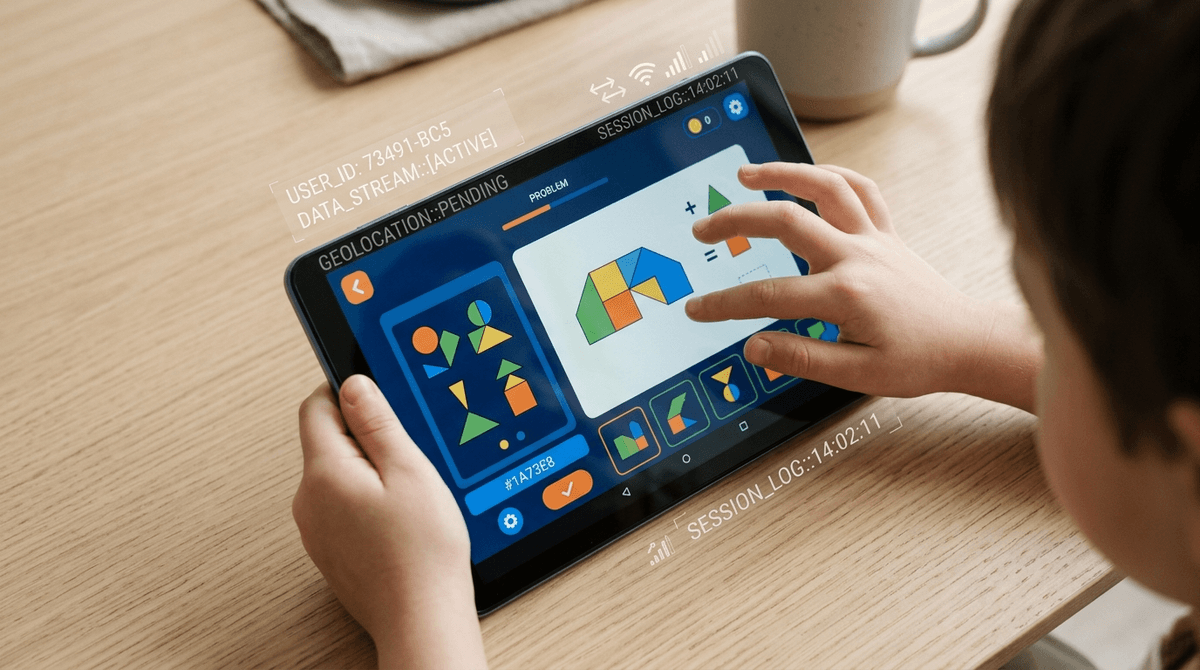
Most "free" Android games for preschoolers are harvesting your child's digital identity to build advertising profiles before they even start kindergarten. While these apps look like harmless entertainment, two-thirds of them are quietly transmitting tracking data to third-party companies.
Two-thirds of popular Android apps for preschoolers track and share device-specific data with third parties, often sidestepping federal privacy laws meant to protect children under thirteen.
The digital footprint being created for your child today may follow them for decades. This isn't just about seeing more targeted toy ads; it is about "persistent identifiers." When an app transmits these unique codes, it allows data brokers to link a child's behavior across different apps and over many years. This creates a behavioral dossier on your child before they even reach elementary school, potentially affecting their digital experience for the rest of their lives.
Privacy is also a matter of device ownership. The study found that children with their own standalone tablets are at the highest risk. These "kids' tablets" often become silos of unmonitored data sharing, whereas sharing a parent's primary device tends to result in lower data transmission rates.
"Free" apps are rarely free; they are subsidized by a complex data-brokerage economy that relies on volume. Researchers were concerned that the "Made for Kids" label in app stores provides a false sense of security for parents. By monitoring real-world usage rather than just testing apps in a vacuum, this study aimed to reveal the gap between what federal law (COPPA) requires and what app developers actually do when they think no one is looking.
Most apps marketed to young children are harvesting data on an industrial scale. The researchers tracked the digital behavior of 124 preschoolers and found a consistent pattern of data leakage across hundreds of popular titles.
- Tracking is the norm. About 67% of the 451 apps tested transmitted persistent digital identifiers to third-party companies.
- The "clean" list is tiny. Only 8% of the children in the study played apps that showed zero data transmissions.
- Data is scattered widely. A single app was found to send tracking data to an average of 1 to 33 different third-party domains.
- Education correlates with privacy. Families with lower parental education levels saw a higher frequency of data sharing per app used, likely due to a reliance on free, ad-supported content.
App store badges like "Teacher Approved" or "Made for Kids" are essentially an honor system that developers frequently ignore. Because the Federal Trade Commission (FTC) lacks the resources to manually vet every single update of every single app, the burden of privacy enforcement has effectively shifted to parents. However, parents lack the technical tools to see the background network traffic, creating a transparency gap that developers exploit to monetize child data.
These findings apply exclusively to Android devices. Apple’s iOS has different privacy architectures and permission requirements that were not tested in this study and may offer different results. Additionally, the participant pool was a convenience sample that was 71% non-Hispanic White, meaning these specific usage patterns might not perfectly reflect the habits of all diverse American families.
- If you are choosing between a "kids' tablet" and sharing your own... choose to share your device. Shared devices in the study showed significantly lower data transmission rates than devices owned exclusively by the child.
- If you are looking for new games for a preschooler... prioritize paid apps over "free" ones. Free games almost always monetize through digital tracking, whereas a $3 upfront cost often removes the incentive for the developer to sell your child's data.
- If you rely on the "Made for Kids" label... treat it as a starting point rather than a safety guarantee. Manually go into the device's Google settings to "Reset Advertising ID" or "Opt out of Ads Personalization" to break the link between different apps.
- If your child is playing a "free" game with heavy advertising... consider it a data-sharing tool first and a game second. If you wouldn't let a stranger follow your child around a playground with a notebook, you shouldn't let these apps run unmonitored.
Your child's digital privacy is being traded for free access to simple games, and the "Made for Kids" label isn't enough to stop it. To limit the profiling, treat "free" apps with extreme skepticism and keep the tablet a shared family tool rather than a private device for a preschooler.
Fangwei Zhao, Serge Egelman, Heidi M. Weeks et al. (2020). Data Collection Practices of Mobile Applications Played by Preschool-Aged Children. JAMA Pediatrics. doi:10.1001/jamapediatrics.2020.3345 — jamanetwork.com