

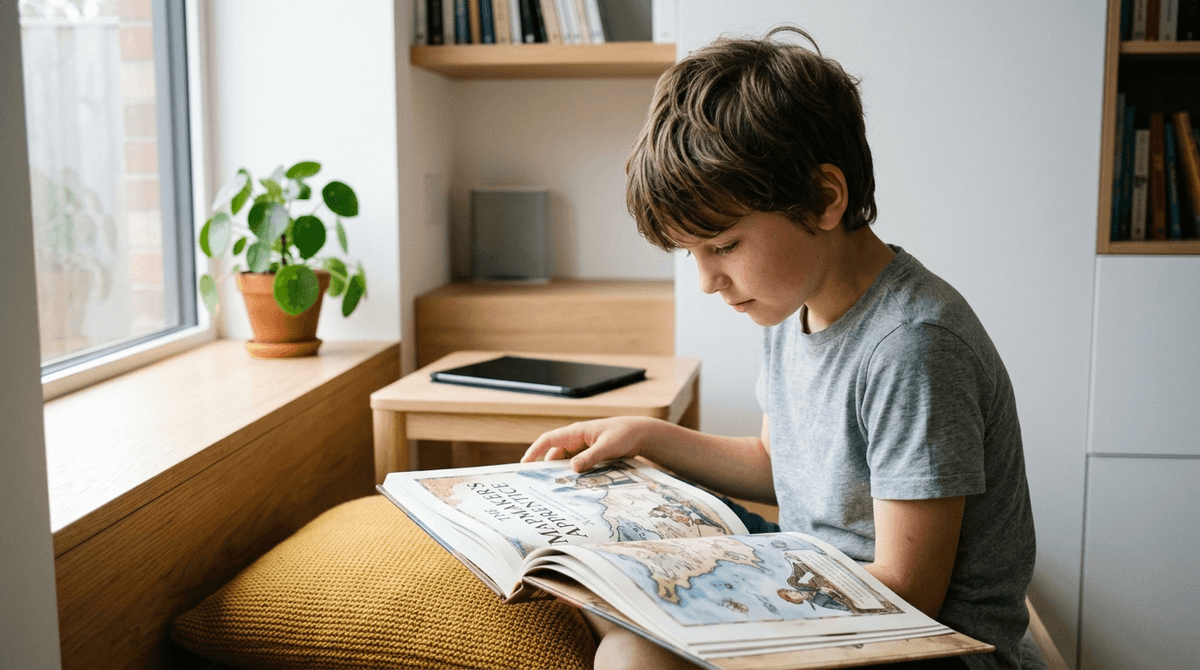
Preschoolers’ brains work harder to build mental images when looking at picture books than when watching videos. Static images provide a "scaffold" that allows the brain to connect words with meaning without doing all the imaginative heavy lifting for them.
Traditional picture books hit a neurological Goldilocks zone for preschoolers, forcing the brain to bridge the gap between words and mental images. While animation does the visual work for the child, paper books (or static e-books) build the mental muscles necessary for future reading.
Choosing between an "enhanced" animated e-book and a standard picture book is more than a choice of format; it is a choice about brain architecture. For a five-year-old, the brain is still learning how to translate abstract sounds (speech) into internal visual concepts.
If the screen provides the motion and the imagery for them, the child’s brain stays in a passive state. By opting for static illustrations, parents give the brain just enough information to understand the story while leaving enough "blank space" for the child to practice the active visualization required for solo reading later in life.
Educators and pediatricians have long observed that "fast-paced" media seems to leave children less engaged with deep story comprehension, but they lacked biological evidence. Researchers wanted to know if the brain's internal networks—specifically those handling language and imagery—stay "in sync" differently depending on the medium.
The goal was to identify if there is an optimal level of visual stimulation that supports literacy without overwhelming the developing brain or allowing it to "check out."
Scans of the preschool brain reveal that the way we tell a story fundamentally changes how different brain regions talk to one another.
- Illustrated stories maximize connectivity. When children see static pictures while hearing a story, their language, visual imagery, and "default mode" networks (responsible for internal reflection) work in high harmony.
- Animation leads to "passive" brain states. During animated stories, connectivity across these same networks significantly drops. The brain appears to stop trying to integrate the information because the moving images provide a finished product that requires no assembly.
- Audio-only is a heavy lift. Without any pictures, the brain's language network shows signs of "strain." While good for vocabulary, audio-only formats can be taxing for five-year-olds who don't yet have the cognitive tools to build an entire world from scratch.
- Pictures act as a scaffold. Static illustrations reduce the "load" on the language network just enough to let the brain focus on building mental models of the story.
This research suggests that "over-spoon-feeding" visuals to a child might stunt the development of their "theatre of the mind." Reading comprehension in later grades relies on the ability to read a sentence like "the dog ran through the forest" and see that image internally.
If a child’s early media diet consists mostly of animation, they are effectively using a cognitive "crutch." They may arrive at first or second grade with a large vocabulary but a weak ability to visualize what they are reading when the pictures are eventually removed from their schoolbooks.
The findings are based on a small sample of 27 healthy children from a single medical center, which limits how much we can generalize to all developmental backgrounds. This was also a "one-shot" study using fMRI; it shows how the brain behaves during the activity, but it doesn't prove that animation causes permanent, long-term damage or that the brain can't "snap back" to active mode immediately afterward.
- If you are choosing between an "animated" story app and a "read-to-me" e-book... choose the one with static pictures to ensure your child's brain stays in an active "story-building" mode.
- If your child struggles to sit through a podcast or audio-only story... don't force it; add a physical picture book to provide the visual "scaffold" their brain needs to process the language.
- If you use YouTube for storytime... look for "vooks" or read-aloud channels that focus on the original book’s static art rather than fully animated cartoons.
- If you want to prepare your child for the jump to chapter books... spend more time with detailed picture books that have complex stories, as this builds the specific brain connectivity needed for visualization.
Imagination is a skill that requires practice, and animation does the work for your child. To build a future reader, stick to books with static illustrations that allow the brain to build its own bridges between words and images.
Hutton, John S., Dudley, Jonathan, Horowitz-Kraus, Tzipi et al. (2020). Differences in functional brain network connectivity during stories presented in audio, illustrated, and animated format in preschool-age children. Brain Imaging and Behavior. doi:10.1007/s11682-018-9985-y — link.springer.com