

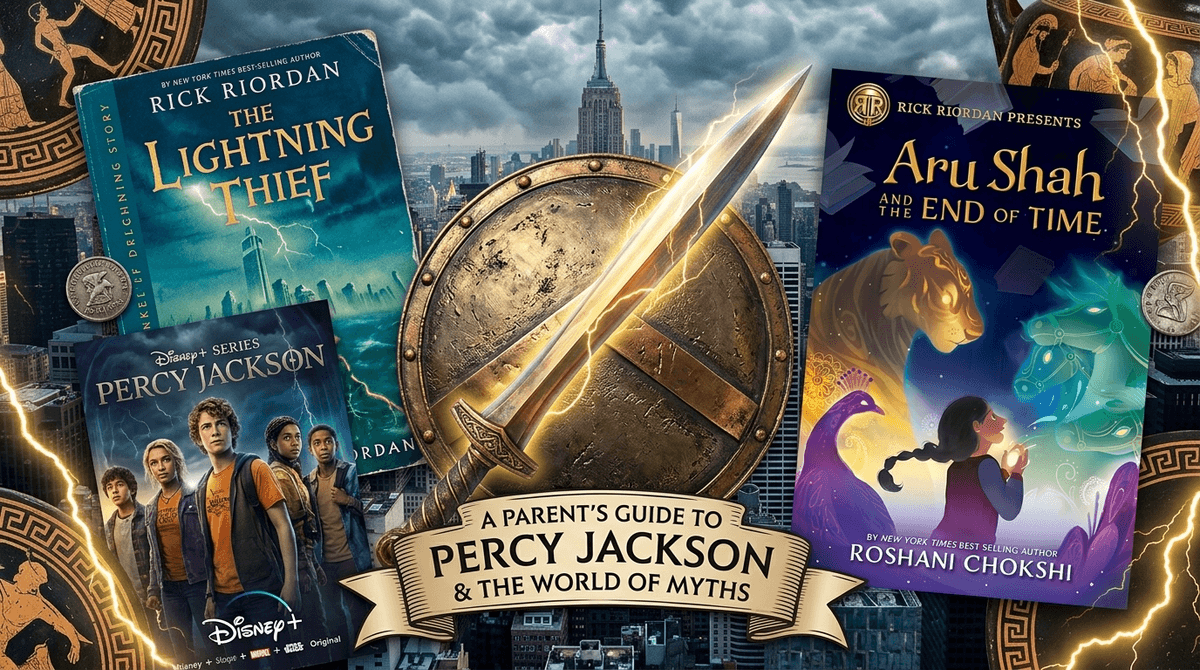
TL;DR: The Demigod Cheat Sheet
If your kid is suddenly obsessed with Greek mythology, carrying a ballpoint pen like it’s a lethal weapon, and explaining why Poseidon is "low-key the best Olympian," you’ve officially entered the Percy Jackson phase. It’s a rite of passage for the 8-to-12-year-old set.
The Quick Recommendations:
- The Gold Standard: Percy Jackson & The Olympians (Book Series) — Start here. Always.
- The New Hotness: Percy Jackson and the Olympians (Disney+ Show) — A faithful, diverse, and parent-approved adaptation.
- The "Skip It": The Lightning Thief (2010 Movie) — Even the author hates these. They aged like milk.
- The Deep Dive: Hades (Video Game) — For older kids (12+) who want more Greek lore in a high-quality format.
See the best order to read the Rick Riordan books
At its core, Percy Jackson is a middle-grade fantasy series by Rick Riordan. The premise is simple: the Greek gods are real, they’re still "interacting" with mortals, and their half-human children (demigods) are running around modern-day America.
Percy starts the series as a "troubled" 12-year-old with ADHD and dyslexia who discovers his father is Poseidon. He gets whisked away to Camp Half-Blood, a training ground for demigods, and spends the next five books trying to prevent a war between the gods and the Titans.
It’s basically Harry Potter but with more snark, better representation, and fewer plot holes involving time-turners.
In a world of Skibidi Toilet and Roblox "tycoon" games that are basically digital slot machines, Percy Jackson is the ultimate "good" obsession.
Around 65% of kids in grades 4-7 have engaged with the Percy Jackson universe in some way. Why? Because it’s funny. Riordan writes with a voice that actually sounds like a kid—not a 50-year-old man trying to sound like a kid.
But the real magic is the "ADHD Superpower" hook. Riordan originally wrote these stories for his son, who had been diagnosed with ADHD and dyslexia. In the books, these aren't "disorders"—they are signs of a demigod's hard-wiring. ADHD is "battlefield reflexes." Dyslexia is because the brain is "hard-wired for Ancient Greek."
For a kid who struggles in a traditional classroom, this isn't just a story; it’s a massive boost to their self-worth. It turns their "weirdness" into a heroic trait. That’s why you’ll see kids who "hate reading" suddenly plow through a 400-page book in a weekend.
Ages 8+ The OG series. If your kid is a reluctant reader, try the Audible versions or the Kindle editions. The pacing is fast, the chapters have hilarious titles (like "I Accidentally Vaporize My Pre-Algebra Teacher"), and the stakes are real without being traumatizing.
Ages 9+ After the disastrous movies from a decade ago, Disney+ finally got it right. The show is co-produced by Riordan himself. It’s diverse, the kids actually look like 12-year-olds (instead of 20-year-olds in tight shirts), and it captures the heart of the books.
- Parent Note: Some of the monsters (like Medusa) can be a bit spooky for the under-8 crowd, but it’s generally very safe family viewing.
Ages 8-12 Once your kid finishes Percy, they’ll want more. Riordan started an imprint to highlight authors from underrepresented cultures writing their own mythologies.
- Aru Shah and the End of Time (Hindu mythology)
- Tristan Strong Punches a Hole in the Sky (African American folklore)
- Dragon Pearl (Korean mythology) These are high-quality, high-action alternatives to the usual algorithm-driven content.
Ages 12+ If you have a middle or high schooler who loves the lore, this is one of the best games of the last decade. It’s a "roguelike" where you play as Zagreus, son of Hades, trying to escape the underworld. The writing is top-tier, the art is beautiful, and it’s a masterclass in storytelling. It’s way more educational than a random Fortnite session.
Check out our guide on the best mythology games for kids
While Percy Jackson is generally the "safe bet" for parents, here’s the reality of the content:
- Violence: There is a lot of sword fighting and monster dusting. In the books, when a monster "dies," it just dissolves into golden dust and goes back to Tartarus to regenerate. It’s very "video game logic" and rarely feels gory.
- Family Dynamics: The Greek gods are... bad parents. A major theme of the series is kids dealing with absent or neglectful fathers. If your family has sensitive dynamics around this, it’s a great opening for a conversation, but something to be aware of.
- Online Fandom: The "PJO" (Percy Jackson & The Olympians) fandom is massive on TikTok and Instagram. While mostly wholesome (fan art, theories), the broader internet is still the internet.
One thing to watch out for is the "Expansion Pack" problem. Rick Riordan has written a lot of books. After the first five Percy books, there’s the Heroes of Olympus series, then The Trials of Apollo, then the Egyptian and Norse series.
It can feel like a never-ending subscription to a bookstore. However, compared to the "brain rot" of endless YouTube shorts or the predatory monetization of Roblox, buying a $10 paperback is a win every single time.
Is it "Woke"?
You might see some grumbling online about the Disney+ show’s diverse casting (specifically casting a Black actress as Annabeth Chase). Here’s the Screenwise take: Riordan has been very intentional about making his world look like the real world. The books and shows include diverse ethnicities and LGBTQ+ characters (especially in the later series like The Trials of Apollo). For most parents, this is a non-issue or a positive, but if you’re looking for a 1950s-style traditionalist narrative, this isn't it. This is 2025, and the demigods reflect that.
If you want to actually engage with your kid about this instead of just nodding while they talk about "The Sea of Monsters," try these prompts:
- "If you were a demigod, who do you think your godly parent would be?" (This tells you a lot about how they see their own strengths).
- "Do you think it’s fair that the gods don't help their kids more?" (Great for talking about responsibility and independence).
- "Why do you think Percy’s ADHD helps him in a fight?" (Perfect for kids who might be struggling with their own neurodivergence).
Get more conversation starters for fantasy books
Percy Jackson is one of the rare "unicorns" in digital parenting: a massive, multi-platform franchise that is actually good for your kid’s brain. It encourages reading, teaches ancient history better than most textbooks, and provides a powerful framework for kids to view their "differences" as strengths.
Next Steps:
- Check the shelf: If they haven't read the The Lightning Thief, grab it from the library.
- Movie Night: Watch the first two episodes of the Disney+ Series together.
- Contextualize: If they start using words like "Ohio" or "Skibidi" in the middle of a Greek myth discussion, just roll with it. At least they know who Zeus is.