

Paw Patrol Screen Time Limits for 3-Year-Olds: What Actually Works
The American Academy of Pediatrics recommends 1 hour per day of high-quality programming for kids ages 2-5, and Paw Patrol actually qualifies as decent content in this category. The real question isn't whether your 3-year-old should watch it (they're going to love it regardless), but how to make it work within healthy limits that don't turn you into the screen time police.
Quick framework that works:
- 20-30 minutes per day on weekdays
- Up to 1 hour on weekends
- Always co-view when possible
- Use episodes as transition tools, not babysitters (though we all know the reality)
- Balance with active play that extends the show's themes
Paw Patrol isn't just another kids show—it's a cultural phenomenon that has completely dominated the 2-5 age bracket since 2013. Your 3-year-old isn't asking for it because of sophisticated taste; they're asking because literally every other kid at daycare is talking about Chase, Marshall, and Skye.
The show hits the sweet spot for toddler development: simple problem-solving narratives, repetitive structure (which kids this age crave), clear heroes and challenges, and talking dogs. It's not going to teach them critical thinking about systemic inequality, but it does model teamwork, helping others, and basic cause-and-effect reasoning.
That said, it's also incredibly formulaic, somewhat commercially aggressive (those toy tie-ins are everywhere), and designed to be addictive. The bright colors, fast cuts, and catchy theme song are engineered to keep little eyes glued to screens. This is why limits matter.
The AAP's 1-hour guideline for ages 2-5 isn't arbitrary. It's based on research showing that:
- Excessive screen time at this age correlates with delayed language development, reduced social-emotional skills, and attention problems
- Quality matters more than quantity—educational, slower-paced content has measurably better outcomes than random YouTube autoplay
- Co-viewing dramatically improves outcomes—when parents watch with kids and talk about what's happening, screen time becomes a learning tool rather than a passive activity
For 3-year-olds specifically, their brains are in a critical period for language acquisition, emotional regulation, and physical development. An hour of Paw Patrol won't destroy these processes, but multiple hours daily absolutely can interfere with the hands-on exploration and human interaction they need.
Here's what actually works for most families with 3-year-olds:
Weekday Structure (20-30 minutes)
- One episode in the morning (11 minutes) OR one episode before dinner (11 minutes)
- Use it strategically: during meal prep, when you need to take a work call, during the witching hour
- Set the expectation clearly: "We're watching one Paw Patrol, then it's time for [next activity]"
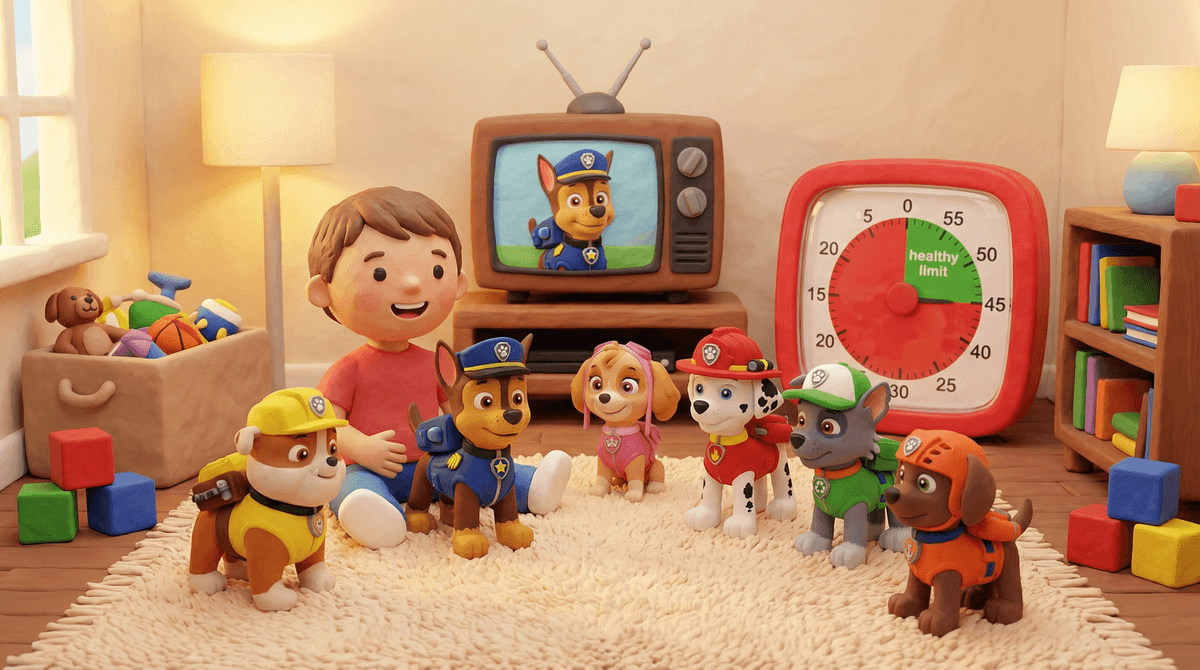
- Use a visual timer so they can see when it's ending—this dramatically reduces meltdowns
Weekend Structure (45-60 minutes)
- Two episodes in a row (22 minutes total) plus maybe one more later in the day
- This is your sanity time—Saturday morning cartoons are a valid parenting strategy
- Consider making it a special ritual: weekend morning Paw Patrol with a specific snack
The Co-Viewing Hack
When you can manage it, sit with them for even 5 minutes and engage:
- "Which pup is your favorite? Why?"
- "Uh oh, what do you think will happen next?"
- "How did they solve that problem?"
This transforms passive consumption into active learning and also helps you understand what they're absorbing.
The biggest Paw Patrol battle isn't getting them to watch—it's getting them to stop. Three-year-olds don't have developed executive function yet. When you turn off the TV, their brain experiences it as a genuine crisis.
Strategies that actually work:
The 2-Minute Warning "Paw Patrol is almost done. When this episode ends, we're going to [specific next activity]." Repeat at 1 minute. This gives their brain time to prepare for the transition.
The Immediate Redirect Have the next activity ready to go before you turn off the screen. Not "go play," but "let's build a Paw Patrol tower with your blocks" or "let's go rescue your stuffed animals from the couch." Make the transition to something engaging, not just the absence of the thing they want.
The Natural Ending Use the episode structure to your advantage. Paw Patrol episodes are exactly 11 minutes. Set expectations: "We're watching one episode, and when it's done, it's done." The natural ending point helps.
The Visual Timer Get a Time Timer or use a visual countdown. Three-year-olds can't tell time, but they can watch a red section disappear. This makes the abstract ("5 more minutes") concrete.
You'll know limits aren't working if:
- Your kid is asking for it constantly throughout the day
- They're having major meltdowns every single time it ends (some protest is normal; 20-minute tantrums are not)
- They're choosing screen time over activities they used to love
- They're imitating screen behaviors more than engaging in creative play
- You're using it as the primary tool for every difficult moment
If you're seeing these signs, it's time to reset:
- Go cold turkey for 3-5 days (yes, it will be rough)
- Reintroduce with much stricter limits
- Diversify their media diet—try Bluey, Daniel Tiger, or Tumble Leaf
- Invest in alternatives to screen time that hit the same pleasure centers
The best way to make screen time work for development is to extend it into the real world:
- Get a few Paw Patrol toy pups (not the whole collection—that's a money pit) and encourage rescue missions
- Read Paw Patrol books together—this builds literacy while feeding their interest
- Do Paw Patrol-themed activities: "Chase is a police pup who helps find things. Can you help me find the missing sock?"
- Play pretend rescue missions outside or with household items
This transforms passive consumption into active, creative play that actually builds skills.
YouTube is a hard no for unsupervised 3-year-olds. The Paw Patrol rabbit hole on YouTube leads to weird unboxing videos, fan-made content of wildly varying quality, and algorithm-driven autoplay that you cannot control. If you're going to do Paw Patrol digital content, stick to:
- Official episodes on streaming services with autoplay turned OFF
- A kids profile on Paramount+, where PAW Patrol streams in the US, with parental controls enabled
- Skip PAW Patrol game apps like PAW Patrol Rescue World at this age. Rescue World is free to download, then sells extra content through in-app purchases and offers rewards for watching ads, and it doesn't add developmental value
One episode of Paw Patrol per day (11 minutes) is totally fine for most 3-year-olds. Two episodes on busy days or weekends won't cause lasting harm. Three or four episodes daily, every day, starts to crowd out the activities that actually build their developing brains.
The goal isn't to be perfect—it's to be intentional. Use Paw Patrol as a tool in your parenting toolkit, not the default answer to "I'm bored" or "I need 10 minutes of peace." Set clear limits, stick to them most of the time, and don't beat yourself up when you need an extra episode to survive a rough day.
Your 3-year-old will move on from Paw Patrol eventually (usually around age 5-6). Until then, Chase is on the case, and you're doing fine.
- Set up your family screen time rules and communicate them clearly
- Explore alternatives to Paw Patrol that might offer more developmental value
- Check out Daniel Tiger's Neighborhood—it's slower-paced and explicitly teaches emotional regulation
- Consider Bluey—it's genuinely excellent and you might actually enjoy watching it
- If you're struggling with transitions, read up on reducing screen time tantrums