

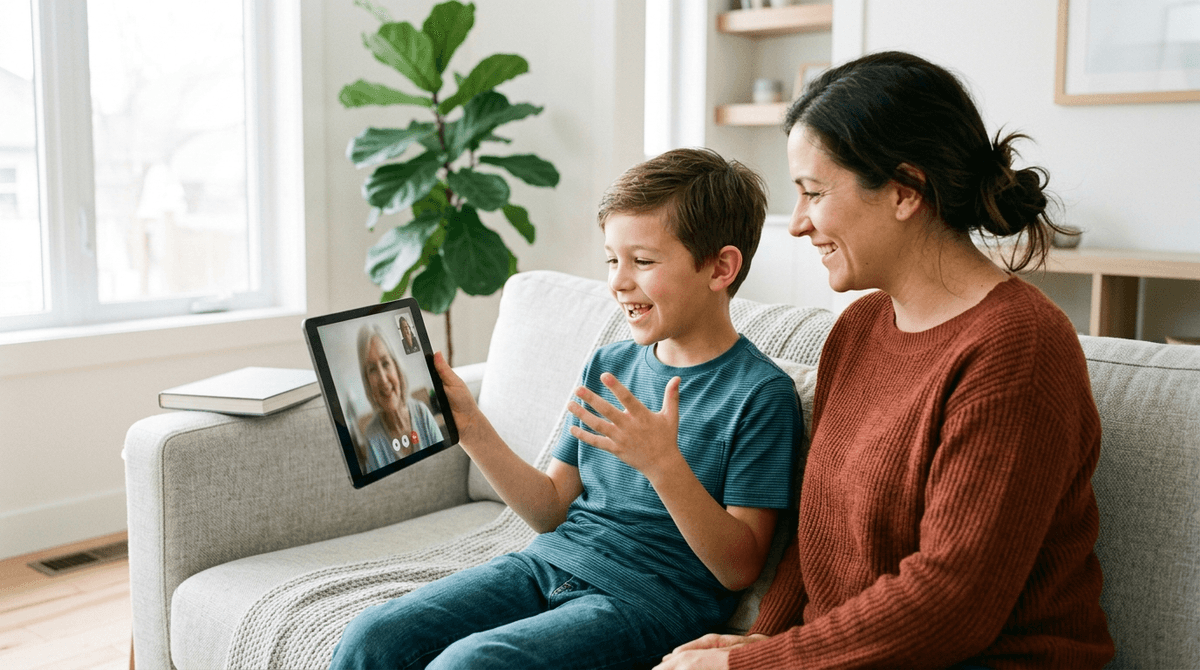

Not all digital media affects young brains the same way. While passive video and solo entertainment are linked to weaker focus and self-control, video chats and co-viewing may actually support language skills.
Passive Video Time Hinders Development While Social Screen Use Helps
Preschoolers in this study spent over an hour a day on screens, mostly watching videos, which was tied to lower self-control and memory; however, using screens for communication or watching with a parent showed clear benefits for language.
Every Ten Minutes of Passive Viewing Correlates With Lower Executive Function
Children who spent more time watching shows, movies, or using mobile devices for entertainment scored lower on assessments of self-control, working memory, and response inhibition. These effects were cumulative and measurable in small chunks; each additional 10-minute increment of daily passive use was consistently associated with lower cognitive performance.
Interactive Video Calls Improve Language Scores
Using devices for communication—like FaceTime or Zoom with relatives—was linked to more advanced language development in three- and four-year-olds. The social and conversational nature of video chatting functions differently in the brain than the one-way consumption of a typical cartoon, providing the interaction necessary for linguistic growth.
Co-Viewing Turns Entertainment Into an Active Learning Experience
When parents watched content alongside their children, those children demonstrated higher language scores than those who watched solo. An adult's presence transforms passive observation into an active language-building opportunity, likely through the conversation and context a parent provides during the show.
What this means for your family
- Prioritize interactive use over passive consumption; video calls with family members do not carry the same cognitive drawbacks as solo video streaming.
- Be mindful of mobile devices—using smartphones and tablets for quick entertainment was more strongly linked to poorer executive function than other screen formats.
- Co-view whenever possible to help turn passive viewing into an active learning experience.
- Small reductions matter, as cognitive associations were measured in increments of just 10 minutes of daily screen time.
Honest caveats
The study is cross-sectional, meaning it only captures a single snapshot in time and cannot prove that screen time caused the differences in cognitive development. All screen data was parent-reported via diaries, which can introduce inaccuracies compared to passive device monitoring. Finally, the sample size is relatively small and geographically narrow, focused on 359 families in Western Canada.
Where this comes from
Carson V, Boyd M, Zheng Y et al. (2026). Screen time patterns and cognitive development among preschool children. American journal of preventive medicine. doi:10.1016/j.amepre.2026.108420 — https://pubmed.ncbi.nlm.nih.gov/42150624/