

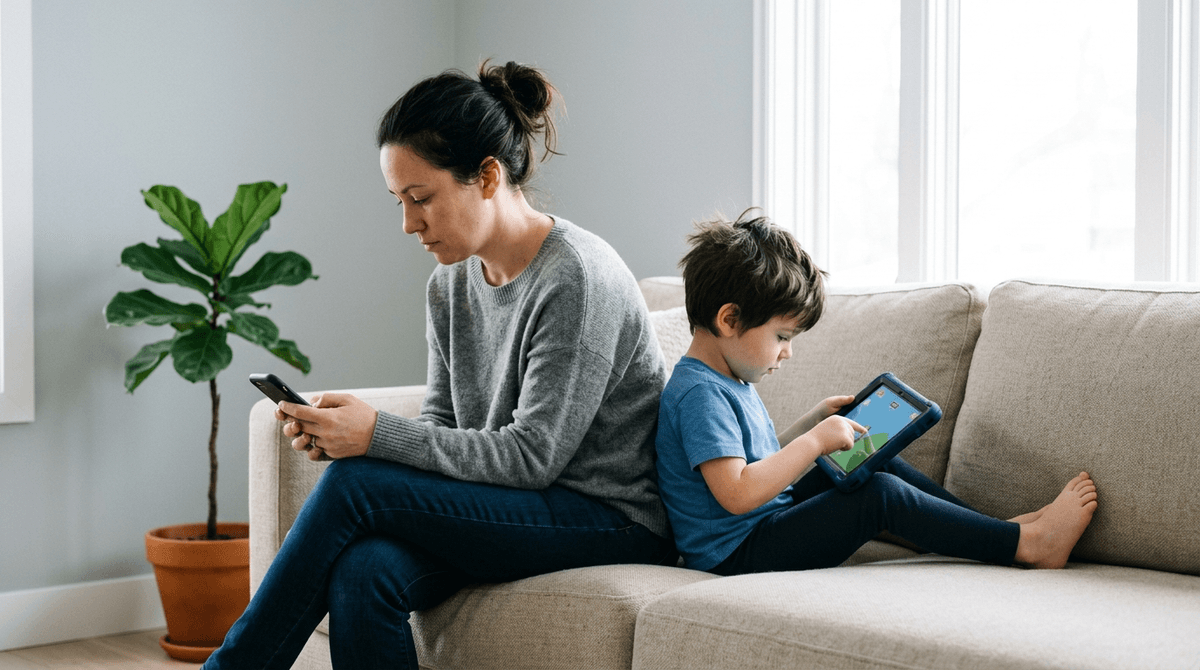
Your child’s screen time is a mirror of your own digital habits, not a reflection of your bank account. If you spend more than three hours a day on your phone, your preschooler is statistically likely to spend significantly more time on devices too.
Parental behavior is the strongest predictor of how much time 4-to-6-year-olds spend on devices. Model the habits you want to see, because your social media use and "boredom scrolling" are more influential than family income or socioeconomic status.
Parents often feel guilty about things they can't change—like their neighborhood or their income—but this research suggests those factors barely move the needle on screen time. What actually matters is your own phone usage and how you frame technology for your child. By adjusting your own habits, you can directly influence your child’s digital trajectory before they even reach elementary school.
Researchers applied social learning theory—the idea that children learn through imitation—to see if parent behavior outweighs demographics. They used machine learning to find the real "red flags" in a household, moving beyond just counting hours to look at why kids are using devices in the first place.
Parental screen use exceeding three hours per day is a major predictor of high child usage.
- The boredom trap: The child's reason for using a device is a massive indicator of total time; kids who turn to screens to escape boredom end up with the highest usage.
- The "educational" paradox: Children using devices for learning often ended up with higher overall screen time than those using them for pure entertainment.
- Social media influence: Frequent social media use by parents specifically and significantly predicts increased device use in their 4-to-6-year-olds.
- Guidance works: Parents who set firm limits and "co-view" content with their children see a measurable reduction in daily usage.
The "educational" label on apps can be a trap for parents. While we often feel better about kids using apps for learning, this content acts as a gateway. Because parents perceive it as "good," they are less likely to enforce strict time limits, leading to higher total screen time. Furthermore, using screens as a tool to solve boredom prevents children from developing the internal skill of self-regulation.
The study was relatively small, focusing on 266 families in Central Anatolia, Turkey. Because it relies on parents reporting their own behavior, the data may be skewed by people wanting to appear more "disciplined" than they actually are. While the machine learning models are sophisticated, the results show a correlation—not a definitive proof that the parent's habit is the sole cause of the child's habit.
- If you find yourself scrolling social media in front of your preschooler... put your phone in a charging station in another room to break the "imitation" loop during family time.
- If your child says they are bored... offer a physical toy, a drawing prompt, or even a simple chore rather than a tablet to prevent boredom from becoming a digital trigger.
- If you rely on "educational" apps to justify screen time... set a hard stop on the timer, as these apps are statistically associated with longer total sessions than entertainment alone.
- If you want to lower your child's usage... sit down and watch the program with them; "active guidance" is one of the few behaviors that measurably reduces total device time.
You have more control over your child’s digital health than you think, but it starts with looking in the mirror. Focus less on the "quality" of the apps and more on the quantity of your own scrolling.
Molu B, Özpulat F (2026). Predicting Preschool Children's Screen Time: The Role of Parental Digital Habits and Bandura's Social Learning Theory. Research and theory for nursing practice. doi:10.1891/RTNP-2025-0178 — pubmed.ncbi.nlm.nih.gov