

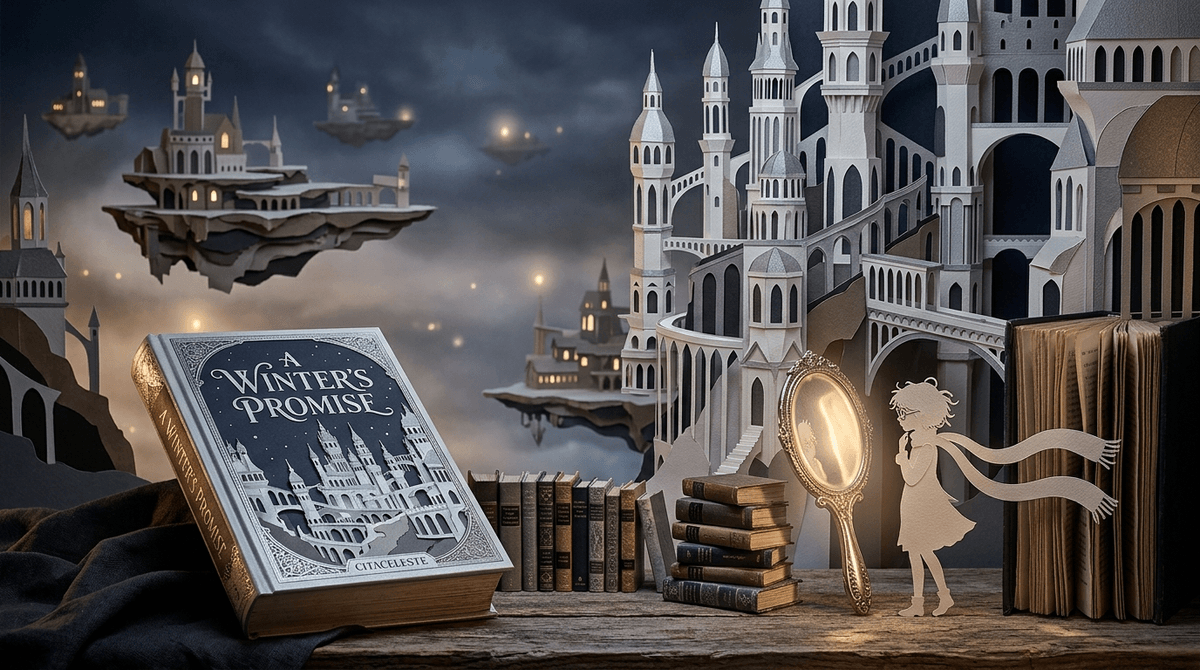
A Winter’s Promise is the antidote to the generic, "chosen one" fantasy fatigue that usually hits around seventh grade. It’s a French import that trades the usual high-speed action for something far more interesting: dense atmosphere, lethal court politics, and a protagonist who is more "introverted librarian" than "superpowered warrior." If your kid is ready for world-building that feels like a Studio Ghibli film directed by someone with a dark streak, this is the series.
TL;DR
A Winter's Promise is a sophisticated, slow-burn fantasy for readers 12+ who appreciate complex world-building and subtle character growth over constant explosions. It follows Ophelia, a "mirror-walker," as she navigates a dangerous arranged marriage on a floating sky-island; it’s a perfect next step for fans of Howl's Moving Castle or Sabriel.
Most YA fantasy leads with a character who is "not like other girls" because they can shoot a bow or lead a revolution. Ophelia, the lead in Christelle Dabos’s Mirror Visitor quartet, is "not like other girls" because she is genuinely, painfully awkward. She’s clumsy, she speaks in a whisper, and she’d much rather be cataloging old shoes in her museum than saving the world.
But she has two specific powers: she can "read" the history of objects by touching them, and she can travel through mirrors. When she’s forced into an arranged marriage with Thorn—a man who is basically a human icicle from a distant, brutal Ark called the Pole—she doesn’t suddenly become a master swordswoman. She survives by being observant. For a kid who feels like they don't fit the "main character energy" mold, Ophelia is a revelation. She proves that being quiet and careful is its own kind of power.
The setting here is brilliant. The world has been shattered into floating islands called "Arks," each ruled by an ancestral "Spirit" (think: demi-gods with amnesia). Ophelia’s home Ark, Anima, is cozy and domestic. The Ark she’s sent to, the Pole, is a vertical, frozen nightmare of optical illusions and social hierarchies.
This isn't the kind of book where the magic system is explained in a boring prologue. The reader (and Ophelia) has to figure out the rules of the Pole as they go. It’s immersive in a way that rewards focus. If your kid is the type to spend hours looking at the maps in the front of a book, they are going to lose their mind over the "Citaceleste"—a floating city where nothing is what it seems and the architecture itself is trying to trick you.
Because this was originally written in French, the tone feels distinct from the American or British fantasy canon. It’s more "theatrical" and "whimsical-yet-grim." There is a heavy emphasis on the sensory details—the smell of old paper, the biting cold of the Pole, the physical sensation of walking through a mirror.
It’s also surprisingly "clean" in the way older fantasy used to be. While modern US YA often leans heavily into romance and "steam," A Winter’s Promise is a true slow-burn. The relationship between Ophelia and Thorn is frosty, complicated, and built on mutual survival rather than instant attraction. It treats the reader like an adult, focusing on the psychological toll of being an outsider in a place where everyone is wearing a literal or figurative mask.
Let’s be real: this book is a commitment. It’s over 500 pages, and the first 100 are spent just setting the table. If your kid needs a dragon battle every three chapters to stay engaged, this might be a "DNF" (Did Not Finish).
The biggest friction point for some readers is Thorn himself. He is deeply unlikable for a large portion of the book—he’s rude, obsessive, and cold. But that’s the point. The book isn't asking you to swoon over him; it’s asking you to watch how these two deeply damaged people navigate a political minefield together.
If your kid is already deep into the Mirror Visitor universe, the best thing you can do is help them find the "extended universe" of moody, atmospheric fantasy. This isn't a series that leads naturally to The Hunger Games; it leads to the classics.
Questions to ask them:
- "If you could 'read' the history of any object in our house, which one would you pick?"
- "Do you think Thorn is actually a villain, or just a product of the Pole's culture?"
- "The Arks are all very different—which 'family power' would you actually want?"
If the "vibes" of A Winter’s Promise landed, skip the bestseller shelf and try these:
- Howl’s Moving Castle by Diana Wynne Jones: The spiritual ancestor to this series. It has that same mix of domesticity and high-concept magic.
- Sabriel by Garth Nix: For a slightly more action-oriented but equally atmospheric story about a girl with a very specific, grim magical job.
- Gormenghast by Mervyn Peake: This is the "deep cut" for older teens. It’s the ultimate "weird castle politics" series and clearly influenced Dabos.
- The Golden Compass (His Dark Materials): If they liked the "traveling to a cold, dangerous place with a secret device" aspect.
For the full age-by-age breakdown of what to read next, check out our best books for kids list.
The content is generally mild in terms of "traditional" red flags—minimal swearing, no graphic sex. However, the psychological intensity is real. There is courtly brutality (think: people being publicly humiliated or threatened) and a general sense of peril. It’s a "mature" read because of its complexity and themes of isolation and betrayal, not because of "adult" content. If your kid is in middle school and handles the later Harry Potter books or The Hunger Games fine, they’ll be more than okay here.
Q: What age is A Winter's Promise appropriate for? A: It’s best for ages 12 and up. While the content is relatively "clean," the vocabulary is sophisticated and the political plotting is dense. Younger readers might find the slow pace and lack of traditional action frustrating.
Q: Is there romance in The Mirror Visitor series? A: Yes, but it’s a "glacial" slow-burn. Book one focuses almost entirely on the characters' mutual distrust and the political necessity of their marriage. It’s a great choice for parents who want to avoid the "insta-love" tropes common in YA.
Q: Is A Winter's Promise part of a series? A: Yes, it is the first of four books. The sequels—The Missing of Clairdelune, The Memory of Babel, and The Storm of Echoes—complete the story. Be warned: once a kid gets hooked, they will want all four immediately.
Q: Are there any content warnings for A Winter's Promise? A: There is some "courtly violence"—threats, slaps, and a general atmosphere of cruelty from the secondary characters. One character is also physically scarred and treated poorly because of it. According to themirrorvisitor.com, the series maintains this moody, slightly dark edge throughout.
A Winter's Promise is for the kid who wants to be respected as a reader. It doesn't talk down to them, it doesn't rush the story, and it builds a world that feels genuinely new. It’s a "prestige" fantasy pick that earns its hype.
- Check the shelf: See if your local library has the rest of the quartet; they’ll need them.
- Explore more: Browse our digital guide for middle school for more sophisticated media picks.
- Ask the bot: Find more European fantasy series
