

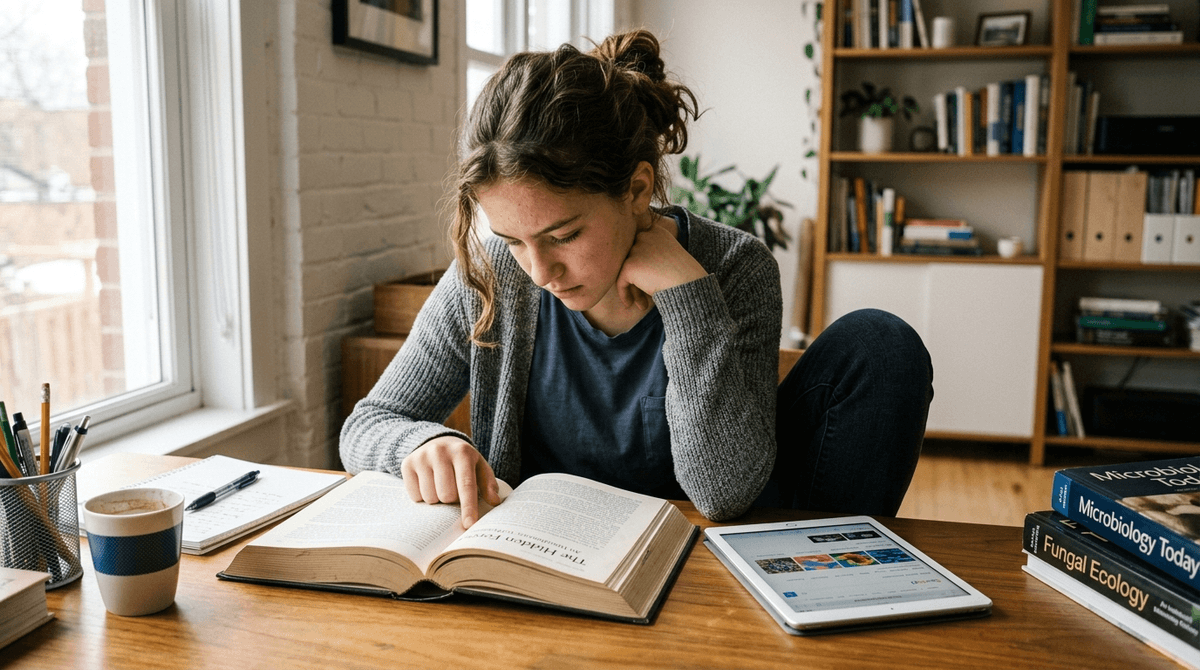
Children understand informational text significantly better on paper than on screens because the physical page helps them better judge their own level of comprehension.
Prioritize physical books and printed materials for schoolwork and non-fiction learning, but feel free to use e-readers for novels and stories. While digital screens are fine for narrative fiction, they lead to a "calibration" problem where readers overestimate how much they actually learned from informational texts.
The "digital native" myth—the idea that kids today process screens more naturally than paper—does not hold up when it comes to deep learning. When a child reads a science chapter or a history article on a screen, they are statistically more likely to miss both the literal facts and the deeper inferences.
Choosing the right medium for the right task prevents academic frustration. Using paper for non-fiction isn't about being a Luddite; it's about providing the specific cognitive environment required for a child to accurately map out new information and avoid the overconfidence that leads to poor test performance.
Researchers were responding to the massive shift toward 1:1 device programs in schools. The assumption was that reading is a universal skill regardless of the medium. However, earlier studies suggested that the fluidity of digital text might change how the brain "anchors" information. This meta-analysis looked at 33 different experiments to determine if the medium itself—not just the content—changes how well we think we understand what we’ve read.
The data shows a clear divide between reading for pleasure and reading to learn. Across 2,799 participants, the findings were consistent:
- Non-fiction suffers on screens. Comprehension of informational text was significantly higher on paper.
- Fiction is format-neutral. For narrative stories, there was no measurable difference in understanding between paper and digital formats.
- The "Overconfidence Gap." Screen readers consistently overvalued their own performance. They walked away thinking they had mastered the material, whereas paper readers had a much more accurate sense of what they did and did not know.
- Speed is a wash. Despite the common belief that we "skim" faster on screens, there was no significant difference in reading speed between the two mediums. Screens don't save time; they just reduce retention.
The superiority of paper for non-fiction likely comes down to "spatial mapping." On a physical page, the text is fixed in space—a specific fact lives in the "bottom-left corner of the third page." This tactile and visual stability provides the brain with a mental map. On a screen, scrolling and fluid layouts destroy these spatial anchors, making it harder for the brain to file information in a way that allows for easy retrieval later.
The analysis grouped various screen types together, meaning e-readers (like Kindles), tablets, and computers were often treated as a single category. High-contrast E-ink displays may have different impacts on eye strain compared to glowing iPad screens. Additionally, the data only goes up to 2018, so it doesn't account for the newest generation of interactive educational software designed to specifically prompt engagement.
- If your child is studying for a science or history test... print out the study materials or use the physical textbook rather than the PDF version.
- If your child is reading a novel for fun... let them use an e-reader or tablet, as the medium doesn't hinder their ability to follow a story.
- If your child must read informational text on a screen... prompt them to stop and summarize each section out loud to combat the digital overconfidence effect.
- If a child is struggling to connect complex ideas in a text... move the material to a physical page to provide the tactile feedback and spatial anchors their brain is likely missing.
For deep learning and factual retention, the physical page remains the superior technology. While tablets are excellent tools for convenience and storytelling, they trick the brain into a false sense of mastery when dealing with complex information. Give your child the advantage of paper when the goal is learning, not just "consuming."
Virginia Clinton (2019). Reading from paper compared to screens: A systematic review and meta-analysis. Journal of Research in Reading. doi:10.1111/1467-9817.12269 — onlinelibrary.wiley.com