

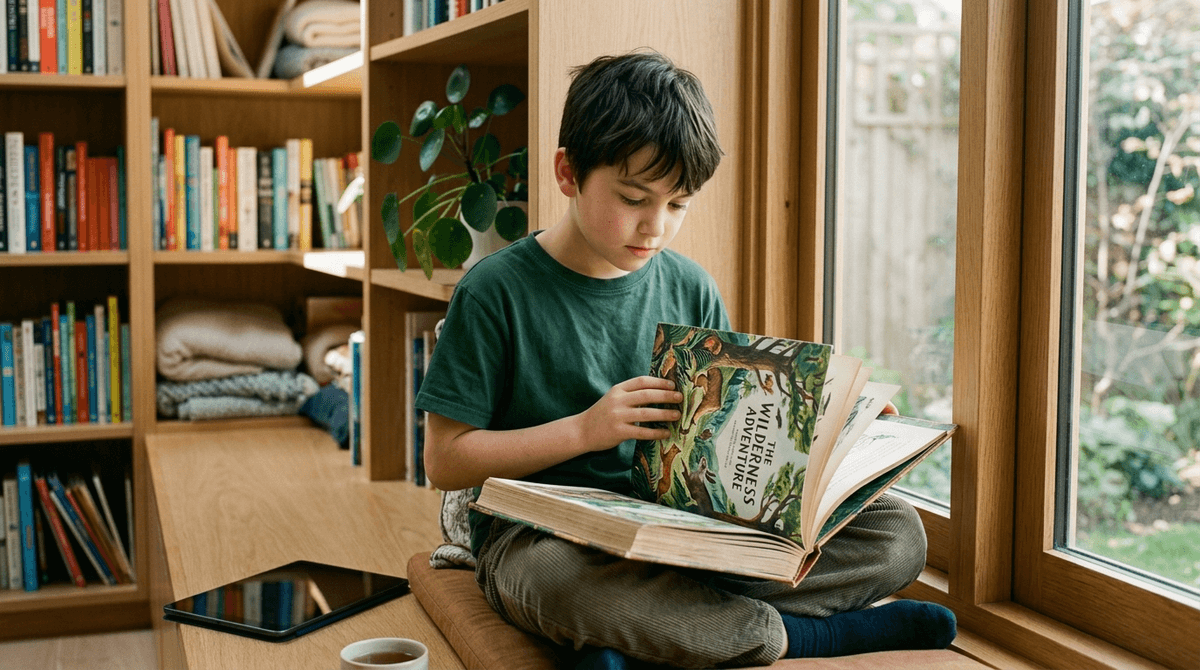
For children under eight, paper books beat screens for learning a story—unless the app includes animations that specifically illustrate the plot.
Prioritize print books for toddlers and early readers unless you find a high-quality app where every animation and sound directly illustrates the action on the page. Digital "extras" like games and pop-ups usually distract kids from the story, even if they look educational.
Digital book sales for children continue to climb, but not all "reading" on a screen is equal. Parents often assume an app with bells and whistles is more engaging, but those features often derail a child's ability to follow a narrative. If you want your child to understand what happened in a story, the physical book remains the gold standard.
This matters because early reading isn't just about identifying words; it’s about "scaffolding"—the process where a child builds a mental model of a story. A paper book naturally invites a parent to talk, point, and explain, which technology hasn't yet replicated for the under-eight crowd.
Researchers wanted to settle the long-standing debate over whether digital books actually help or hinder early literacy. As publishers add more "interactive" features to apps, the question shifted from "Is paper better?" to "Which specific digital features actually work?" This meta-analysis synthesized results from 39 experimental studies involving over 1,800 children to find the pattern.
Children show significantly lower comprehension scores when they read a digital book that is simply a flat, scanned version of a print book. However, when apps include "story-congruent" enhancements—like an animation of a character jumping when the text says "jump"—the screen can actually outperform paper for learning.
- Adults are the secret weapon. A parent reading a physical book and discussing the plot is more effective than a child using even the "smartest" app independently.
- Dictionaries are a double-edged sword. Embedded word definitions help kids learn new vocabulary, but the interruption often causes the child to lose the thread of the story.
- Distractions are the enemy. Non-narrative features, such as "hotspots" that trigger unrelated sounds or mini-games, consistently tank a child's understanding of the plot.
- The "scanned" book fails. When an e-book is just a PDF of a paper book without any smart features, children consistently understand the story less than if they had held the physical copy.
The "interactivity" promised by most app developers is often just digital noise. While parents might feel good seeing a child "engaged" with an app, if that engagement is focused on clicking a bird to hear it chirp (when the story is about a dog), the brain is switching tasks rather than building a narrative map.
True digital literacy for kids under eight isn't about the screen—it's about how closely the digital tricks match the words on the page. The researchers are essentially saying that "busy" apps are turning reading time into gaming time, which uses an entirely different part of the brain.
The study grouped kids from age one to eight together, which is a massive developmental gap. A toddler’s brain processes a screen very differently than a second-grader’s. Most of these findings also come from controlled, experimental settings; they don't account for the chaos of a typical living room where siblings, toys, and background noise might make a "distracting" app even more detrimental than it appeared in the lab.
- If your goal is for your child to follow a story independently, choose apps where the animations show the action described in the text rather than providing a separate game.
- If you are using a digital book to build your child's vocabulary, expect to step in and help them reconnect the new word back to the story's plot after they click the dictionary.
- If you have the choice between a physical book and a "flat" PDF on a tablet, stick to paper every time to ensure your child actually understands what they are reading.
- If your child is using a "busy" story app with frequent pop-ups, treat it as a reward or a game rather than a substitute for a reading session.
- If you want the highest possible learning outcome, read a paper book together; the human interaction provides a level of support that no "enhancement" can currently match.
Paper books are still the safest bet for building a young child's comprehension and fostering a connection with a parent. If you do go digital, ignore the "all-in-one" apps that mix stories with mini-games and stick to titles where the technology actually helps tell the story.
May Irene Furenes, Natalia Kucirkova, Adriana G. Bus (2021). A Comparison of Children’s Reading on Paper Versus Screen: A Meta-Analysis. Review of Educational Research. doi:10.3102/0034654321998074 — journals.sagepub.com