

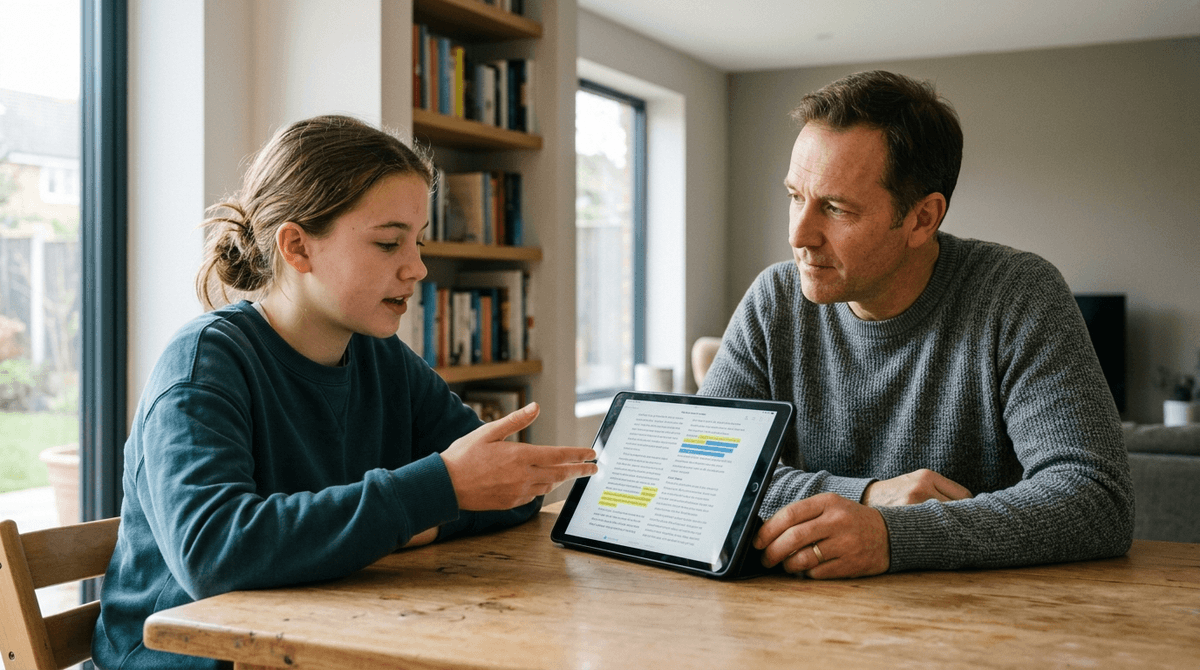
Elementary students lost significant ground in reading comprehension during the pandemic because remote screens could not replicate the deep, social dialogue of a physical classroom. To fix the gap, parents must pivot from focusing on how well a child sounds out words to how well they understand the story's meaning.
Reading achievement for K-5 students plummeted during school closures as instruction shifted from deep, conversational meaning-making to basic word-sounding drills. For elementary-aged learners, recovery requires moving past simple phonics to prioritize explicit strategies like questioning, visualizing, and summarizing during reading time.
If your child can read a page aloud with perfect pronunciation but cannot tell you why the main character is making a specific choice, they are struggling with the exact skill that eroded during the pandemic. Reading is not a solo act of decoding symbols; it is a "transactional" social process.
When the social layer of the classroom was replaced by self-paced apps and muted Zoom calls, children lost the mental stamina required to parse complex texts. This isn't just "learning loss"—it is an instructional gap. This week, you can change your child’s trajectory by worrying less about their "reading level" and more about the quality of the conversation you have about the books they bring home.
Researchers noticed that even as schools reopened, reading scores didn't just bounce back. They sought to identify what was missing from the "emergency remote" version of literacy. They found that while teachers successfully pushed "decoding" (the ABCs and phonics), the "meaning-making" (the deep thinking) was largely abandoned because it is incredibly difficult to facilitate through a screen or in isolation.
The data shows a clear divergence between being able to read and being able to understand.
- Reading comprehension achievement for elementary students dropped markedly compared to pre-pandemic groups.
- Instruction at home and online frequently prioritized "low-level" skills—correct pronunciation and speed—over "high-level" engagement with the text’s themes.
- The "transactional" nature of reading—the back-and-forth dialogue where a teacher helps a student build a mental model of a story—was the primary casualty of school closures.
- The decline was most pronounced in underserved communities, where students often lacked the high-speed internet or one-on-one adult support necessary to facilitate deep instructional conversations.
The "phonics vs. whole language" debate—often called the Reading Wars—is a distraction in this context. This research implies that a child can be a phonics expert and still fail at literacy because they’ve been conditioned to view reading as a performance of sounds rather than a search for meaning. The researchers are essentially warning that we have raised a cohort of "efficient decoders" who don't actually know what they are reading. The social interaction isn't a "bonus" feature of learning to read; it is the engine that drives comprehension.
This study is a research synthesis—a "study of studies"—rather than a single new experiment with a control group. Because it relies heavily on standardized test scores from the 2020–2022 era, it captures a period of immense chaos. These scores are observational "snapshots" that may not reflect a child’s full potential or the specific nuances of every school district’s curriculum.
- If your child is a fluent reader but struggles to summarize a chapter, stop the "reading aloud" drills and switch to "think-alouds" where you narrate your own thoughts about the plot as you read together.
- If your child’s school is focusing heavily on phonics and worksheets, supplement at home with "dialogic reading"—ask open-ended questions like "What would you do in that situation?" to rebuild the social "transaction" of literacy.
- If your child seems to have lost the "stamina" for long books, break reading into 10-minute "sprints" followed by a 5-minute discussion to help them practice visualizing the story in chunks.
- If you are choosing between a reading app and a physical book, choose the physical book whenever possible to eliminate digital distractions and facilitate eye contact and shared attention during the story.
Your child isn’t "behind" because they are less capable; they are behind because they missed years of high-quality classroom conversation. You can bridge this gap by making reading at home less about "getting the words right" and more about the exchange of ideas. Focus on the meaning, and the fluency will follow.
Almasi, Janice F., Yuan, Dongyang (2023). Reading Comprehension and the COVID-19 Pandemic: What Happened and What Can We Do about It?. Reading Teacher. — http://dx.doi.org/10.1002/trtr.2254