

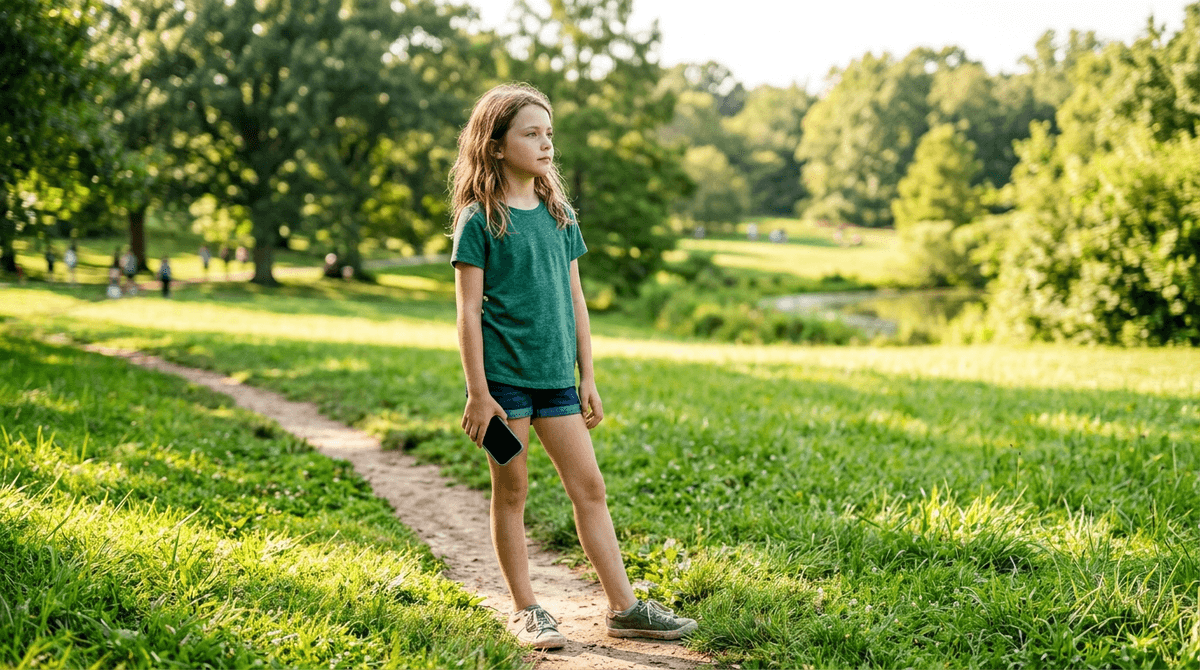

Nearsightedness is increasingly common in school-aged children, but a specific threshold of two hours of screen time and one hour of outdoor play marks the tipping point for eye health. Protecting a child’s vision requires balancing the "near work" of tablets and books with the "far work" of being outside.
About one in six school-aged children requires vision correction, and those who exceed two hours of daily screen time or spend less than one hour outdoors face the highest risk. Prioritize natural daylight and distance viewing to counteract the physical strain of digital devices on developing eyes.
Vision issues often go unnoticed until a child begins to struggle with reading or cannot see the whiteboard, but the damage from "near-work" strain starts much earlier. By the time a child complains of blurry vision, the eye has often already elongated—a permanent physical change known as myopia (nearsightedness).
This finding gives parents a concrete "budget" for the day. It moves the conversation beyond "screens are bad" and toward a specific, manageable ratio: for every hour of close-up digital engagement, children need a corresponding amount of distance viewing in natural light to maintain healthy eye development.
The global "myopia epidemic" has accelerated as childhood has moved indoors and onto smaller displays. Researchers wanted to quantify the specific lifestyle triggers—like urban living and digital habits—that distinguish children with healthy vision from those who need glasses in a post-pandemic environment where remote learning became a standard.
Roughly 17% of children have vision issues that require correction, and nearly 60% of those cases are nearsightedness. The data highlights a clear "risk profile" for the modern student.
- The two-hour cliff: Children who use screens for more than two hours a day are significantly more likely to develop refractive errors.
- The outdoor antidote: Spending less than one hour per day outdoors is a primary predictor of vision trouble; natural light acts as a protective barrier for the eye.
- Geography matters: Children in urban environments show higher rates of vision issues than their rural counterparts, likely due to "visual confinement" and less time spent looking at distant horizons.
- Genetics are a baseline: A family history of glasses remains a major risk factor, but lifestyle choices either accelerate or mitigate that genetic predisposition.
The "urban" risk factor is likely a proxy for what ophthalmologists call "visual volume." In a city, a child’s gaze is frequently stopped by a wall, a screen, or a book within 10 to 20 feet. In rural settings, the eye regularly focuses on objects miles away. This "deep focus" relaxes the eye muscles.
The study also implies that the type of school or the parents' education level doesn't protect a child’s eyes—only their physical habits do. You cannot "study" your way out of myopia; in fact, heavy reading without outdoor breaks contributes to the problem.
The data comes from a specific region in Eastern India, so while the 17% prevalence rate is a strong indicator, exact percentages may vary by country. The habits were also self-reported by families, which often leads to people underestimating their actual screen time and overestimating their time spent outdoors. Because this was an observational study, it shows a strong link between screens and vision loss, but it doesn't "prove" that the screens are the sole cause—other factors like indoor lighting or diet could play secondary roles.
- If your child has a family history of wearing glasses... schedule a comprehensive eye exam before they start first grade, regardless of whether they have symptoms.
- If your child hits the two-hour screen limit by mid-afternoon... implement a "hard stop" on recreational devices and move activities outdoors to reset their focal distance.
- If you live in a high-rise or dense urban area... make a "distant horizon" walk part of the daily routine, intentionally looking at clouds, tall buildings, or trees in the distance to relax the eye's ciliary muscles.
- If your child is a "bookworm" who avoids screens... remember that intense reading carries similar "near-work" risks as tablets; apply the 20-20-20 rule (every 20 minutes, look 20 feet away for 20 seconds).
One hour of outdoor time is the minimum "payment" for two hours of screen time. You can significantly lower the odds of your child needing a heavy prescription by simply pushing them out the door for 60 minutes of daylight every day.
Priya, Epil R, Karunamay V (2026). Prevalence and Risk Factors of Refractive Errors among School-aged Children in Postpandemic Eastern India: A Cross-sectional Study. Annals of African medicine. doi:10.4103/aam.aam_797_25 — https://pubmed.ncbi.nlm.nih.gov/42144740/