

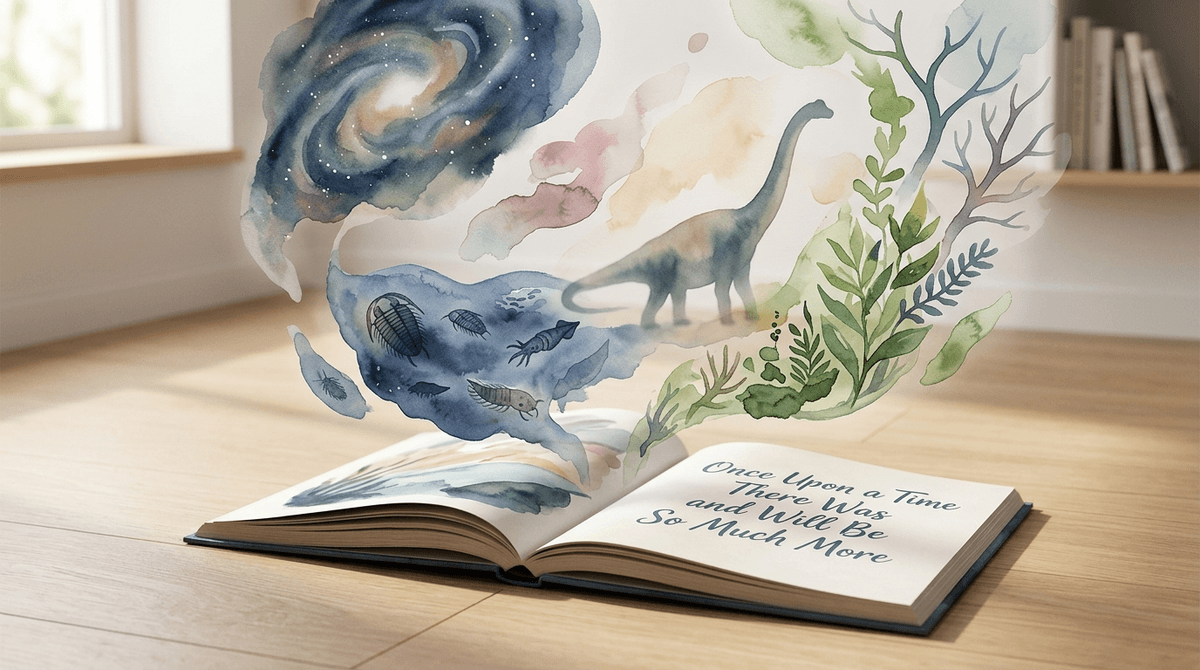
Once Upon a Time There Was and Will Be So Much More is the rare "big picture" book that manages to be visually stunning without being pretentious and educational without feeling like a Sunday school lesson. It’s a large-format, atmospheric journey through the history of life on Earth that treats kids like the smart, curious humans they are, making it a must-have for any elementary schooler’s shelf.
TL;DR: Once Upon a Time There Was and Will Be So Much More is a gorgeous, oversized exploration of deep time, moving from the Big Bang through the age of dinosaurs to the future. It’s perfect for kids aged 5–10 who are starting to ask the "where did we come from?" questions. If your kid likes The Street Beneath My Feet or the Brains On! vibe, this is their next favorite read.
Most science books for kids fall into one of two traps: they’re either dry, fact-heavy encyclopedias that feel like homework, or they’re overly "cutesy" and condescending. Once Upon a Time There Was and Will Be So Much More avoids both.
Author and illustrator Chinlun Lee uses a lush, painterly style that feels more like a gallery visit than a classroom lecture. The book is physically huge, which matters—it forces the kid (and you) to slow down, spread it out on the floor, and actually look at the details. It’s the kind of book that makes a kid feel "grown-up" because the art is sophisticated, yet the narrative is simple and poetic.
The book tackles "deep time"—the concept of Earth’s history on a scale of billions of years. For a seven-year-old, "last week" is a long time ago, so explaining the Permian extinction is a tall order.
This book handles it by focusing on the continuity of life. It’s not just a list of what died; it’s a story of what changed. It moves through:
- The Beginning: The sparks of life and the vastness of the early oceans.
- The Giants: Dinosaurs, obviously, but presented as part of a larger flow rather than just a standalone "dino phase."
- The Now: Where we fit into the timeline.
- The Future: This is the "Will Be" part of the title, and it’s the most important. It gives kids a sense of agency and hope rather than just "everything is old and gone."
The "I Only Like Pictures" Category
If you have a kid who usually gravitates toward Dog Man or The Last Kids on Earth because they’re intimidated by walls of text, this is a perfect bridge. The text is sparse but impactful. It lets the illustrations do the heavy lifting, which is great for reluctant readers or for younger kids who are still in the "read-to-me" stage but want to stay engaged with the page.
For more visual-heavy winners, check out our best books for kids list.
This isn't a book you read once and put away. It’s a conversation starter. Because it covers everything from the Big Bang to the future of the planet, it’s going to spark questions.
The Existential Reframe: Instead of getting bogged down in the "wait, did everything die?" part of history, focus on the "and then what happened?" The book is great at showing that life is resilient. It’s a masterclass in perspective. When your kid is stressed about a math test, looking at a book that spans four billion years is a weirdly effective way to lower the stakes.
Pairing it with other media: If this book ignites an interest in the "unseen" history of the world, keep the momentum going.
- Listen: The Brains On! episodes on evolution or the Earth's core are perfect companions.
- Read: Tiny Creatures: The World of Microbes hits that same "unseen world" vibe.
- Explore: If they’re on the older end of the range, they might appreciate the scale of The Street Beneath My Feet, which uses a fold-out format to show what’s under the ground.
There is one potential friction point: extinction. The book doesn't shy away from the fact that things have gone away to make room for new things. For very sensitive kids, this might lead to a "wait, are we going to go extinct?" moment.
The Pro-Tip: Use the "Will Be" section of the book to ground them. The book’s whole thesis is that the story isn't over. It’s a narrative of survival and evolution, not a tragedy. If they get stuck on the dinosaurs being gone, point to the birds outside. It’s the same story, just a different chapter.
Q: What age is Once Upon a Time There Was and Will Be So Much More appropriate for?
The sweet spot is 5–10 years old. Younger kids (3–5) will love the big pictures and the simple rhythm of the text, while older kids (8–10) will actually start to grasp the scientific concepts of deep time and evolution.
Q: Does the book cover evolution?
Yes, it’s a central theme. It presents the progression of life on Earth as a continuous, changing process. It’s handled poetically rather than as a technical textbook, making it very accessible for families who want to introduce these concepts early.
Q: Is it too sad for sensitive kids?
Not usually. While it mentions that certain eras ended, the tone is overwhelmingly one of wonder and curiosity. It’s much less "scary" than a typical dinosaur book that focuses on predators and combat; this is more about the flow of life itself.
Once Upon a Time There Was and Will Be So Much More is a rare find. It’s beautiful enough to sit on your coffee table and interesting enough that your kid will actually pull it off that table. It’s an investment in their curiosity, and it’s one of those books they’ll likely keep until they’re "too old" for picture books, only to realize you’re never actually too old for art this good.
- Check out our digital guide for elementary school for more age-appropriate picks.
- Explore the best podcasts for kids to find more science-themed audio.
- Find "deep time" books for kids
