

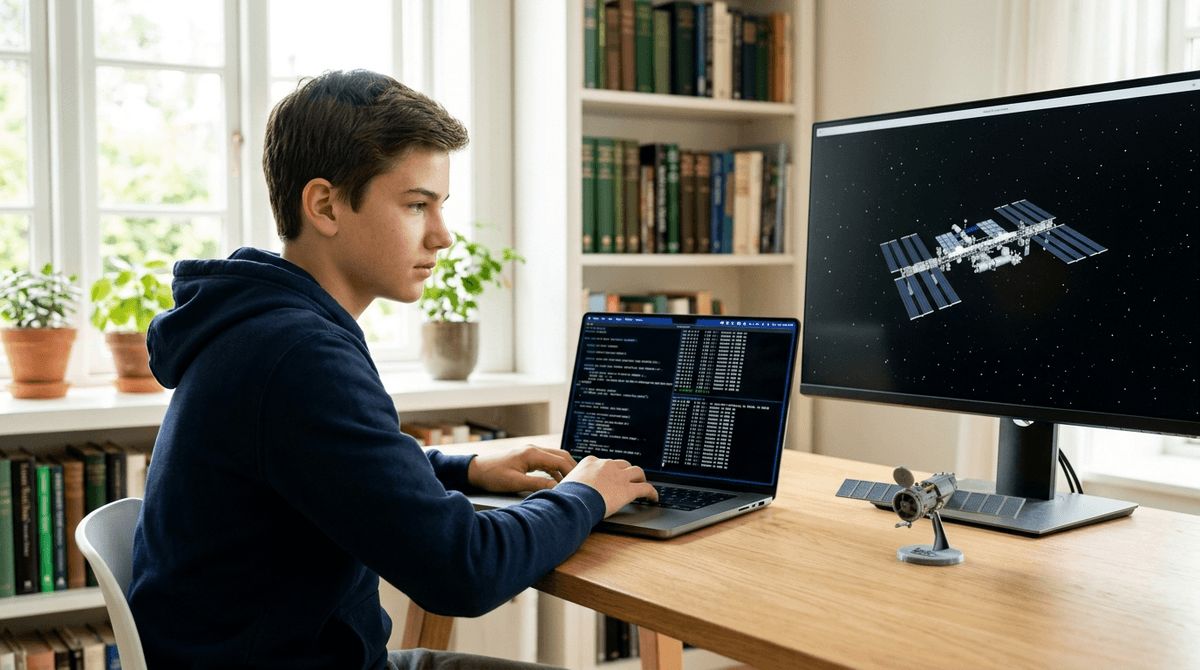
A new open-source tool lets students simulate the technical hurdles NASA faces when sending data from the International Space Station to Earth.
Researchers released a professional-grade software framework that mimics how the International Space Station handles unreliable internet connections, giving students a hands-on laboratory for space-age coding.
For parents of kids interested in aerospace or cybersecurity, this bridges the gap between "coding a game" and "engineering for NASA." It turns abstract computer science into a tangible project that uses the same protocols as the ISS. This provides a high-level resource for college-bound teens to experiment with "disruption-tolerant" networking without needing a laboratory or expensive hardware.
Traditional networking assumes a constant connection, but space communication is messy—signals drop as satellites move or orbits shift. The researchers noticed that while the specific communication protocols used in space are vital for the future of exploration, they are rarely accessible to students or hobbyists due to technical complexity. This tool was built to lower that barrier.
The system allows users to visualize how data "hops" between points even when the connection is broken.
- It uses "custody transfer," meaning the system stores data safely in a "waiting room" until the next link is available, preventing data loss during signal drops.
- Security is built-in using AES-256 encryption and authentication, the same level of security used by government agencies to protect sensitive information.
- A modern web interface makes these invisible network processes visible, so students can see exactly where their data is stored or moving in real-time.
This isn't just a toy; it is a "full-stack" implementation. A student using this tool is learning the actual plumbing of the modern internet’s future—where everything from self-driving cars to remote sensors might need to communicate without a perfect, constant Wi-Fi signal.
The software is a simulation environment, not a direct radio link to the actual ISS. Additionally, as a preprint on arXiv, this work has not yet undergone formal peer review by the scientific community. There is also no data yet on how effectively students learn from this specific tool compared to traditional classroom methods.
- If your teen is bored with basic Python or Scratch, challenge them to install this framework and send a secure file across a simulated "unstable" network to see how the system handles the lag.
- If your student is interested in cybersecurity, have them explore the built-in encryption features to see how "packets" of data are locked and unlocked as they move through different nodes.
- If your child wants to study aerospace engineering, use the web interface to show how orbital "blackouts" change the way we have to design computer systems for Mars or the Moon.
You can now give your child the same communication tools used by NASA to practice solving real-world engineering problems from your living room. It is a free, professional-grade resource for any student ready to move beyond the basics of STEM.
Krit Grover, Marcelo Ponce (2026). An Open-Source Framework to Emulate Delay and Disruption Tolerant Networks for International Space Station Communication. arXiv (preprint). — http://arxiv.org/abs/2605.21624v1