

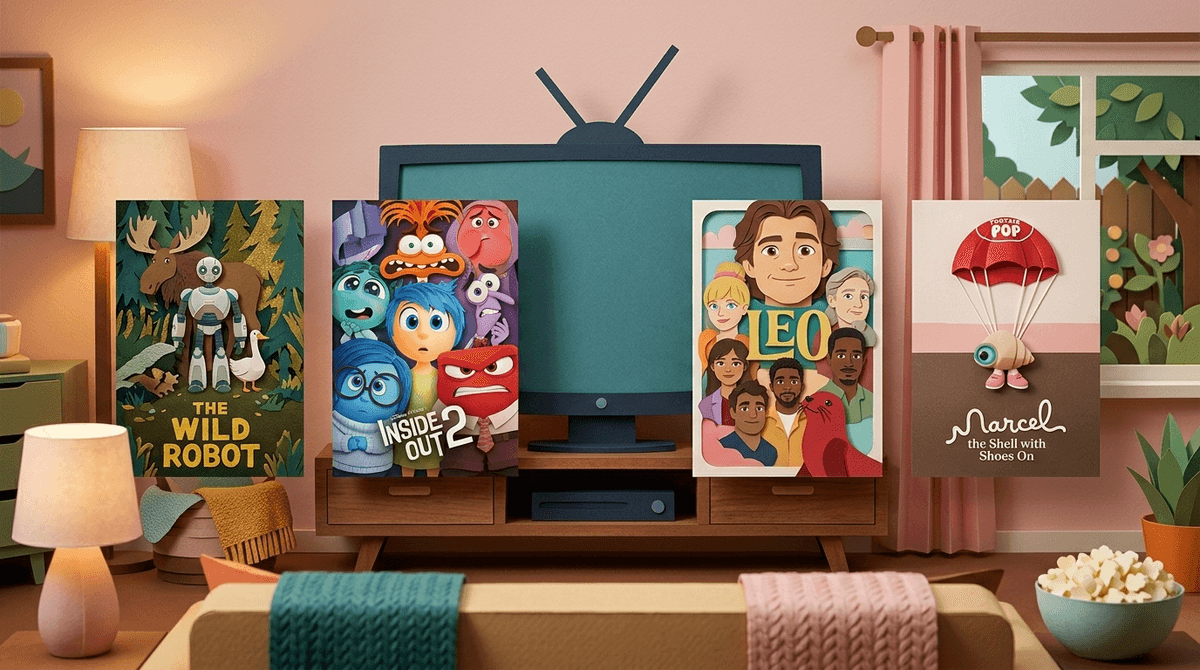
TL;DR: If you’re looking to move past the "sharing is caring" platitudes and actually show your elementary-age kid what empathy looks like in the wild, queue up these recent hits:
- The Wild Robot – For understanding that kindness is a "survival skill."
- Inside Out 2 – For developing kindness toward yourself (and managing that middle-school-prep anxiety).
- Elio – For seeing the value in the "weird" and the "other."
- Leo – For the power of actually listening to people.
- Marcel the Shell with Shoes On – For finding big empathy in a tiny, fragile package.
Let’s be real for a second: the world feels a little "Ohio" right now. If you aren't up on the slang, that just means it’s weird, cringey, or just plain off. Between the relentless pace of TikTok trends and the "brain rot" of some YouTube content, it’s easy for our kids to get desensitized. We want them to be kind, but "be nice" is such a vague, boring instruction. It’s like telling someone to "be healthy" while they’re standing in the middle of a candy shop.
Kindness isn't just about not being a jerk. It's about empathy, perspective-taking, and the grit to do the right thing when it’s socially expensive.
As we kick off 2026, we have some incredible recent films that tackle these nuances better than any "After School Special" ever did. Here is how to use movie night to build some actual emotional intelligence without your kids feeling like they’re in a second classroom.
By the time kids hit 2nd or 3rd grade, they’re navigating complex social hierarchies. They’re seeing Roblox scams, hearing "Skibidi" jokes that walk the line of mean-spiritedness, and dealing with the first real stings of exclusion.
Movies allow kids to "test drive" emotions. They can feel the sadness of a robot losing its home or the anxiety of a girl trying to fit in, all from the safety of your couch. When we watch these together, we aren't just "consuming content"—we’re building a shared vocabulary for how to treat people.
Check out our guide on movies for emotional intelligence
The Wild Robot (Ages 6+)
If you haven't seen this yet, grab the tissues. Based on the The Wild Robot by Peter Brown, this movie is a masterclass in "radical kindness."
- The Lesson: Roz (the robot) has to override her basic programming to survive, and she discovers that kindness isn't a weakness—it's a survival strategy.
- Why it works: It shows that kindness is work. It’s about adaptation and sacrifice. For a kid who feels like they don't "fit in" (which is basically every 4th grader), Roz is the ultimate hero.
- Parent Tip: Talk about how Roz had to learn the "language" of the animals. Kindness often starts with just trying to understand where someone else is coming from.
Inside Out 2 (Ages 8+)
This was the massive hit of 2024, but its staying power in 2026 is real because it hits the "tween" transition perfectly.
- The Lesson: You cannot be truly kind to others if you are being a tyrant to yourself.
- Why it works: It introduces "Anxiety" as a character. For elementary kids, kindness often fails because they are too stressed, too anxious, or too desperate to fit in. This movie gives them permission to be messy and still be "good."
- Parent Tip: This is the best movie for talking about "self-kindness." Ask your kid: "Which emotion is driving your bus today?"
Elio (Ages 7+)
Pixar’s recent release about a kid who accidentally becomes the ambassador for Earth to a bunch of aliens is more than just a space romp.
- The Lesson: Empathy for the "alien."
- Why it works: Elio is a kid who struggles to fit in on Earth but finds his voice by being the only one who tries to understand these bizarre creatures. It’s a great metaphor for the "weird kid" at school.
- Parent Tip: Use this to talk about the "new kid" or the kid who plays differently at recess. How would Elio treat them?
Leo (Ages 7+)
This Netflix animated musical starring Adam Sandler as a 74-year-old lizard is surprisingly deep.
- The Lesson: The most underrated form of kindness is just listening.
- Why it works: Leo spends the movie listening to the problems of 5th graders. He doesn't judge them; he just hears them. It shows kids that they have the power to help their friends just by being a safe place to talk.
- Parent Tip: Ask your kid, "Who is the 'Leo' in your class? Who is the person everyone feels safe talking to?"
Flow (Ages 6+)
This is a gorgeous, wordless animated film about a cat and other animals surviving a flood.
- The Lesson: Cooperation across differences.
- Why it works: Because there’s no dialogue, kids have to read the body language and "feel" the empathy. It’s a literal exercise in perspective-taking.
- Parent Tip: This is great for younger elementary kids (K-2) who might get bogged down by heavy dialogue but can easily understand the "vibe" of helping a friend in danger.
When we talk about "kindness" movies, we have to acknowledge that the best ones usually involve someone being unkind first, or something very sad happening.
- Grades K-2: Stick to movies where the "mean" behavior is clearly labeled and resolved quickly. Leo is great here because the "threats" are mostly just the anxieties of growing up.
- Grades 3-5: They can handle the "gray areas." They can handle The Wild Robot and its themes of loss and the "law of the jungle." This age group is ready to discuss why a character was mean (e.g., were they scared? lonely?).
Ask our chatbot for more age-specific movie recommendations
We’re competing with a lot of noise. If your kid is spending three hours a day watching MrBeast or Skibidi Toilet, their "empathy battery" might be a little drained. Those formats are designed for high-octane stimulation, not deep reflection.
Watching a movie like Marcel the Shell with Shoes On is the "slow food" of digital media. It’s quiet. It’s vulnerable. It’s a little bit sad.
Don't be afraid of the "sad" parts. A lot of parents want to skip the scenes where the character gets rejected or the dog dies. But those are the moments where empathy is forged. If a movie makes your kid cry, that's not a failure—it’s a sign their "kindness muscles" are working.
If you finish a movie and immediately ask, "So, what did we learn about empathy today?", your 10-year-old will physically exit their own body from embarrassment.
Try these instead:
- The "What Would You Do?" Move: "If you were Roz and the other animals were being mean to you, would you have stayed or just left the island?"
- The "Vibe Check": "That character was acting pretty 'Ohio' at the beginning. Do you think they were actually mean, or just scared?"
- The "Real World" Bridge: "Is there anyone at school who reminds you of Elio? Like, someone who is actually cool but people just don't get them yet?"
Kindness isn't a personality trait; it’s a practice. In 2026, our kids are bombarded with content that rewards "the roast," the "prank," and the "flex." Using high-quality cinema to reset their internal compass isn't just a nice weekend activity—it’s essential digital wellness.
- Pick one movie from the list above for your next family night.
- Commit to the "No Phones" rule—for you, too. Empathy requires presence.
- Take our Screenwise Survey to see how your family’s media diet compares to other intentional parents in your community.
Take the Screenwise Family Media Survey
Ask our chatbot about how to handle mean behavior in online games