

Mastering the Baba Is You Level Editor: A Parent's Guide to Logic Puzzles and Creative Design
Baba Is You is one of the most brilliant puzzle games ever made, and its level editor is a genuine computational thinking workshop disguised as creative play. If your kid is into the game, the editor is where the real learning happens—but you'll want to know about the community sharing features and how to keep things age-appropriate. Ages 8+ for playing, 10+ for meaningful editor use.
Quick links:
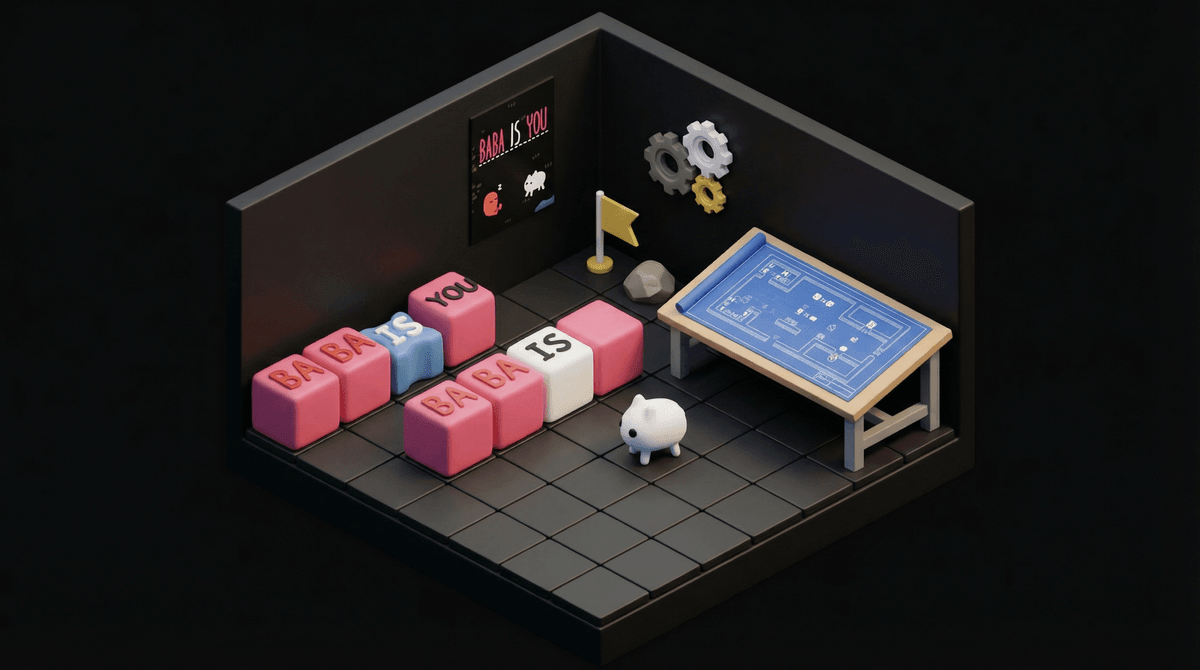
Baba Is You is a puzzle game where you manipulate the rules of the game itself. Instead of just moving characters around obstacles, you push around word blocks that literally change how the game works. "BABA IS YOU" means you control Baba. Push those blocks to make "ROCK IS YOU" and suddenly you're controlling the rock instead. "FLAG IS WIN" means touching the flag wins the level—change it to "WALL IS WIN" and now touching any wall wins.
It's mind-bending, genuinely challenging (like, adults-get-stuck-for-hours challenging), and teaches formal logic, systems thinking, and rule manipulation in ways that feel more like a philosophy class than a video game.
The level editor lets players create their own puzzles using all these mechanics, then share them with the community.
Most game level editors are basically digital LEGO—fun, creative, but not necessarily educational. The Baba Is You editor is different. Creating a working level requires kids to:
Think in formal logic systems: If BABA IS YOU and WALL IS STOP, what happens when WALL IS YOU? They're literally programming cause-and-effect relationships.
Understand constraints: A good puzzle needs to be solvable but not obvious. Kids learn to think about difficulty curves, red herrings, and solution paths.
Debug their own work: When a level doesn't work as intended (and it won't, at first), they have to trace through the logic to find the break. This is literally what programmers do all day.
Iterate and test: Making a level that's actually fun requires playtesting, revision, and more playtesting. Real design thinking.
If your kid is spending hours in the Baba editor, they're not just "playing games"—they're doing computational thinking exercises that would make a computer science teacher weep with joy.
The editor is accessible from the main menu and uses the same visual language as the game itself. Kids who've played through the first few worlds will already understand the basic mechanics.
For younger kids (8-10): Start by having them recreate simple levels from the main game. Can they rebuild the first level? This teaches them the interface without requiring original puzzle design.
For tweens (10-13): Challenge them to create a level with a specific constraint: "Make a level where you have to become three different objects to win" or "Create a puzzle that uses the NOT operator." Constraints actually boost creativity.
For teens (13+): Encourage them to explore complex interactions. The game has dozens of operators (IS, HAS, MAKE, EAT, FEAR, etc.) and hundreds of objects. The possibility space is enormous.
The game includes a tutorial system for the editor , but honestly, the best way to learn is by experimenting and breaking things. That's the whole point.
Here's where parents need to pay attention. The level editor includes the ability to share levels online through Steam Workshop (PC) or through level codes (Nintendo Switch).
The good news: There's no chat, no usernames visible in-game, and no social features beyond sharing the levels themselves. You can't message other players or see who created what (beyond a creator ID number).
The less-good news: You can download and play any level from the community, and there's no content moderation. Most levels are genuinely creative puzzles, but I've seen:
- Levels with crude jokes spelled out in word blocks
- Impossible "troll" levels designed to frustrate players
- Levels with inappropriate references (nothing explicit, but stuff like drug references or edgy humor)
It's not a cesspool by any means—the community skews older and more thoughtful than, say, Roblox—but it's also not curated for kids.
Ages 8-10: Let them use the editor offline. They can create levels and share them with family members via screenshots or by showing you directly. This age group often creates "impossible" levels or levels that are just weird and funny—that's developmentally appropriate. They're experimenting with the system, not designing balanced puzzles yet.
Ages 10-13: Supervised community browsing is fine. Play downloaded levels together first, especially if they're searching for specific themes or creators. Teach them to recognize troll levels (usually obvious from the title or first few seconds) and back out immediately. Have them share their own creations with you before uploading.
Ages 13+: Most teens can navigate the community independently, but it's worth having a conversation about good digital citizenship. Creating quality content, not uploading spam or troll levels, respecting other creators' work—these are real skills.
This game is genuinely hard: If your kid is playing Baba Is You, they're probably pretty sharp. But the difficulty curve is steep, and the editor adds another layer of complexity. Don't be surprised if they get frustrated. That's actually valuable—learning to sit with difficult problems is a life skill.
Time investment is real: Creating a good level can take hours. Multiple sessions. Lots of testing and revision. This isn't Minecraft where you can build something cool in 20 minutes. If your kid is deep in the editor, they're doing real creative work. Budget time accordingly.
It's not multiplayer: Some kids will lose interest because there's no social component beyond sharing levels. Others will love the solo creative space. Know your kid.
The main game is worth playing first: The editor makes way more sense after experiencing the game's puzzles. I'd recommend kids complete at least the first 3-4 worlds before diving into creation. They need to internalize the logic system first.
It runs on everything: PC, Mac, Linux, Switch. No expensive hardware needed. The game costs around $15 and goes on sale regularly.
If your kid is obsessed with Baba Is You, here are some ways to build on that interest:
Other logic puzzle games: Stephen's Sausage Roll, The Witness, A Monster's Expedition—all brilliant, all challenging, all teach systems thinking.
Programming for kids: The logical thinking in Baba translates directly to coding. Check out Scratch or games that teach programming concepts.
Logic puzzle books: Old school, but grid logic puzzles use similar deductive reasoning skills.
Game design discussions: Watch GDC talks together about puzzle design. The Game Maker's Toolkit YouTube channel has excellent videos breaking down what makes puzzles satisfying.
Screen time: The game doesn't have microtransactions, ads, or infinite content designed to maximize engagement. Kids will play until they're stuck or satisfied, then stop. That's healthy. Editor sessions can run long, but they're creative work, not passive consumption.
Online interaction: Minimal. No chat, no profiles, no friend systems. Just level sharing. This is about as safe as online gaming gets.
Content concerns: The game itself is completely family-friendly. Community levels are 95% fine, 5% potentially inappropriate. Easy to supervise.
Accessibility: The game has colorblind modes and remappable controls, but it's heavily text-based (all those word blocks). Kids need to be comfortable reading and understanding English. There's no voice acting or audio cues to help struggling readers.
The Baba Is You level editor is one of the best "stealth learning" tools I've encountered. Kids think they're making silly puzzles; they're actually doing formal logic and computational thinking. The community features require some supervision for younger kids, but the risks are minimal compared to most online gaming spaces.
If your kid is into puzzles, systems, or creative problem-solving, this is worth your time and money. If they're more into action, social play, or narrative games, they might bounce off it—and that's fine too.
The game respects players' intelligence (maybe too much—some puzzles are brutally hard) and rewards patience and creative thinking. In a gaming landscape full of dopamine-optimized engagement loops, Baba Is You is refreshingly focused on making you think.
-
Try it yourself first: Seriously, play through the first world before showing your kid. You'll understand why it's special and be able to guide them better.
-
Set editor time limits: Creative work is great, but hours can disappear. "You can work on your level for 45 minutes" is reasonable.
-
Create together: Make a level as a family. You'll see how your kid thinks through problems and can guide their design thinking.
-
Explore other puzzle games for kids: If Baba clicks, there's a whole genre of brilliant puzzle games waiting.
-
Join the conversation: Ask other parents how they're handling the level editor
and share what's working for your family.
The level editor isn't just a fun add-on—it's where the game transforms from entertainment into education. And your kid won't even notice.