

Low-Stimulation TV for Little Kids: Finding Calm in the Chaos
Low-stimulation TV is exactly what it sounds like: shows that don't feel like they're mainlining sugar directly into your kid's brain. We're talking slower pacing, gentler music, fewer scene cuts, and characters who speak at a normal human volume instead of screaming every line like they're trying to be heard over a jet engine.
Think about the difference between watching Bluey and, say, watching Ryan's World unbox toys at warp speed with dubstep playing in the background. One feels like a warm bath. The other feels like someone's shaking your eyeballs.
The technical term researchers use is "formal features" — things like editing pace, visual complexity, and auditory intensity. Shows with high formal features (fast cuts, loud music, rapid dialogue) can genuinely overstimulate developing brains. And yeah, you can see it happen in real time when your three-year-old goes from chill to completely unhinged after 20 minutes of the wrong kind of screen time.
Here's the thing: not all screen time is created equal. A toddler watching Daniel Tiger's Neighborhood is having a fundamentally different neurological experience than a toddler watching YouTube compilations of surprise eggs.
Research shows that fast-paced, high-stimulation content can:
- Make it harder for kids to focus afterward
- Increase hyperactive behavior
- Interfere with executive function (the brain's ability to plan, focus, and self-regulate)
- Make the transition off screens way harder (hello, meltdowns)
Meanwhile, slower-paced shows with clear narratives and prosocial messages can actually support learning and emotional development. They model problem-solving, use repetition that helps young brains process information, and don't leave kids feeling jangled.
The American Academy of Pediatrics doesn't just say "limit screen time" — they emphasize quality matters. And for kids under 5, quality almost always means slower and calmer.
The gold standard shows share these traits:
- Slower pacing: Scenes last longer than 3 seconds. Characters pause between thoughts. There's actual breathing room.
- Gentle music: Background scores that soothe rather than amp up
- Minimal jump cuts: The camera isn't constantly changing angles like a music video
- Conversational dialogue: Characters talk like humans, not game show hosts
- Clear narratives: Simple stories with beginnings, middles, and ends
- Real emotional beats: Space for feelings, not just constant stimulation
Ages 2-5:
Bluey — The reigning champion. Every episode is basically a masterclass in imaginative play and emotional intelligence, wrapped in genuinely funny writing that doesn't talk down to kids. Parents actually want to watch this one.
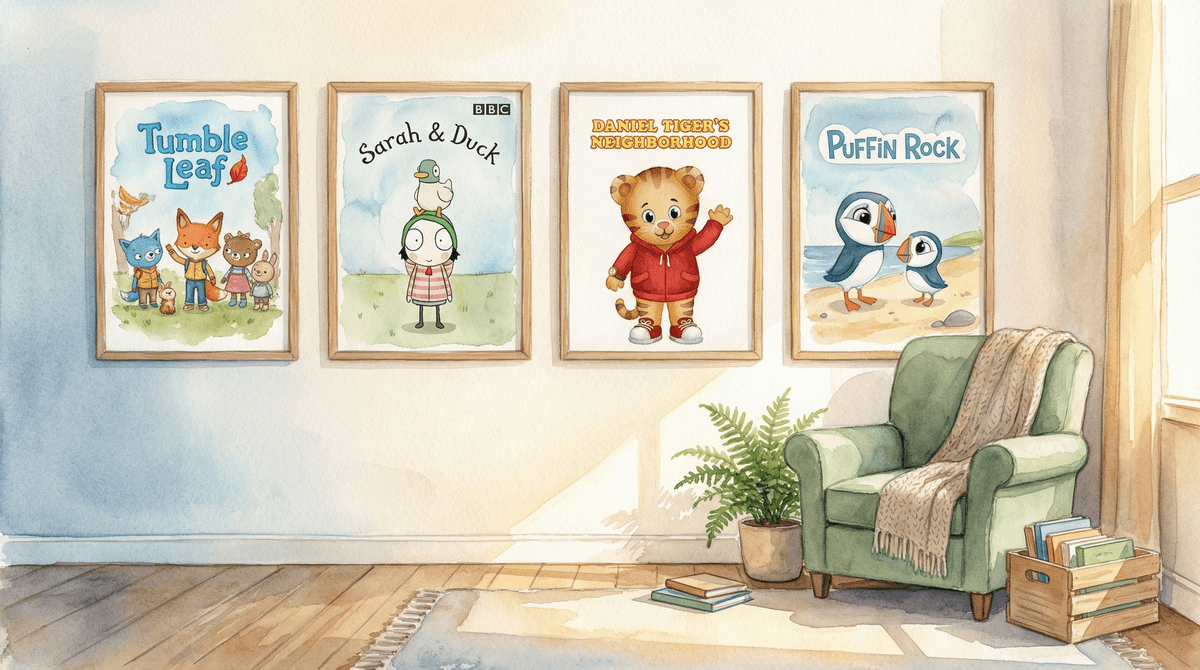
Daniel Tiger's Neighborhood — Fred Rogers' spiritual successor. Painfully earnest, yes, but those little songs ("When you feel so mad that you want to roar...") genuinely work. Slow, repetitive, emotionally intelligent.
Puffin Rock — Narrated by Chris O'Dowd, this Irish gem about a baby puffin is so gentle it's basically a lullaby. Gorgeous animation, nature themes, zero chaos.
Sarah & Duck — Wonderfully weird British show that moves at a snail's pace (in the best way). The humor is dry and absurdist. Kids love it, and it won't make you want to claw your eyes out.
Tumble Leaf — Stop-motion Amazon original about a blue fox who explores nature and science concepts. Meditative pacing, beautiful to look at, genuinely educational without being preachy.
Ages 5-8:
Hilda — Adventure show that manages to be exciting without being overstimulating. Thoughtful pacing, gorgeous art, and a protagonist who solves problems with empathy and creativity.
Elinor Wonders Why — PBS show about a bunny who asks scientific questions. Calm, curious, and models actual scientific thinking rather than just spouting facts.
Look, I'm not here to shame anyone's choices, but if we're talking low-stimulation, these are the opposite:
-
Most YouTube content for kids — Even the "educational" stuff tends to be rapid-fire, overly loud, and designed to maximize watch time rather than actual learning. Learn more about YouTube vs. YouTube Kids.
-
Cocomelon — Controversial take incoming: yes, babies are hypnotized by it. That's kind of the problem. The pacing is relentless, the colors are aggressive, and kids often zone out completely or melt down when it ends. Some parents swear by it for desperate moments, and I get it, but it's the definition of high-stimulation.
-
Most toy unboxing content — It's literally designed to overstimulate and create desire. Hard pass.
-
Fast-paced Netflix algorithm favorites — Just because Netflix auto-plays it doesn't mean it's good for a 3-year-old's nervous system.
If your kid is currently deep in the high-stimulation content ecosystem, transitioning to slower shows might take some adjustment. Here's how to make it easier:
Start with co-viewing: Watch together and narrate what's happening. "Oh, Bluey is pretending to be a grownup! That's silly!" Your engagement helps them engage.
Use it strategically: Offer low-stim shows during wind-down times (before nap, after daycare) when you want calm, not during times when they're already hyped up.
Expect an adjustment period: Kids used to constant stimulation might initially say slower shows are "boring." That's actually their nervous system recalibrating. Give it a week.
Limit choices: Don't scroll through Netflix together. Pick 2-3 approved shows and rotate. Decision fatigue is real for little kids.
Talk about how shows make us feel: "Do you notice how you feel calm after Bluey but kind of crazy after that other show?" Even young kids can start to notice.
Low-stimulation TV isn't about being a perfect parent or eliminating all screens. It's about recognizing that the type of content matters just as much as the amount of time.
A 30-minute episode of Bluey is not the same as 30 minutes of YouTube rabbit holes. One leaves your kid ready to play imaginatively. The other leaves them demanding more screen time and melting down when you say no.
The goal isn't perfection — it's being intentional. And sometimes that means choosing shows that don't feel like they're actively trying to scramble your kid's brain.
Next steps:
- Pick one new low-stim show from the list above and try it this week
- Notice how your kid acts during and after different types of content
- Check out our guide to screen time by age for more context on how much is appropriate
- Remember: you're doing great. The fact that you're even thinking about this stuff means you're already ahead of the game.