

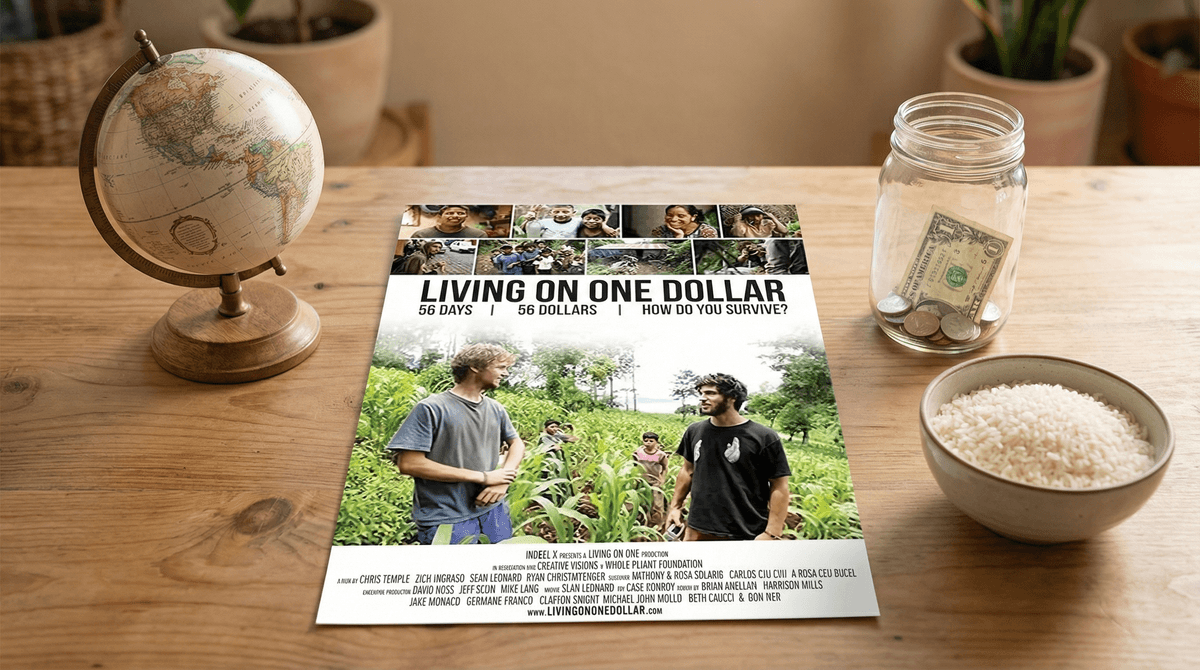
Living on One Dollar: Using This Documentary to Teach Kids About Global Poverty
Living on One Dollar is a 2013 documentary that follows four college students as they live on just $1 a day for two months in rural Guatemala. It's genuinely compelling viewing that works for kids as young as 10, and it's one of those rare films that can spark real conversations about privilege, economic systems, and global inequality without feeling like a lecture. Available on multiple streaming platforms and YouTube, it's about 56 minutes long—perfect for a family movie night that won't require a bathroom break intermission.
Best for: Ages 10+ (younger kids with scaffolding)
Watch time: 56 minutes
Where to watch: YouTube, Amazon Prime, various streaming services
Conversation starter rating: 10/10
Most documentaries about poverty feel like they're made about people rather than with them. Living on One Dollar manages to avoid that trap by putting the filmmakers themselves in the experience—four college buddies (Chris, Zach, Sean, and Ryan) who decide to live on the equivalent of $1 per day in rural Guatemala to understand what extreme poverty actually feels like.
This isn't poverty tourism or some performative stunt. The guys genuinely struggle. They go hungry. They get sick. They run out of money and have to make impossible choices about whether to buy food or save for emergencies. And crucially, they build real relationships with their Guatemalan neighbors—particularly a family with a son named Chino who becomes central to the story.
The documentary works because it's honest about what the experiment can and can't teach. The filmmakers acknowledge their privilege repeatedly: they have return plane tickets, they have families back home, they have college degrees waiting for them. But the experience still changes them, and watching that transformation is what makes this so valuable for kids.
Here's the thing about most educational content on global poverty—it's boring. Kids zone out when you show them statistics about income inequality or talk abstractly about "people in developing nations." Living on One Dollar works because:
It's structured like a challenge. Kids understand challenge videos. They've watched countless YouTube creators try to survive on weird constraints. This taps into that same energy but with actual stakes and meaning.
The guys are relatable. They're young, they joke around, they make mistakes. They're not polished TV presenters. When one of them gets parasites and is genuinely miserable, kids feel it.
The Guatemalan community isn't portrayed as helpless. Rosa, the mother of the family they befriend, is resourceful and dignified. Chino has dreams and hustle. The documentary shows poverty as a systemic problem, not a character flaw, which is a crucial distinction for kids to understand.
There's actual suspense. Will they make it the full two months? Will Chino be able to afford school? The documentary has narrative drive, which keeps kids engaged even when it's teaching them about microfinance and agricultural economics.
Ages 10-12: This is the sweet spot. Kids this age are starting to understand that the world is bigger than their immediate experience, but they haven't yet developed the cynicism that can make older kids dismissive. They'll need some context before watching—maybe a quick conversation about what $1 can buy in the US versus other countries, and why that matters.
Ages 13-15: Middle schoolers will get more out of the economic concepts—the documentary touches on microfinance, education access, and agricultural markets in ways that connect to what they might be learning in social studies. They're also old enough to grapple with the ethical questions: Is this experiment exploitative? What does it mean to have the privilege to opt into and out of poverty?
Ages 16+: High schoolers can engage with the documentary critically. They can discuss whether the filmmakers' approach was appropriate, what the documentary reveals (and doesn't reveal) about systemic poverty, and how their own consumption choices connect to global economic systems. This pairs beautifully with economics, sociology, or global studies classes.
Younger than 10: Probably skip it. The concepts are abstract enough that younger kids won't fully grasp what's happening, and there are some genuinely difficult moments (hunger, illness, economic desperation) that might be distressing without the cognitive framework to process them.
It's not traumatizing, but it is real. Nobody dies, there's no graphic violence, but kids will see real people struggling with real hunger and real desperation. That's kind of the point. If your kid is sensitive, watch it with them so you can pause and process as needed.
The filmmakers are transparent about their methodology. They explain how they calculated the $1/day figure (it's based on the World Bank's extreme poverty line), they show what they're eating (or not eating), and they're honest when things go wrong. This transparency makes it a great teaching tool about research methods and documentary ethics.
There's a follow-up component. The filmmakers created a nonprofit called Living on One and have continued their work in Guatemala. The documentary ends with information about how Chino and his family are doing, which provides closure and shows kids that engagement with global poverty isn't just about watching—it can lead to actual change.
It's surprisingly hopeful. Despite the harsh realities, the documentary doesn't leave you feeling helpless. It highlights specific solutions (microfinance, education access, agricultural cooperatives) and shows how small interventions can create meaningful change. This is crucial for kids, who can easily slip into either apathy or overwhelm when confronted with big global problems.
The production quality is... fine. This isn't a Ken Burns documentary. It's shot on consumer cameras by college students. Some of the editing is rough, some of the narration is a bit earnest. But honestly, that DIY quality makes it more accessible to kids. It doesn't feel like capital-I Important Documentary. It feels like something they could imagine making themselves.
The documentary itself will do most of the heavy lifting, but here are some conversation starters that work:
Before watching:
- "What do you think you could buy with $1? What if that was all you had for an entire day—food, housing, everything?"
- "Why do you think some countries are wealthier than others?"
- "Have you ever thought about where your clothes/food/phone comes from?"
During or after:
- "What surprised you most about what you saw?"
- "The guys in the documentary knew they could leave whenever they wanted. How do you think that changed their experience?"
- "Rosa (Chino's mom) was really resourceful. What are some of the ways she made their limited money stretch?"
- "Chino wanted to go to school but couldn't always afford it. Why do you think education costs money in some places but not others?"
- "What's one thing you have that you realized you take for granted?"
For older kids:
- "Do you think this documentary was ethical? Is it okay for privileged people to 'experiment' with poverty?"
- "The documentary focuses on individual stories. What are the bigger systems that create poverty in the first place?"
- "What's the difference between charity and systemic change?"
- "How do our choices as consumers connect to the lives of people in other countries?"
If this documentary lands well with your kid, here are some natural next steps:
Books:
- A Long Walk to Water by Linda Sue Park (ages 10+) — Based on a true story about a Sudanese refugee
- I Am Malala (ages 12+) — Memoir about education access and girls' rights
- The Rent Collector by Camron Wright (ages 14+) — Fiction set in a Cambodian trash dump community
Documentaries:
- Girl Rising (ages 10+) — Stories of girls fighting for education access globally
- He Named Me Malala (ages 12+) — Documentary about Malala Yousafzai
Games that build empathy:
- Spent (free browser game) — Simulate a month of poverty in America; great for ages 12+
- Papers, Please (ages 14+) — You play an immigration officer making impossible moral choices
YouTube channels:
- Vox's Explained series has several episodes on global poverty and economic systems
- CrashCourse Economics (ages 13+) — Makes economic concepts accessible
This is where things get real, and honestly, it's the most valuable part of watching this documentary with your kids. Living on One Dollar will inevitably make your child aware of their own privilege in ways that abstract conversations never could.
Some kids respond to this awareness with guilt. Some with defensiveness ("But we're not rich"). Some with genuine curiosity about how to help. All of these responses are normal and worth exploring.
If your kid feels guilty: Acknowledge the feeling, but redirect toward action. "It's normal to feel uncomfortable when you realize how much you have compared to others. That discomfort can be useful—it can motivate us to learn more and do something. What's one thing you'd want to learn more about?"
If your kid gets defensive: This often happens when kids conflate "having privilege" with "being a bad person" or "not having problems." You can validate their struggles while also acknowledging the bigger picture: "You're right that our family works hard and has our own challenges. And it's also true that we have access to things—clean water, education, healthcare—that many people in the world don't. Both things can be true at the same time."
If your kid wants to help: This is beautiful, and also a chance to talk about the difference between feeling good and doing good. Sending $20 to a charity is fine, but understanding why poverty exists and what creates lasting change is better. You might explore how microfinance works , or look into organizations that focus on systemic change rather than just charity.
What it gets right:
- Shows poverty as a systemic issue, not individual failure
- Centers Guatemalan voices alongside the American filmmakers
- Explains economic concepts (microfinance, income volatility, education access) in accessible ways
- Demonstrates that small interventions can create meaningful change
- Honest about the limitations of the experiment
What it misses:
- Doesn't deeply explore the historical and political reasons Guatemala has high poverty rates (colonialism, US intervention, etc.)
- The focus on individual stories, while engaging, can obscure larger structural issues
- Limited discussion of gender dynamics (though Rosa is a strong presence)
- Doesn't address the ethics of Americans profiting from a documentary about others' poverty (though proceeds do support their nonprofit)
These limitations don't make it a bad documentary—they make it an incomplete one. Which is fine! No single film can cover everything. But these gaps create opportunities for further learning and discussion with older kids who are ready to dig deeper.
Living on One Dollar is one of those rare pieces of media that can actually change how kids see the world. It's accessible enough for tweens, substantive enough for teens, and structured in a way that holds attention without being manipulative.
Will watching it turn your kid into a global poverty expert? No. Will it make them suddenly grateful for everything they have? Maybe temporarily, until they're complaining about the Wi-Fi again tomorrow. But it plants seeds. It creates a framework for understanding that poverty isn't about people being lazy or making bad choices—it's about systems, access, and circumstances.
And crucially, it shows that engagement with these issues doesn't have to mean feeling helpless or overwhelmed. The documentary is ultimately hopeful, showing how education access, microfinance, and community support can create real change.
Is it perfect? No. But it's real, it's accessible, and it works. Which is more than you can say for most educational content about global poverty.
-
Watch it together. Don't just assign this as homework. The conversations that happen during and after are where the real learning occurs.
-
Follow up with action. Whether that's researching organizations that support education access globally
, or just having an ongoing conversation about consumption and privilege, let the documentary be a starting point rather than an endpoint. -
Revisit it. Your 11-year-old will get something different from this than your 15-year-old. Consider rewatching as kids get older and can engage with more complex questions.
-
Connect it to their world. Help kids see the links between their daily choices (what they buy, what they waste, how they think about money) and the larger global economic systems the documentary explores.
The goal isn't to make your kid feel bad about having a comfortable life. It's to help them understand that comfort isn't universal, that systems create and perpetuate inequality, and that awareness is the first step toward being someone who gives a damn about making things better.
And honestly? In a world where kids are spending hours watching streamers play video games, 56 minutes watching something that might actually expand their worldview feels like a pretty good trade.