

TL;DR
Little Alchemy and its successor Little Alchemy 2 are the rare "unblocked" school favorites that actually use a kid's brain. It’s a logic-based sandbox where you mix basic elements (Air, Earth, Fire, Water) to create everything from dinosaurs to the Internet. It is 100% single-player, zero-stress, and contains no "brain rot" or predatory microtransactions. If your kid is obsessed, consider this a parenting win.
Quick Links:
- The Original: Little Alchemy
- The Sequel: Little Alchemy 2
- The AI Version: Infinite Craft
- The Strategy Alternative: Doodle God
If you’ve walked past your kid’s Chromebook and seen a black or white screen cluttered with tiny icons of "puddles," "obsidian," and "unicorns," you’ve seen Little Alchemy.
Screenwise Parents
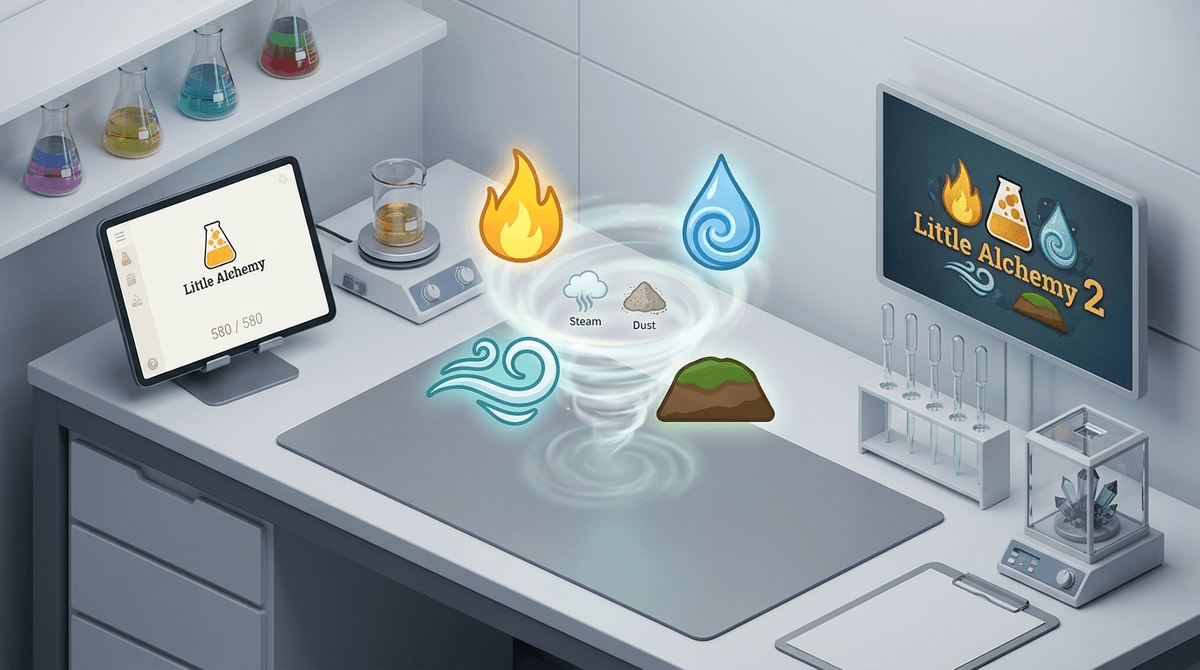
See allThe premise is deceptively simple. You start with the four classical elements. You drag "Fire" onto "Water" and get "Steam." You drag "Air" onto "Earth" and get "Dust." From there, the rabbit hole goes deep—like, 700+ items deep. Eventually, you’re combining "Life" and "Clay" to make a "Golem," or "Metal" and "Electricity" to make a "Wire."
It’s a "combination game," a genre that has existed since the early days of the web but has found a massive second life in modern classrooms because it’s usually not blocked by school filters. It’s categorized as "educational," and while it’s not going to replace a chemistry textbook, it does force kids to think through logical (and sometimes hilarious) associations.
Kids are currently living in a digital world of high-decibel chaos. Between the sensory overload of Roblox and the frantic pace of Fortnite, Little Alchemy is a total vibe shift.
- The "Aha!" Moment: There is a genuine dopamine hit when you figure out a complex recipe. Mixing "Glass" and "Sand" to get "Time" (an hourglass) feels like solving a riddle.
- The Absurdity: It’s not all "Science." Kids love the weird stuff. You can eventually make "Batman," "Godzilla," or a "Yoda" (usually called "Jedi" in the game for copyright reasons).
- Low Stakes: There is no way to "lose." You don't die, you don't run out of lives, and nobody is screaming at you in a lobby. It’s a digital version of a fidget spinner for the mind.
- Completionist Energy: For the kids who love to collect every Pokémon or finish every quest, the "580/580 items found" counter is an irresistible challenge.
Check out our guide on why kids are obsessed with collection-based games
We talk a lot about "brain rot" content—those mindless, colorful YouTube loops that leave kids in a zombie-like trance. Little Alchemy is the literal opposite.
It requires combinatorial thinking. To get to an "Airplane," a kid has to understand that they need "Metal" and "Bird." To get "Metal," they need "Fire" and "Stone." It’s a constant exercise in "If this, then that."
It also encourages external research. Most kids eventually hit a wall where they can’t figure out how to make "Human" or "Electricity." This leads them to look up "Little Alchemy Cheats," which—while technically "cheating"—actually involves reading lists, following multi-step instructions, and navigating wikis. In the world of digital literacy, knowing how to find and apply information is a core skill.
Learn more about how logic games can help with school performance
If your kid has already unlocked the "Universe" in Little Alchemy, they’re likely looking for the next thing to scratch that itch. Here are the best transitions:
Infinite Craft (Ages 10+)
This is the "Little Alchemy on steroids" that went viral recently. Created by developer Neal Agarwal, it uses AI (Large Language Models) to allow you to combine anything. You can mix "Elon Musk" with "Mars" to get "SpaceX," or mix "Harry Potter" with "Cheese" to get "Gryffindor." Because it's AI-generated, the possibilities are literally infinite. Note: Because it's AI-based, very rarely a weird or slightly inappropriate combination might pop up, which is why I suggest it for slightly older kids.
Doodle God (Ages 9+)
This is a more "produced" version of the element-combining genre. It has better graphics and a bit more of a "story" (you are God creating the world). It’s a bit more "gamey" than the minimalist vibe of Little Alchemy.
Scratch (Ages 8-14)
If your kid loves the logic of "If I put these two things together, this happens," they are a prime candidate for coding. Scratch uses block-based logic that feels very similar to the "dragging and dropping" of elements, but they’re actually building their own games.
Minecraft (Ages 7+)
The ultimate "combination" game. If they haven't already fallen into the Minecraft hole, the crafting system (combining wood and iron to make a pickaxe) is the natural evolution of Little Alchemy’s mechanics.
Ages 5-7: They can play it, but they will likely get frustrated. The logic can be a bit abstract (e.g., "Earth + Water = Mud" is easy, but "Air + Energy = Wind" is harder). This is a great "lap game" to play with them.
Ages 8-12: This is the sweet spot. They are independent enough to use the "Hint" system and will take pride in showing you their "Dinosaur" or "Astronaut."
Ages 13+: It might be a "boredom killer" for them during school breaks. It’s less of a primary hobby and more of a digital palette cleanser.
From a digital wellness perspective, Little Alchemy is about as safe as it gets.
- No Multiplayer: There is no chat room. No one can talk to your kid. No "stranger danger" here.
- No Microtransactions: You aren't going to get a $100 bill on your credit card for "Alchemy Gems." The game is free to play in a browser. There are some ads in the mobile app versions, but they are generally unobtrusive.
- Privacy: The game doesn't require an account to play (though you can create one to save progress across devices). It’s not harvesting massive amounts of data.
- Content: It is incredibly wholesome. While you can make "Beer" or "Blood" or "Blade" in some versions, the icons are stylized and clinical. There is no gore, no "adult" themes, and no suggestive content.
The only real "issue" parents run into with Little Alchemy is the "Cheat Sheets." If you Google "Little Alchemy," the first five results are lists of every combination.
Some parents feel this "ruins the point" of the game. I’d argue differently. In 2026, knowing how to navigate a database or a wiki to find a specific solution is a practical skill. If you see them using a cheat sheet, don't sweat it. Ask them: "How many steps did it take to make that 'Cyborg'?" They still have to do the work of dragging and dropping and organizing the elements.
If you want to engage with your kid about their Alchemy habit, skip the "Is that a game?" questions and go for:
- "What’s the weirdest thing you’ve made so far?"
- "I bet you can't figure out how to make a 'T-Rex'." (Challenge accepted, usually.)
- "Show me the most complex thing in your library. How many elements did it take to get there?"
It’s a great way to validate their "nerdy" curiosity without making it a lecture about science.
Little Alchemy is a rare win for both parents and kids. It’s a quiet, thoughtful, and creative corner of the internet that doesn't want your money or your data. It just wants you to figure out that "Bird" plus "City" equals "Pigeon."
If your kid is playing this, they are practicing logic, patience, and categorization. In the grand scheme of the internet, this is the "organic kale" of gaming—except kids actually like it.
- Try it yourself: Spend 5 minutes on the Little Alchemy website. You’ll get the appeal immediately.
- Check the school vibe: If they're playing it at school, ask if it's during "free time" or if they're using it to procrastinate on Zearn or IXL.
- Explore more: If they love the "building" aspect, check out our guide on the best sandbox games for kids.