

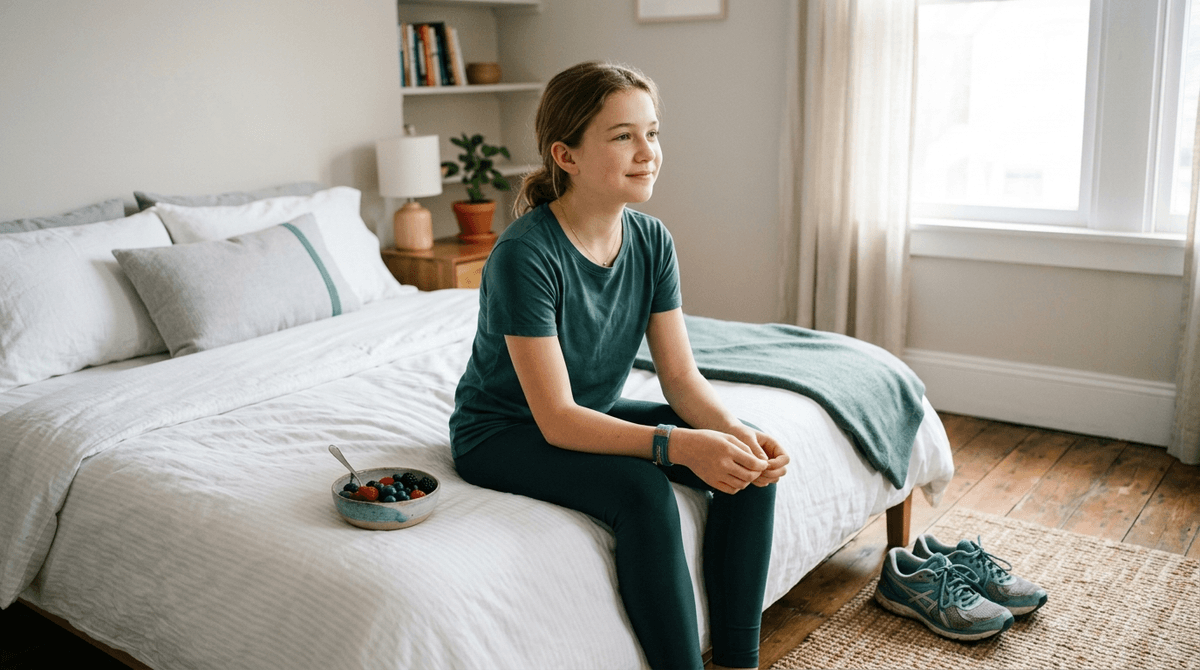
A combination of consistent sleep, regular exercise, and solid nutrition creates a 30% reduction in anxiety and depression for children, but these mental health benefits are significantly weaker for kids who are overweight.
Cumulative healthy habits slash the risk of childhood anxiety and depression by nearly a third, though physical weight acts as a "buffer" that can block these mood-boosting effects.
Parents often play "whack-a-mole" with individual habits, focusing on just sleep one month and just screen time the next. This research suggests the "ensemble" of habits is what actually builds a protective shield for a child’s brain.
If your child is carrying extra weight, the standard advice to "just eat more vegetables" or "get more sun" may not relieve mood symptoms as effectively as it does for their peers. For these children, mental health and metabolic health are so tightly linked that treating them as separate issues—one for a therapist, one for a pediatrician—is likely a losing strategy.
Mental health markers for adolescents are trending in the wrong direction globally. Researchers wanted to move past looking at single factors, like screen time, to see if a "multidimensional" lifestyle creates a dose-response relationship—where more "units" of healthy living equal more protection for the mind. They specifically tracked how body mass index (BMI) might change how the body and brain process these healthy inputs.
The study of over 1,100 children found that lifestyle choices don't just affect the body; they are primary drivers of emotional stability.
- The 30% Rule: Kids who hit high marks for sleep, exercise, and nutrition had roughly 32% lower odds of experiencing anxiety and 31% lower odds of depression.
- Thresholds over perfection: The benefits are non-linear. You don’t need to be an elite athlete or a vegan to see results; there are "optimal thresholds" where the bulk of the mental health protection kicks in.
- The Weight Gap: For the 36% of participants who were overweight or obese, the protective link between healthy habits—specifically vegetable intake—and lower depression was "noticeably diminished."
- Widespread Struggle: About 29% of the kids surveyed showed signs of anxiety, and about 12% showed signs of depression.
The "non-linear" finding is a massive win for busy families. It implies that moving a child from "zero exercise" to "some exercise" provides a huge mental health jump, but moving them from "regular exercise" to "varsity-level intensity" doesn't necessarily offer additional protection against anxiety. We should be aiming for a "solid baseline" rather than optimization.
The data also suggests that obesity may create a state of low-grade inflammation or metabolic stress that "muffles" the positive signals the brain usually receives from healthy food and movement.
The study is a cross-sectional "snapshot" in time. It cannot prove that healthy habits cause better moods; it is equally possible that kids who are already depressed find it harder to sleep well or choose healthy foods.
Furthermore, the data relies on self-reported questionnaires from children in China. Kids are notoriously bad at estimating their own screen time (usually underreporting) and their vegetable intake (usually overreporting). While the trends are clear, the exact numbers should be viewed as estimates.
- If you are trying to improve your child's mood... focus on the "bundle" of habits—sleep, movement, and nutrition—simultaneously rather than trying to perfect one at a time, as the cumulative effect is what drives the 30% risk reduction.
- If your child is currently meeting basic activity and sleep targets... stop pushing for more intense schedules or stricter diets, as the mental health benefits likely plateau once those baseline thresholds are met.
- If your child is overweight and struggling with anxiety... look for "integrated" support that addresses emotional regulation and weight management together, as lifestyle tweaks alone may not be enough to break through the metabolic buffer.
- If you are worried about screen time... view it primarily as a "displacement" issue. It matters most if it is pushing your child below the threshold for sleep (9-11 hours) or daily movement.
You don't need to raise an elite athlete to protect your child's mental health, but you do need to protect the "big three": sleep, movement, and nutrition. If your child is struggling with weight, understand that these lifestyle levers might not be enough on their own to manage anxiety, and a more holistic medical approach is required.
Li YN, Liu JY, Song XL et al. (2026). [Dose-response relationship of multidimensional lifestyle with anxiety and depression in children and adolescents: a moderated analysis on overweight/obesity effect]. Zhonghua liu xing bing xue za zhi = Zhonghua liuxingbingxue zazhi. doi:10.3760/cma.j.cn112338-20251030-00778 — https://pubmed.ncbi.nlm.nih.gov/42151057/