

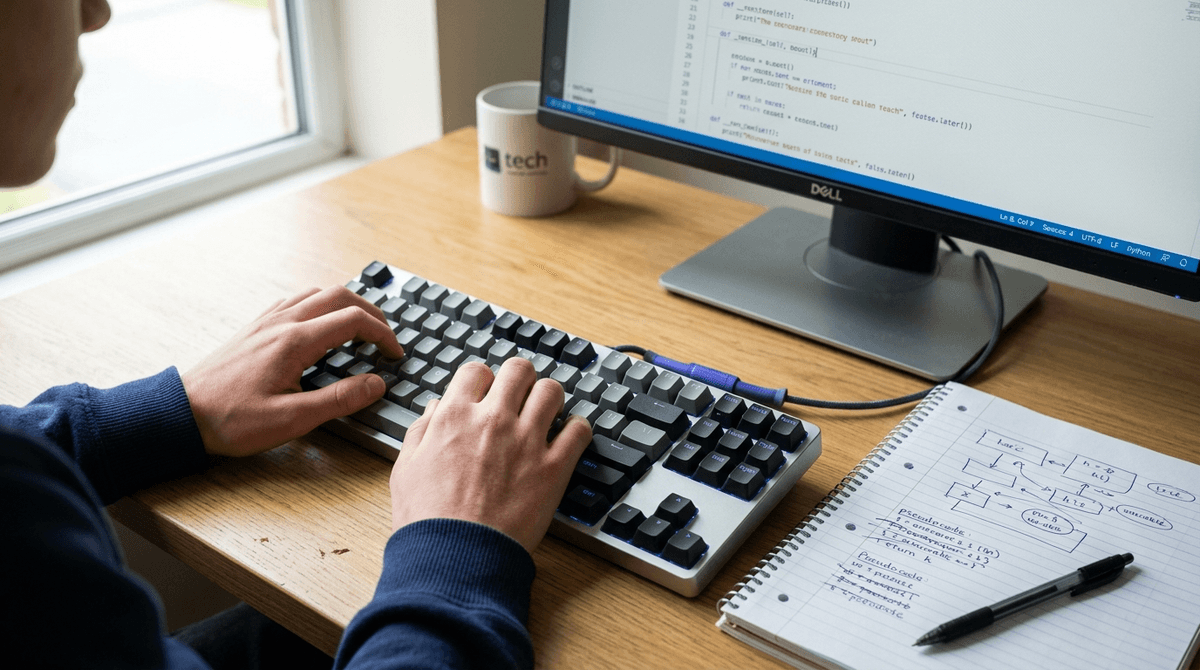
Schools are moving from grading a student's final computer code to tracking their every keystroke in real-time to catch AI-assisted cheating. Computer science programs are shifting toward "process monitoring," where the messy, step-by-step path to a solution is worth more than the answer itself.
Computer science educators are replacing traditional project submissions with secure "sandboxes" that record a student's incremental progress. If a child doesn't show their work evolving line-by-line within school-approved software, they risk being flagged for cheating by algorithms designed to distinguish human effort from AI speed.
The definition of "doing your homework" is fundamentally changing for students in STEM. It is no longer enough to submit a working program; students must now prove they struggled through the logic in a way that "looks human" to a monitoring system. For parents, this means a child’s natural work habits—like solving a problem entirely in their head before typing it out—could now trigger a red flag for academic dishonesty.
This shift signals a broader move toward digital proctoring that tracks how a child thinks, not just what they produce. While this may curb the use of ChatGPT, it also places students under constant surveillance. Students who prefer to work offline or use their own specialized tools may find themselves at a disadvantage or forced to "perform" their work for a monitoring algorithm to prove it is authentic.
The explosion of Generative AI has made traditional computer science homework nearly impossible to grade fairly. Because tools like ChatGPT or GitHub Copilot can generate complex, functional code in seconds, teachers can no longer tell if a student actually understands the concepts or simply wrote a high-quality prompt. Researchers are scrambling to build digital environments that force students back into an iterative, "manual" coding process.
Researchers developed a framework called "VISMATIC" to create a secure, containerized environment where every student interaction is logged and analyzed. The findings from their pilot project highlight a new landscape for technical education:
- Grading final code is dead. The authors argue that examining a finished product is now "insufficient" to verify that a student actually did the work.
- Behavioral metrics are the new rubric. The system tracks "macro-level" patterns, looking for the specific rhythm of a human programmer—including typos, pauses, and logical cycles.
- Instant code is a red flag. The system uses statistical analysis to identify "anomalies," such as a hundred lines of perfect code appearing in a single second. This is a primary indicator of "off-platform" work or AI copying.
- Security is a two-way street. The framework uses "rootless" containers, which allow schools to monitor students' computers without exposing the school's central servers to potentially malicious code written by the students themselves.
We are entering the era of the "Black Box" student. As AI becomes better at mimicking human output, schools are responding with more invasive surveillance of the human process. This creates a new kind of pressure: students aren't just learning to code; they are learning to code in a way that satisfies an algorithm designed to detect "human-like" struggle.
There is also a hidden technical barrier here. These monitored environments require significant computer resources. If a school moves to this "sandbox" model, students with older or slower home computers may experience lag or crashes that their wealthier peers do not, potentially turning "keystroke monitoring" into a new form of the digital divide.
This research is currently an arXiv preprint and has not yet undergone formal peer review by the scientific community. The results are based on a small pilot group of university students in a specific computer graphics course, meaning the "cheating detection" success rates might look very different in a large-scale high school setting. Furthermore, the tool was tested specifically for graphics programming; its ability to accurately track students in more common languages like Python or Java remains unproven.
- If your child is a "copy-paster" who likes to draft code in a separate notes app... tell them to stop immediately. These new systems flag sudden blocks of text as AI-generated, even if the student wrote the code themselves elsewhere. They must type their work directly into the school's assigned portal.
- If your child is entering a computer science or engineering program... check the syllabus for terms like "process-oriented monitoring" or "proctored IDEs." They need to be aware that their work habits—how often they save, how many mistakes they make, and how long they pause—are being recorded and analyzed.
- If your child is a fast, non-linear thinker who "sees" the whole solution at once... encourage them to deliberately "show their work" by saving incremental versions of their code. In the age of AI detection, a "messy" history of errors and corrections is the best evidence that the work is genuinely theirs.
The "final answer" is losing its value in technical education. To succeed in an AI-saturated world, students must learn to document and demonstrate their iterative thinking process within the specific digital fences schools have built to watch them.
Germán Arroyo, Luis López, Juan Carlos Torres (2026). Securing the Sandbox: A Rootless Containerized Framework for Process-Oriented Monitoring in Computer Graphics Education. arXiv (preprint). — arxiv.org