

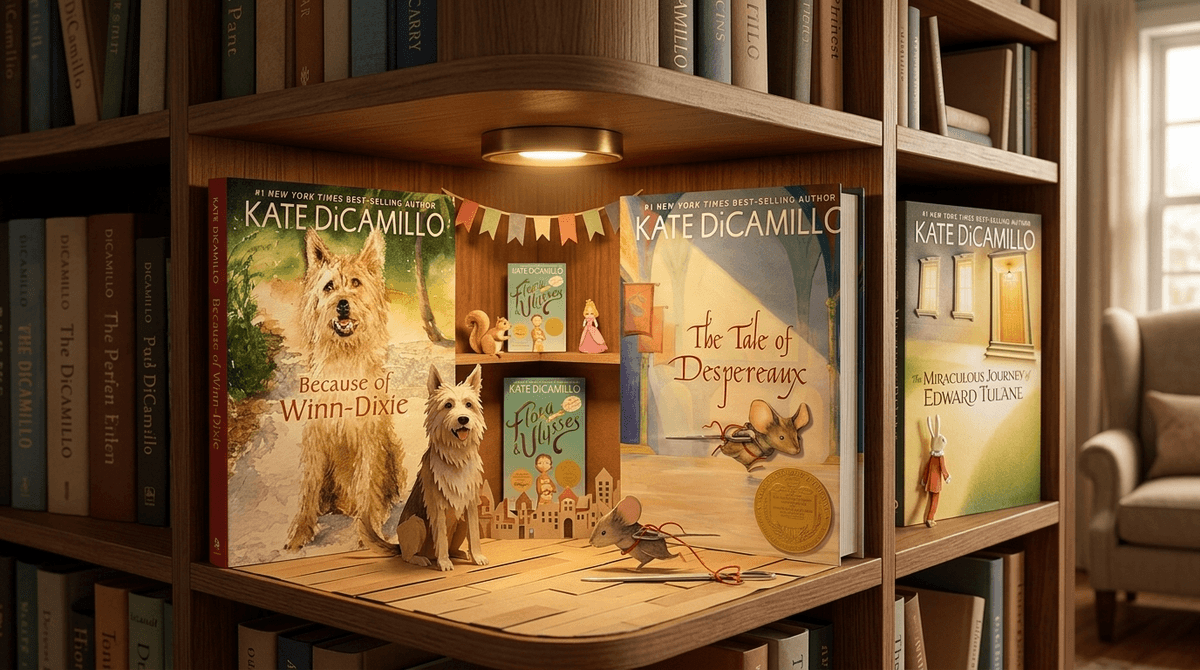
TL;DR: Kate DiCamillo is the gold standard for middle-grade fiction because she refuses to lie to children. Her books are the perfect "analog reset" for kids who spend their days navigating the chaotic irony of YouTube or the social pressures of Roblox. If you want to move your child from "brain rot" content to stories that actually build empathy, these are your starting points:
- For the early reader (Ages 6-8): Mercy Watson
- The absolute classic (Ages 8-12): Because of Winn-Dixie
- For the brave heart (Ages 7-10): The Tale of Despereaux
- The emotional powerhouse (Ages 7+): The Miraculous Journey of Edward Tulane
- For the quirky/funny kid (Ages 8-12): Flora & Ulysses
We spend a lot of time worrying about what’s going into our kids' heads through their screens. We track their Minecraft hours, we Google whether Skibidi Toilet is actually harmful (it’s mostly just weird), and we try to decode why everything they don't like is suddenly "Ohio."
But in the middle of all that digital noise, there’s a specific kind of "quiet" that kids actually crave, even if they don't know it yet. That quiet is found in the work of Kate DiCamillo.
If you aren't familiar, DiCamillo is the author who has basically cornered the market on "the beautiful sad." She writes books that don't shy away from the fact that life can be lonely, complicated, and occasionally unfair. In a world where TikTok trends disappear in 48 hours, her stories stick to the ribs. They are the gateway to "big feelings"—the kind of emotional literacy that helps a kid understand why they feel a certain way when a friend leaves them out of a group chat or when a pet passes away.
According to our community data, by the time kids hit 4th grade, about 65% of them are regularly engaging with some form of socialized gaming or video platform. These platforms are designed for high-frequency hits of dopamine. They are loud, fast, and often emotionally shallow.
DiCamillo’s books are the literal opposite. They require "slow processing." When a child reads The Miraculous Journey of Edward Tulane, they aren't just consuming a plot; they are practicing empathy. They are learning to sit with a character’s pain and hope. This is a vital skill for digital wellness. If a kid can empathize with a china rabbit or a stray dog, they are much more likely to think twice before posting something "savage" in a Discord server.
You don't want to dump a deeply tragic story on a kid who just wants to laugh. DiCamillo has range, so pick the right entry point for your specific human.
Mercy Watson (Ages 6-8)
If your kid is just transitioning from picture books to "real" books, start here. Mercy is a pig who loves buttered toast. It’s hilarious, the illustrations are great, and it’s low-stakes. It builds the "reading is fun" muscle without the emotional heavy lifting of her later work. Check out our guide on transition books for early readers
Because of Winn-Dixie (Ages 8-12)
This is the one that started it all. India Opal Buloni moves to a new town, finds a dog at a grocery store, and starts collecting "sorrows." It deals with abandonment and loneliness in a way that feels safe. It’s a masterclass in community building. If your kid feels like an outsider at school, this book is a hug in paper form. Note: There is a Because of Winn-Dixie movie from 2005 that is actually a pretty faithful adaptation.
The Tale of Despereaux (Ages 7-10)
A small mouse who loves music and light, a rat who lives in darkness, and a servant girl who just wants to be a princess. This is a fairy tale that feels old-fashioned but moves quickly. It’s about forgiveness and "breaking the rules" for the right reasons. Learn more about the Despereaux movie adaptation
Flora & Ulysses (Ages 8-12)
For the kid who loves Marvel or DC, this is the "superhero" entry. It’s about a cynical girl and a squirrel who gains superpowers after an incident with a vacuum cleaner. It’s funny, it uses comic-style panels, and it deals with parental divorce with incredible nuance. Watch it on Disney+: Flora & Ulysses (movie)
I’m going to be straight with you: some of these books are "cry books."
The Miraculous Journey of Edward Tulane is often cited by parents as the most beautiful book they’ve ever read to their kids—and also the one that made them sob. It follows a vain china rabbit who is lost at sea and passes through the hands of many different owners, experiencing deep love and deep loss.
Some parents ask, "Why would I want to make my kid sad?"
In the Screenwise philosophy, we talk a lot about controlled exposure. We’d rather a child experience sadness or loss through a beautifully written book with you sitting next to them than through a viral, context-less video on YouTube Shorts. DiCamillo’s "sadness" is always hopeful. It teaches kids that even when things are broken, they can be mended. That is a core pillar of resilience.
While most of her books are marketed for ages 8-12, the "read-aloud" age is much younger.
- Ages 5-7: Stick to Mercy Watson or the Tales from Deckawoo Drive series.
- Ages 8-10: This is the sweet spot for The Magician's Elephant or The Tiger Rising.
- Ages 11+: Kids this age might start acting "too cool" for middle-grade fiction, but DiCamillo’s more recent work like Raymie Nightingale or The Beatryce Prophecy has a sophistication that holds up even for jaded middle schoolers.
If your child finishes a DiCamillo book, don't treat it like a school assignment. Don't ask "What was the theme?" Instead, try these Screenwise-style conversation starters:
- "Which character did you feel the most sorry for?" (This builds perspective-taking).
- "If this book was a video game, what would the 'main quest' be?" (This bridges the gap between their digital and analog worlds).
- "Do you think the ending was happy, or just 'okay'?" (This helps them understand that life isn't always a 5-star win or a total fail).
Kate DiCamillo isn't just an author; she’s a digital wellness tool. In an era of infinite scroll and 15-second attention spans, her books are an invitation to slow down and feel something real.
Whether it’s a pig eating toast or a mouse in love with a princess, these stories provide the emotional vocabulary our kids need to navigate a world that is increasingly loud and confusing. If you’re looking to swap 30 minutes of iPad time for something that will actually stick with your child for years, you can’t do better than this.
- Audit your bookshelf: If you don't have a copy of Because of Winn-Dixie, get one. It’s the baseline.
- Screen-to-Page pipeline: If your kid is resistant to reading, watch The Magician's Elephant (Netflix) together first, then suggest the book to see "what the movie left out."
- Community Check: See what other parents in your community are reading by taking the Screenwise survey
 .
.