

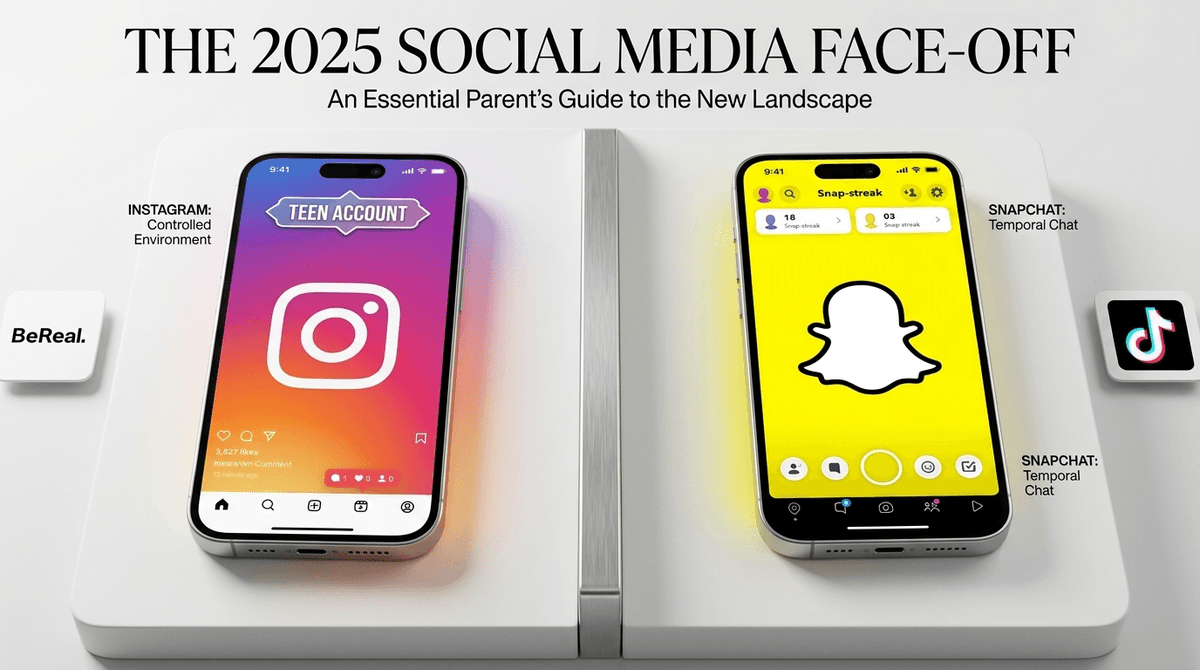
TL;DR: The Quick Verdict
If you’re looking for the "set it and forget it" option, Instagram took a massive lead in late 2024 and early 2025 with their mandatory Teen Accounts. It’s now a walled garden by default. Snapchat remains the "Wild West" of communication—better for privacy from the public, but much harder for parents to monitor without a high level of trust and active setup.
Ask our chatbot for a custom safety checklist for your teen's phone
Choosing between Instagram and Snapchat used to be like choosing between a fashion show and a passing note in class. One was for looking perfect; the other was for being weird with your friends.
But in 2026, the lines have blurred. Both apps have "Stories," both have short-form video feeds (Reels vs. Spotlight), and both have integrated AI chatbots that your kids are probably treating like unpaid therapists. According to recent community data, about 85% of high schoolers are active on both, but they use them for very different social "jobs."
If your kid says their current setup is "Ohio" (weird/bad) or they’re begging to move from a "kid" app to one of these giants, you need to know which one actually has your back when things get messy.
For years, Instagram was the "villain" of digital wellness. It was the home of filtered faces and "comparison is the thief of joy." However, Meta (the parent company) finally got tired of being grilled by Congress and rolled out Instagram Teen Accounts.
Why It’s Safer Now
Instagram's new default settings for anyone under 18 are legitimately impressive. If your teen signs up (or is already on there), they are automatically funneled into a restricted experience:
- Private Accounts by Default: They have to manually accept every follower. No random adults sliding into the DMs.
- Messaging Restrictions: They can only be messaged by people they already follow or are connected to.
- Sensitive Content Limits: The algorithm is supposedly dialed back to hide the "edgy" or body-image-distorting content that used to run rampant.
- Sleep Mode: Notifications are silenced from 10 PM to 7 AM.
The Downside
It’s still a "performance" app. The pressure to look "slay" (good) is high. Even with safety walls, the Explore page can still be a rabbit hole of fitness influencers and "get rich quick" crypto schemes.
Learn more about how to navigate Instagram's Teen Accounts
Snapchat is the app parents usually hate the most because of the disappearing messages. It feels like a platform built for secrets. But for teens, it’s just how they talk. It’s less about "the grid" and more about the "vibe."
Why Kids Love It
It’s low pressure. You send a goofy face, it disappears, and you don’t have to worry about how many likes it got. It’s the digital equivalent of hanging out in the back of the bus.
The Safety Risks
- The Snap Map: This is the big one. If "Ghost Mode" isn't on, anyone your teen is friends with can see their exact physical location. In 2026, this is still the #1 safety concern we see in the Screenwise community.
- My AI: Snapchat’s built-in AI chatbot is... persistent. It sits at the top of the chat list and can be a bit "cringe" or, worse, give bad advice to vulnerable kids.
- Streaks: This is a psychological dopamine trap. Kids feel a physical need to send a Snap every day to keep a number alive, which leads to high anxiety if they lose their phone or go to camp.
Check out our guide on disabling Snap Map and My AI
1. Privacy Controls
- Instagram: Wins here. The "Teen Account" architecture is baked-in. You don't have to go hunting through menus to find the "make private" button; Meta did it for you.
- Snapchat: Requires manual setup. You have to go into the Family Center and link your account to theirs to see who they are talking to (though you still can't see the actual messages).
2. Stranger Danger
- Instagram: Much better at blocking "People You May Know" who are actually 40-year-old strangers. Their AI now flags "suspicious" adult accounts and prevents them from interacting with teens.
- Snapchat: Still has a "Quick Add" feature that can lead to random people adding your teen. It’s a common gateway for sextortion scams.
3. Mental Health & Sleep
- Instagram: Now includes "Nudges" to tell kids to close the app after 60 minutes and "Sleep Mode" for nighttime.
- Snapchat: Doesn't really care if your kid is up at 2 AM keeping a streak alive. It’s built for constant engagement.
Middle School (Ages 11-13)
Honestly? Neither. If they need to communicate, stick to Messenger Kids or just plain old iMessage. If they are dying for social media, BeReal is a much gentler "starter" app because it only happens once a day.
Early High School (Ages 14-15)
If you're going to pick one, Instagram is the safer "training wheels" app because of the Teen Account restrictions. It allows them to follow their interests (hobbies, sports, celebrities) without the "secretive" nature of Snapchat.
Late High School (Ages 16-18)
By now, they likely have both. This is where the Snapchat Family Center becomes useful—not for reading their texts (don't be that parent), but for seeing who they are talking to. If you see a username you don't recognize, that's your opening for a conversation.
Ask our chatbot for tips on transitioning from restricted to open accounts
Let’s be real: your teen wants Snapchat because that’s where the group chats are. They want Instagram because that’s where they "exist" publicly.
The biggest danger on both platforms isn't just "predators"—it's commercialization and AI.
- Instagram is trying to sell them things every three posts.
- Snapchat is trying to get them to subscribe to "Snapchat+" for $3.99 a month so they can see who "rewatched" their story.
It's all designed to drain the bank account (or your sanity). If your kid is spending real money on "Snap Tokens," it's time to have the "entrepreneurship vs. exploitation" talk. Are they using the tech, or is the tech using them?
Instead of saying, "I read that Snapchat is dangerous," try these:
- "I saw Instagram has these new Teen Accounts that block DMs from strangers. Does that actually work, or is it just annoying?"
- "Hey, I’m worried about the Snap Map showing people where you live. Can we look at your 'Ghost Mode' settings together?"
- "I heard some kids are using 'My AI' to do their homework. Have you tried it? Is it actually smart or is it kind of mid?"
Pro Tip: If they use the word "mid" or "basic," they're telling you something is mediocre. If they say it's "cooked," it's over/ruined. Use this knowledge sparingly.
In the 2025 safety face-off, Instagram is the winner for safety features. They’ve put in the work to make the app less of a minefield for minors.
Snapchat is still the winner for actual peer-to-peer connection, but it requires much more parental oversight and "digital citizenship" training.
If your family is just starting this journey, start with Instagram. Set up the Meta Family Center, keep the account private, and talk about the "highlight reel" vs. reality.
Next Steps for Intentional Parents:
- Audit the Map: If they have Snapchat, check the Snap Map right now. Turn on Ghost Mode.
- Verify the Age: Ensure their birth year is correct on Instagram so the Teen Account features actually kick in.
- Set a "Tech-Free" Zone: No phones in the bedroom after 9 PM. Instagram's "Sleep Mode" helps, but a physical basket in the kitchen works better.
Check out our guide on setting up a Family Tech Contract Learn more about the differences between TikTok and Instagram Reels