

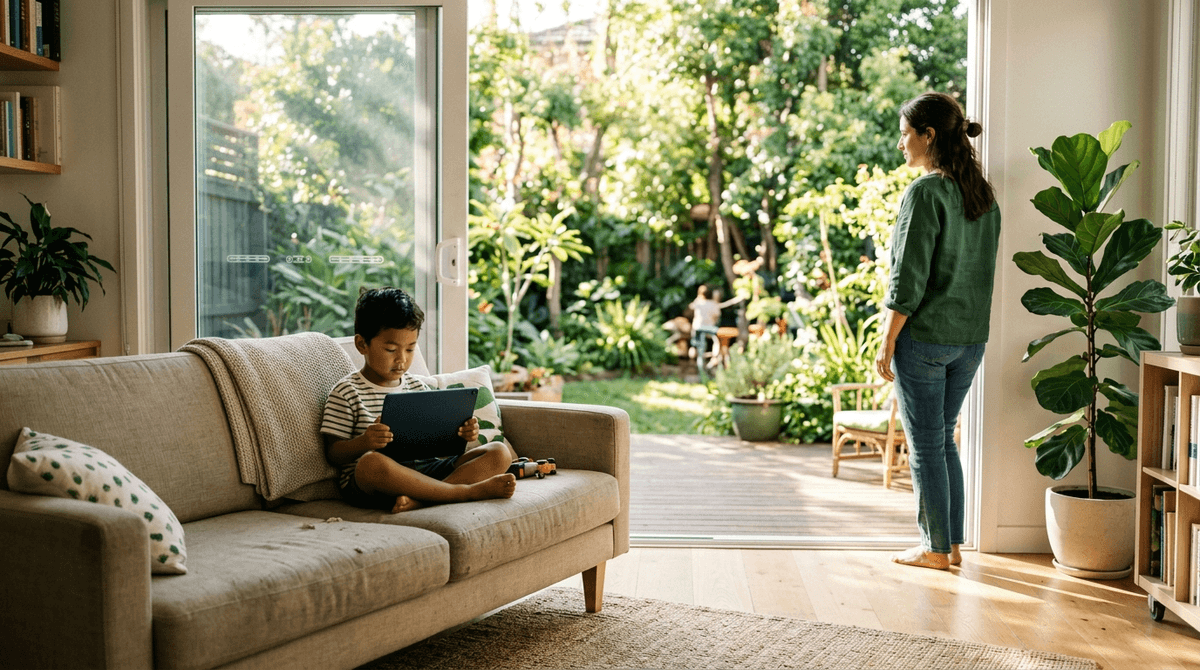
Immigrant parents provide a powerful "health buffer" for their preschoolers, but that protection has an expiration date. Families who have lived in the U.S. for over a decade tend to adopt the sedentary, screen-heavy habits of their U.S.-born neighbors.
Caregivers born outside the U.S. are significantly more likely to prioritize outdoor play and limit screen time for their preschoolers, but this benefit erodes the longer a family lives in the United States. If you have been in the country for 10 years or more, your child is statistically likely to follow the U.S. trend of high screen use and low physical activity.
This research highlights that "Americanization" isn't just about language or food; it is about how children spend their minutes. For parents, this serves as a warning that the local environment is "obesogenic"—it naturally pushes families toward digital consumption and away from the outdoors. If you are an immigrant parent, your "default" cultural settings for play are likely healthier for a child's development than the local U.S. norms. If you are a U.S.-born parent, this study provides a benchmark showing that lower screen time is achievable and common in other cultural contexts within the same borders.
Researchers have long observed an "immigrant health paradox," where newcomers are often healthier than long-term residents despite having fewer resources. They wanted to see if this trend starts in the preschool years, a critical window for habit formation. By analyzing the 2022 National Survey of Children's Health, the team looked for the "tipping point" where the health advantages of foreign-born parenting start to fade. They were specifically looking at how the "U.S. environment"—which includes everything from car-centric infrastructure to the ubiquity of digital entertainment—slowly reshapes family life over time.
The data shows a clear "dose-response" relationship between time spent in the U.S. and a shift in lifestyle habits for kids aged 3 to 5.
- Outdoor play is higher: Children of foreign-born caregivers are roughly 20% more likely to meet daily outdoor play recommendations than those of U.S.-born parents.
- Screens are lower: These same children are significantly less likely to exceed one hour of screen time daily.
- The five-year peak: The "protection" against sedentary behavior is strongest in the first five years of U.S. residency.
- The ten-year cliff: By the 10-year mark, the differences in screen time between immigrant and U.S.-born households virtually disappear.
- Socioeconomics aren't everything: The "nativity effect" remains a strong predictor of behavior regardless of the family's income level or education.
The study suggests that "acculturation" is a double-edged sword. While moving to the U.S. might offer more economic opportunity, it often comes at the cost of the "active lifestyle" infrastructure found in many other countries. In many cultures of origin, walking and outdoor socializing are the default modes of life; in the U.S., they are often "scheduled activities." The fact that the 10-year mark is the equalizer suggests that it takes about a decade for the U.S. environment to fully break down traditional parenting habits and replace them with the domestic "norm" of indoor, digital-first leisure.
The study relies on the 2022 National Survey of Children's Health, which is a massive and reputable dataset, but it is observational. It cannot prove that living in the U.S. causes the increase in screen time, only that the two are linked. Additionally, "outdoor play" was defined broadly by parents, and definitions of what counts as "play" can vary significantly across cultures. The study also did not distinguish between types of screen time (educational vs. entertainment), which might vary by nativity and influence the impact on development.
- If you are a recent immigrant... consciously guard your family’s traditional "active" routines and limit devices as you navigate the transition to U.S. life.
- If you have lived in the U.S. for a decade or more... do a "habit audit" this week to see if your preschooler’s screen time has slowly climbed to match the local average of 60+ minutes.
- If you find yourself driving more than you did in your home country... replace one short car trip a day with a walk to the park to preserve the "outdoor play" advantage identified in the study.
- If you are a U.S.-born parent... look to the routines of newcomer families in your community for practical examples of how to integrate more movement and less digital media into a preschooler's daily schedule.
Your place of birth is a powerful predictor of your child’s health habits, but the American environment acts as a powerful eraser of those traditions over time. Whether you are a newcomer or have been here for decades, the goal is to resist the "cultural gravity" that pulls kids toward screens and keep them moving outside.
Tchoua PP, Peterson SM, Smith FT et al. (2026). Association of caregiver nativity and U.S. residency on preschoolers' time playing outdoors and screen time: Findings from the 2022 National Survey of Children's Health. medRxiv : the preprint server for health sciences. doi:10.64898/2026.05.07.26352664 — https://pubmed.ncbi.nlm.nih.gov/42145628/