

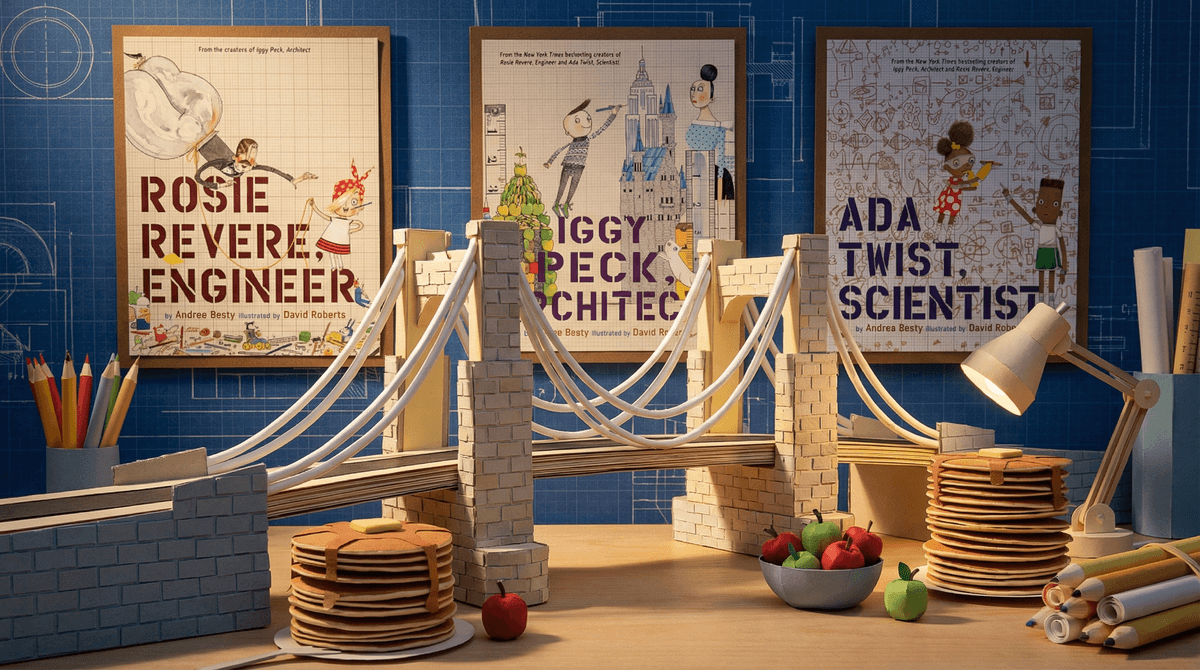
Iggy Peck, Architect by Andrea Beaty is a delightful picture book about a kid who's obsessed with building things—and I mean obsessed. From diapers and pancakes to church pews and apples, Iggy turns everything into architectural masterpieces. The story follows him from toddlerhood through second grade, where he encounters a teacher who initially bans all building projects (gasp!) before eventually recognizing his unique talent.
It's part of Andrea Beaty's beloved series that also includes Rosie Revere, Engineer and Ada Twist, Scientist—all celebrating kids who think differently and pursue their passions despite obstacles. The rhyming text and whimsical illustrations by David Roberts make it genuinely fun to read aloud (important for the 47th time).
The appeal is pretty straightforward: Iggy gets to do what most kids are constantly told not to do—make a mess, build with random household items, and turn everyday objects into something completely different. There's something deeply satisfying about watching a kid stack fruit into a tower or construct a building out of chalk.
The rhyming cadence is catchy enough that kids often memorize chunks of it, and the illustrations are packed with details worth examining on every re-read. Plus, Iggy's passion is so pure and joyful that it's contagious. He's not building to win a prize or impress anyone—he just loves creating structures.
Here's where things get interesting for us as parents. Unlike a lot of screen-based content that leaves kids wanting more of the same thing (one more episode, one more level), Iggy Peck tends to inspire kids to actually do something.
After reading it, you might find your kid:
- Raiding the recycling bin for cardboard tubes
- Stacking blocks with renewed purpose
- Asking questions about how bridges stay up
- Noticing architecture in your neighborhood for the first time
This is the kind of "screen-free inspiration" that actually works—not because you're forcing it, but because the story plants a seed of curiosity.
Ages 3-5: Keep it simple with blocks, LEGO DUPLO, or even cardboard boxes. Let them stack, knock down, and rebuild without worrying about following instructions. The goal is pure experimentation.
Ages 5-7: Introduce basic engineering challenges: Can you build a bridge that holds a toy car? Can you make a tower taller than you are? Magna-Tiles and LEGO Classic sets are perfect for this age.
Ages 8-10: This is when kids can handle more complex projects. Try Minecraft in creative mode (yes, screen time, but purposeful), paper architecture projects, or even simple blueprints. Some kids love learning about famous buildings and trying to recreate them.
Ages 10+: Older kids might enjoy Kerbal Space Program, actual architectural software like SketchUp, or even visiting local buildings and sketching them. This is also a great age to explore architecture as a potential career interest.
One of the trickiest parts of modern parenting is figuring out how books, hands-on play, and screens can all coexist without one dominating everything else. Iggy Peck is actually a great bridge.
After reading the book and doing some hands-on building, you might explore:
- Architecture videos on YouTube Kids (search for "how bridges are built" or "famous buildings for kids")
- Building games like Minecraft or Roblox where kids can design structures
- Apps like Toca Builders for younger kids
The key is sequence: book → hands-on activity → screen time that extends the learning. Not the other way around.
Iggy Peck, Architect is one of those rare books that genuinely inspires creativity beyond the page. It celebrates persistence, problem-solving, and following your passion—all without being preachy about it.
In a world where kids are constantly consuming content, this book encourages them to create instead. And honestly? That's worth its weight in LEGO bricks.
- Read the book together and ask: "What would you build if you could use anything?"
- Set up a "building station" with recyclables, tape, and cardboard
- Take a walk and point out interesting architecture in your neighborhood
- Explore other books in the series
 if your kid connects with this one
 - Consider how building games like Minecraft might fit into your family's screen time in a purposeful way
The goal isn't to turn every kid into an architect—it's to show them that their ideas and creations matter, whether they're built from blocks, pixels, or pancakes.