

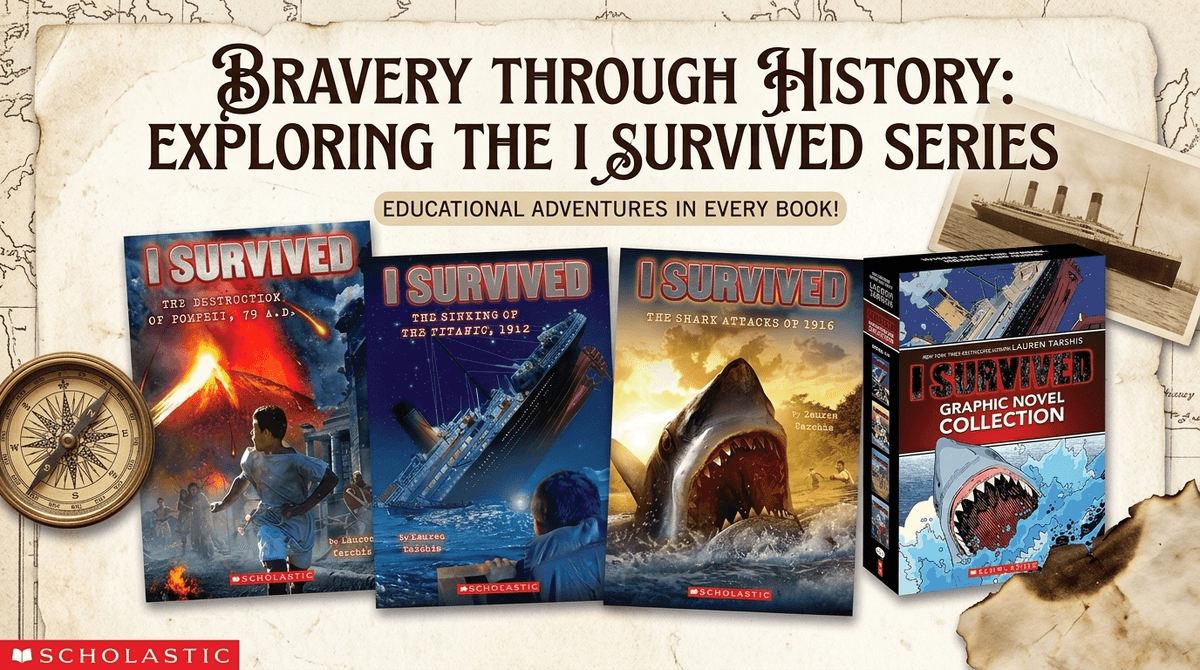
TL;DR: If your 8-year-old is suddenly an expert on the Hindenburg or the 1906 San Francisco earthquake, don't panic—they haven't joined a doom-scrolling cult. They’ve likely discovered the I Survived (Series) by Lauren Tarshis. These books are the ultimate "bridge" media: they move kids from the "brain rot" of low-effort YouTube shorts into deep, historical literacy. They offer high-stakes peril that satisfies the same itch as a Roblox disaster sim but with actual educational value and emotional resonance.
Quick Links to Top Picks:
- I Survived the Sinking of the Titanic, 1912 (The classic starter)
- I Survived the Shark Attacks of 1916 (High engagement for reluctant readers)
- I Survived the Attacks of September 11, 2001 (Best for older kids/mature discussions)
- I Survived Graphic Novels (The gateway drug for visual learners)
If you’ve spent any time in an elementary school library lately, you’ve seen them: the distinctive, action-packed covers of the I Survived (Series). They are ubiquitous. In a world where we are constantly fighting for our kids’ attention against the dopamine-loop of TikTok or the chaotic "Ohio" memes of YouTube, Lauren Tarshis has managed to do the impossible. She’s made historical non-fiction (well, historical fiction based on real events) "viral" among the 7-to-12-year-old set.
But why are kids so obsessed with disasters? And is reading about the destruction of Pompeii actually "wellness," or is it just another form of trauma-baiting?
The formula is consistent and, frankly, brilliant. Each book follows a fictional child (usually around age 10 or 11) who finds themselves in the middle of a massive historical catastrophe. We’re talking the Titanic, the American Revolution, the Great Molasses Flood (yes, that was real), and more modern events like Hurricane Katrina.
The protagonist faces the disaster, loses things (sometimes people), but ultimately survives. The books end with a "Non-fiction" section where Tarshis explains the actual history, the science of the disaster, and the real-life survivors who inspired the story.
We talk a lot about "brain rot" at Screenwise—that passive, low-quality digital consumption that leaves kids overstimulated but under-nourished. I Survived is the literal antidote.
- High Stakes, Safe Environment: Kids are naturally curious about the "worst-case scenario." It’s why they play "Natural Disaster Survival" on Roblox. These books allow them to explore fear and peril from the safety of their beanbag chair.
- The "Underdog" Narrative: The heroes are always kids. In a world where children often feel powerless, seeing a peer survive a volcanic eruption or a grizzly bear attack is incredibly empowering.
- Visual and Fast-Paced: The chapters are short. The vocabulary is accessible but not "dumbed down." For a kid who struggles to finish a 300-page novel, a 100-page I Survived installment feels like a win.
- The Graphic Novel Gateway: If your kid refuses to touch a book without pictures, the I Survived Graphic Novels are a godsend. They use the same stories but with high-quality illustrations that keep the "screen-addicted" brain engaged.
Learn more about the difference between graphic novels and chapter books for literacy
If you’re looking to build a home library or just want to see if this "sticks," here is where you should start:
This is the "classic." Most kids start here because the Titanic has a weird, magnetic pull on the childhood imagination. It’s a great litmus test for whether your kid can handle the emotional weight of historical tragedy.
If you have a reluctant reader who likes animals or "scary" stuff, this is the one. It’s fast, it’s intense, and it actually teaches a lot about how people thought about nature a hundred years ago.
This is the best one for "History Buff" potential. It moves the setting away from modern times and introduces kids to the concept of archaeology and ancient civilizations. It often leads to a massive Google Earth rabbit hole.
The sweet spot for these books is Grades 2 through 5 (Ages 7-11).
- 7-8 Year Olds: Stick to the I Survived Graphic Novels. The visual context helps them process the "scary" parts without getting overwhelmed by the text.
- 9-11 Year Olds: The original chapter books are perfect. At this age, they can handle the "Author’s Note" at the end, which often contains the more sobering historical facts.
- A Note on Sensitivity: If your child is highly sensitive to death or loss, be aware that these books do deal with those themes. While the protagonist always survives, secondary characters or "the masses" often don't.
One of the best things about I Survived is that it rarely ends when the book is closed. This is where you, the intentional parent, can lean in.
When a kid finishes I Survived the Attacks of September 11, 2001, they are going to have questions. They might want to look up videos of the Twin Towers or the Pentagon. This is a critical "digital wellness" moment. Instead of letting them fall into the unregulated world of YouTube search results—which can lead to conspiracy theories or graphic footage—direct them to curated resources.
Try these follow-up media items:
- Who Was? series (Great for biographical context)
- Nathan Hale's Hazardous Tales (If they love the graphic novel style but want more "gritty" history)
- National Geographic Kids (For the science behind the disasters)
Look, I’m not going to tell you that a book about the Hindenburg Disaster is "more fun" than playing Roblox with friends. They serve different purposes.
But where Roblox is about instant reaction and social chaos, I Survived is about empathy. It forces a child to sit in someone else’s shoes, to feel the cold water of the Atlantic or the ash of Vesuvius, and to wonder, "What would I do?" That is a level of cognitive and emotional development that a "disaster simulator" game simply can't provide.
The I Survived (Series) is parent-approved, educator-loved, and—most importantly—kid-obsessed. It’s one of the few media properties that bridges the gap between entertainment and education without feeling like "homework."
If your kid is asking for these books, say yes. If they are already reading them, ask them which disaster was the "most Ohio" (trust me, they’ll find it funny) and then ask them what the real-life survivors did to make it through. You might find yourself having one of the best conversations of the week.
- Check your local library: These are almost always available, but often have long waitlists—that's how popular they are.
- Try an Audiobook: If you have a long car ride, the I Survived audiobooks are incredibly well-produced and keep the whole family quiet.
- Compare the Media: If your kid loves the books, watch a (parent-vetted) documentary on the same topic together to discuss what the book got right.