

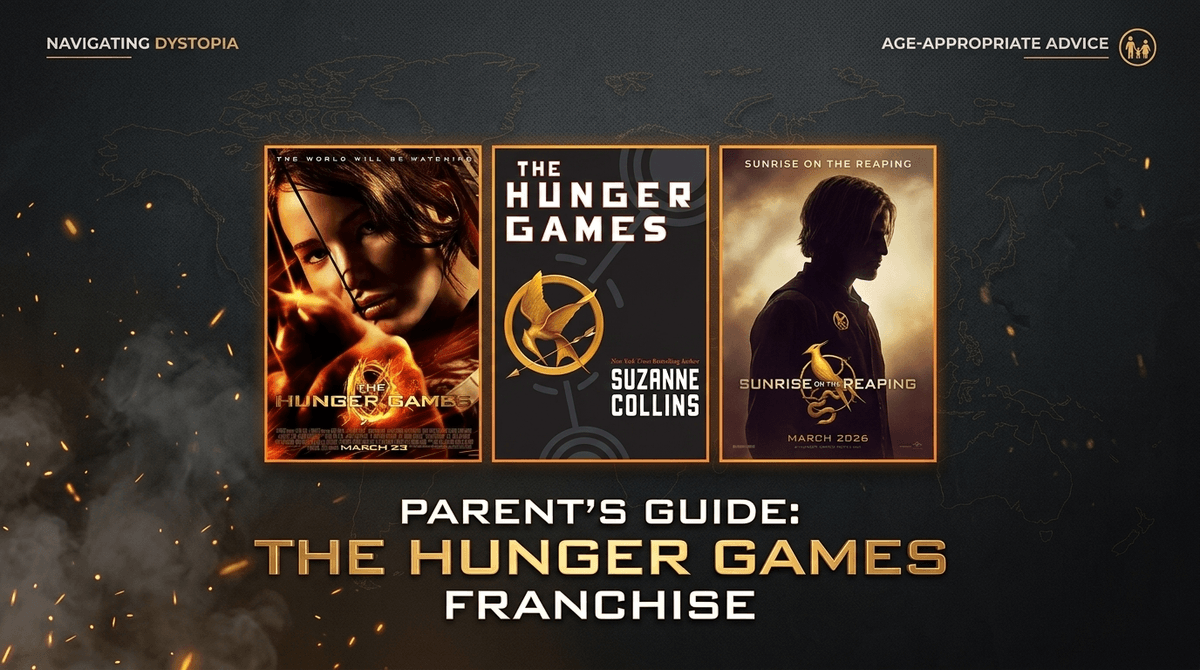
May the Odds Be Ever in Your Favor: The Parent’s Hunger Games Guide
TL;DR
- The Books: Start with The Hunger Games book for ages 12+. It’s a masterclass in political thrillers for teens.
- The Original Movies: The Hunger Games movie is rated PG-13 and holds up incredibly well in 2026.
- The New Prequel: Sunrise on the Reaping (2026) is finally here, focusing on Haymitch Abernathy’s Games. It’s darker and more psychological than the original trilogy.
- The Vibe: High-stakes survival, heavy themes of media manipulation, and intense (but not gratuitous) violence.
- The Verdict: If your kid is ready for Fortnite or Stranger Things, they are likely ready for Panem.
Ask our chatbot if your child is ready for the violence in Hunger Games
If you’ve been living under a rock (or just successfully avoided the YA explosion of the 2010s), The Hunger Games is set in a dystopian future North America called Panem. The country is divided into 12 poor districts and one glittering, wealthy Capitol. As punishment for a past rebellion, each district must send two "tributes"—a boy and a girl between ages 12 and 18—to participate in a televised fight to the death. Only one comes out alive.
The story follows Katniss Everdeen, who volunteers to take her younger sister's place. While it sounds like a "battle royale" trope (and it basically invented the modern version of it), the series is actually a deep dive into how governments use media, "spectacle," and fear to control people. In 2026, with our kids growing up in an era of deepfakes and algorithmic "engagement," the themes of how reality is edited and sold to us are more relevant than ever.
It’s not just the "kids fighting kids" hook. That’s the "Ohio" version of the explanation—weird and surface-level.
Kids love The Hunger Games because it treats them like adults. It acknowledges that the world can be unfair, that authority figures can be corrupt, and that one person’s choices—even a teenager’s—can actually change the world.
There’s also the "Capitol" aesthetic. Between the wild fashion, the high-tech gadgets, and the intense drama, it taps into the same energy that makes games like Roblox or apps like TikTok so addictive: the "spectacle."
Ages 11-12+ The books are actually better than the movies (shocker, I know). Because they are written in the first person, you get inside Katniss’s head. You see her PTSD, her cynicism, and her strategic thinking.
- The Hunger Games: Essential reading.
- Catching Fire: Even better than the first; introduces the "Quarter Quell."
- Mockingjay: This one is heavy. It deals with the actual cost of war. Some kids find it "boring" because there’s less "action" and more "political maneuvering," but it’s the most important book of the three.
Ages 13+ Jennifer Lawrence basically became a superstar because of these. They are PG-13, and they push that rating to the limit. You see the "bloodbath" at the start of the games, and while the camera is shaky and fast, the impact of the violence is real. Check out our guide on the best order to watch the Hunger Games movies
Ages 14+ This is the prequel about a young President Snow. Warning: This is not a "hero's journey." It’s a villain's origin story. It’s longer, more philosophical, and honestly, a bit more brutal. If your kid is looking for a "happy ending," they won’t find it here.
Ages 13+ The newest addition to the franchise focuses on the 50th Hunger Games—the year Haymitch Abernathy (Katniss’s mentor) won. This film is a big deal in 2026. It explores how the Capitol treats "winners" and the psychological toll of the games. It’s less about the "love triangle" and much more about the propaganda machine.
Every kid is different, but here is the general consensus from the Screenwise community:
- Ages 9-11: Might be okay for the first book if they are advanced readers, but the concept of kids killing kids can be a lot to process. If they’re still into Bluey and Minecraft, maybe wait a year.
- Ages 12-14: The "Sweet Spot." This is when they start noticing social hierarchies and "fake" behavior online. They’ll get the metaphors.
- Ages 15+: They can handle the prequels and the more complex political themes of Mockingjay and Sunrise on the Reaping.
Learn more about how to tell if your teen is ready for dystopian media
1. The Violence
It’s not "cartoon" violence like in Super Smash Bros. It’s visceral. In the movies, the deaths of characters like Rue are emotionally devastating. If your kid is highly sensitive to "sad" violence rather than just "action" violence, proceed with caution.
2. The Themes of Suicide and Sacrifice
In the first book/movie, Katniss and Peeta threaten to eat poisonous berries so the Capitol doesn't get a winner. In the later books, characters deal with extreme depression and "morphling" (drug) addiction. These are heavy topics that deserve a conversation, not just a "let them watch it" approach.
3. Media Literacy
The Hunger Games is a perfect tool to talk about "The Edit." In the story, the Capitol editors change the footage to make Katniss look more in love or more rebellious than she is. This is a 1-to-1 comparison for how Instagram or TikTok filters and "storytelling" work today.
If you’re watching or reading along with them, here are a few "non-cringe" questions to spark a real conversation:
- "Why do you think the people in the Capitol treat the Games like a reality show instead of a tragedy?"
- "If you were Katniss, would you have volunteered, or is that just a movie thing?"
- "How do the Gamemakers use the 'arena' to control what the players do? Does that remind you of how apps try to keep us scrolling?"
- "In Sunrise on the Reaping, we see Haymitch before he was a 'drunk mentor.' Does seeing his backstory change how you feel about him in the original movies?"
The Hunger Games isn't "brain rot." It’s the opposite. It’s a series that demands its audience think critically about power, media, and empathy. While the 2026 release of Sunrise on the Reaping brings the violence back into the spotlight, it also brings a fresh opportunity to talk to our kids about resilience and what it means to stay "human" in a world that wants to turn everything into a viral moment.
If your kid wants to dive in, let them. Just be ready to talk about it afterward. The odds are actually in your favor on this one—it’s a great bridge to deeper conversations.
- Watch the original: Rent The Hunger Games movie for a family movie night (with the 13+ crowd).
- Read the new book: Pick up a copy of the Sunrise on the Reaping book before the movie hype hits its peak.
- Compare and Contrast: If they love the "survival" aspect, check out our guide on games like The Hunger Games to find safer, more age-appropriate alternatives for younger siblings.
Ask our chatbot for more book recommendations for fans of Katniss Everdeen