

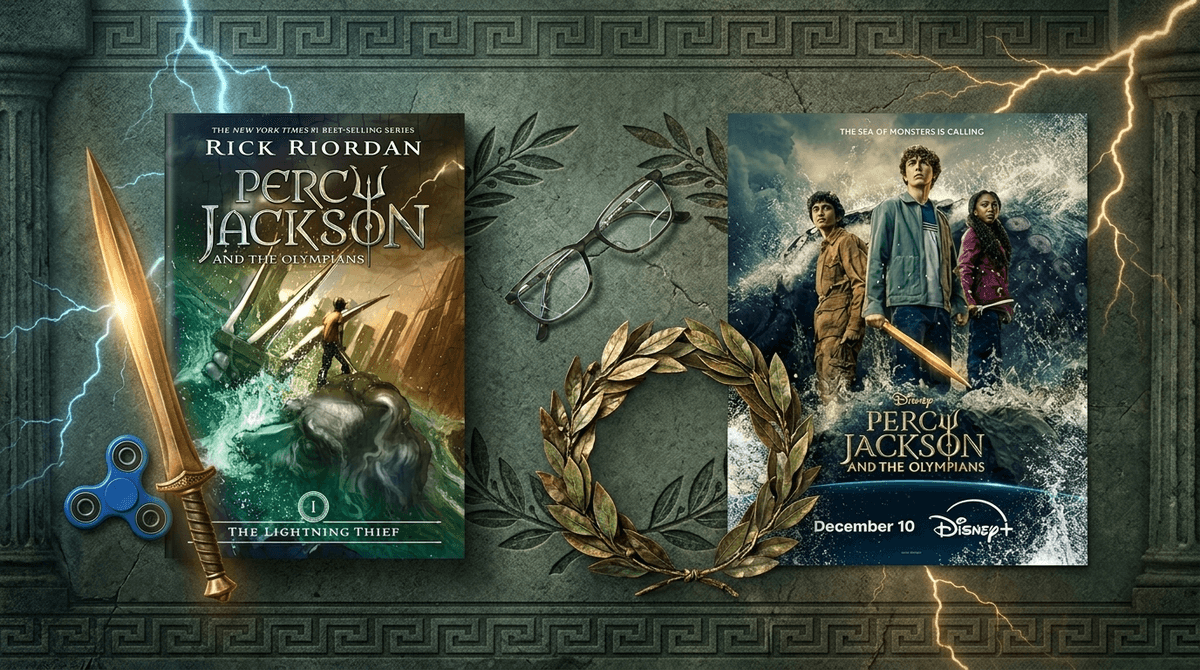
TL;DR: If your kid has been diagnosed with ADHD or dyslexia, the Percy Jackson series is the ultimate "vibe shift" they need. Instead of viewing these traits as "disorders" that need fixing, Rick Riordan reframes them as biological signs that a kid is actually a demigod. ADHD is "battle reflexes." Dyslexia is a brain "hardwired for Ancient Greek." It’s transformative for self-esteem.
Quick Links:
- The Books: Percy Jackson & The Olympians (Ages 8+)
- The Show: Percy Jackson and the Olympians (Disney+) (Ages 7+)
- The Game: Hades (Ages 12+ for stylized violence/complexity)
- The Podcast: Greeking Out (Ages 6+)
If you’ve been living under a rock (or just haven't hit the "middle grade" parenting phase yet), Percy Jackson is a massive media franchise that started with a book series by Rick Riordan. The premise is simple: the Greek gods are real, they’re still "active" in modern-day America, and they occasionally have children with mortals.
Percy is a "troubled" kid who has been kicked out of every school he’s ever attended. He struggles with reading and can’t sit still in class. But everything changes when he discovers he’s the son of Poseidon. Suddenly, the things that made him a "bad student" in the mortal world are the very things that keep him alive in the world of monsters and myths.
Ask our chatbot for more book series featuring neurodivergent leads
Riordan wrote the first book for his son, who had been diagnosed with ADHD and dyslexia. He wanted to create a hero who looked like his kid. Here is how the series flips the script:
ADHD as "Battle Reflexes"
In the world of Camp Half-Blood, kids with ADHD aren't "distracted"—they’re hyper-aware. Their brains are processing sensory input at a lightning-fast rate because, in a life-or-death fight with a Minotaur, noticing a slight rustle in the bushes or a change in the wind is the difference between surviving and becoming a snack. It’s not a deficit of attention; it’s an abundance of it, specifically tuned for combat.
Dyslexia as "Ancient Greek Hardwiring"
Percy and his friends struggle to read English because their brains are literally hardwired for Ancient Greek. When they look at a modern alphabet, the letters float and flip because their "native" language is thousands of years old. This is a brilliant narrative move because it takes the shame out of a "learning disability" and replaces it with a "hidden heritage."
Learn more about how media representation affects neurodivergent kids
We spend a lot of time in IEP meetings, doctor’s offices, and tutoring sessions talking about what our kids can’t do. We talk about "managing" symptoms and "accommodating" weaknesses.
Percy Jackson offers a different narrative for the dinner table. It allows you to say, "Hey, I saw how fast you reacted when that glass fell—you’ve got those demigod reflexes." It gives kids a vocabulary of strength. When a kid feels like a "demigod in training" rather than a "problem student," their entire approach to challenges shifts.
Ages 8-12 The OG series is still the best. Riordan’s writing is fast-paced, funny, and deeply respectful of kids' intelligence. If your child struggles with reading (the irony isn't lost on us), the audiobooks narrated by Jesse Bernstein are top-tier.
Ages 7+ Forget the 2010 movies (seriously, they are hot garbage and the fans hate them). The new Disney+ series is much more faithful to the books. It’s visually great, the casting is spot-on, and it handles the neurodivergent themes with a lot of heart. It’s a perfect "family movie night" pick that actually sparks good conversations.
Ages 12+ If you have a middle schooler who is obsessed with the lore after reading the books, Hades is a masterpiece. It’s a "roguelike" game, meaning you die and restart often, which actually teaches incredible resilience. The art and voice acting are phenomenal. Just a heads-up: it’s got some stylized violence and "God-level" family drama.
Ages 6+ This is the "car ride" essential. It breaks down the actual myths that Riordan references. It’s funny, high-energy, and educational without being "school-ish."
Ages 9+ Once your kid finishes Percy, they’ll want more. Riordan started an imprint to highlight authors from different cultures writing their own mythologies. Check out Aru Shah and the End of Time (Hindu mythology) or Tristan Strong Punches a Hole in the Sky (African American folk magic).
- Grades 2-3: Start with the Greeking Out podcast or the Percy Jackson TV show. The books might be a heavy lift for independent reading at this age, but they make great read-alouds.
- Grades 4-6: This is the "sweet spot." Most kids in this range are reading Percy Jackson or Wings of Fire.
- Grades 7+: If they’ve outgrown Percy, move them toward Hades or more complex series like Heroes of Olympus.
While the "superpower" reframe is amazing, we have to be careful not to accidentally dismiss the real-world frustration our kids feel.
No-BS Moment: Having ADHD in a 5th-grade math class isn't a superpower; it sucks. It’s frustrating to know the answer but not be able to show the work, or to lose your pencil for the tenth time today.
Use Percy Jackson as a bridge, not a bypass.
- The Bypass: "Don't worry about that F in spelling, you're just a demigod!" (This doesn't help them navigate the world).
- The Bridge: "I know it's frustrating that your brain wants to move faster than the teacher is talking. That's those battle reflexes kicking in. Let's figure out how to 'hack' this assignment so you can get back to the stuff you're great at."
Check out our guide on supporting neurodivergent kids in a digital world
Here are a few conversation starters for the next time you're stuck in traffic:
- "If you were a demigod, who do you think your godly parent would be? Based on your personality, would you be in the Athena cabin (wisdom/strategy) or maybe Hermes (speed/pranks)?"
- "Percy gets kicked out of schools because the world isn't built for demigods. Do you ever feel like school isn't 'built' for the way your brain works?"
- "In the show, Percy says 'I didn't want to be a half-blood.' Why do you think he feels that way even though he has cool powers?"
Percy Jackson is more than just "brain rot" entertainment or a way to pass a reading test. For a neurodivergent kid, it’s a mirror. It’s one of the few places in popular culture where their "glitches" are rewritten as "features."
If your kid is struggling to find their place, hand them The Lightning Thief. It might not finish their homework for them, but it’ll give them the confidence to keep trying.
Next Steps:
- Take the Screenwise Survey to see how your family's media consumption compares to your community.
- Explore more "Superpower" themed media for kids