

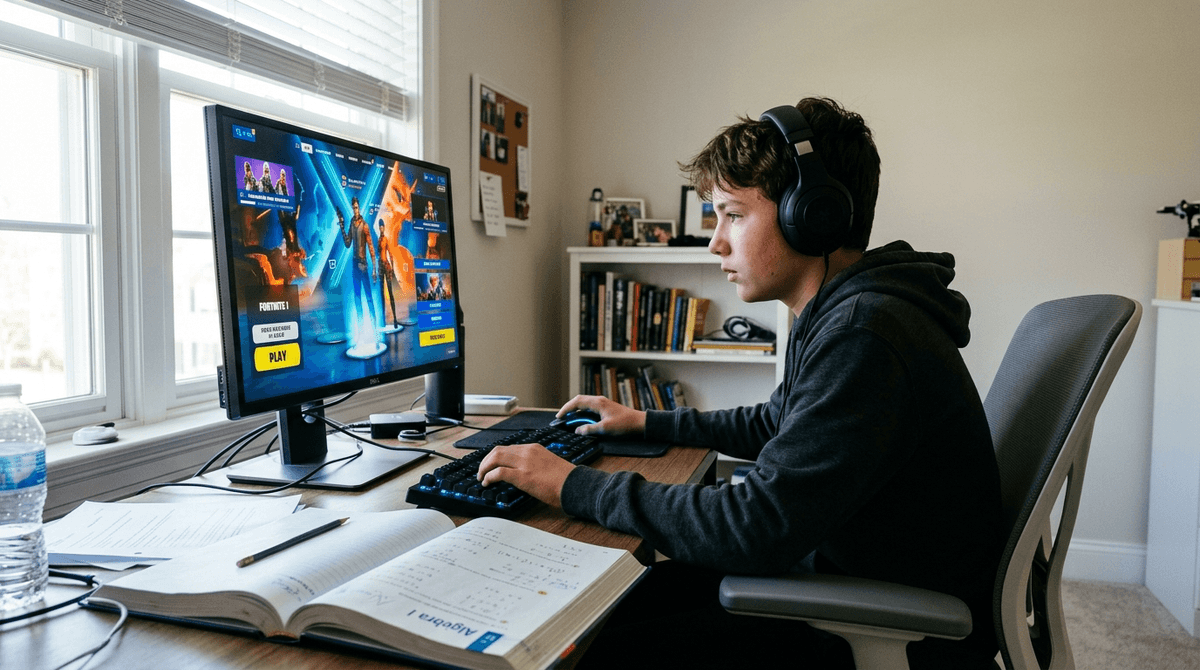
Handing a child a computer without a strict plan is more likely to lower their grades than raise them. While parents often view home technology as an essential ladder to success, new research suggests it functions more like a slide for academic performance.
Giving low-income students home computers improved their technical fluency but caused their math and language grades to drop significantly. The devices did not turn children into self-taught scholars; instead, they turned study time into play time. If you provide a child with a screen but no supervision, they will prioritize entertainment over education every single time.
The "hardware fallacy"—the belief that simply owning a computer makes a child smarter—is a trap that costs parents money and kids their class rank. Many parents feel a nagging guilt if their child doesn’t have the latest MacBook or a dedicated PC for "homework," fearing a digital divide will leave them behind.
This study clarifies that the real digital divide isn't about who has the fastest processor; it’s about how the time on that processor is spent. For a parent making decisions this week, this means that buying a computer for a child who is already struggling in school may actually accelerate their decline unless you are prepared to act as a full-time digital gatekeeper.
Researchers wanted to know if the digital divide could be closed simply by subsidizing the cost of technology. They looked at a government program in Romania that gave vouchers to low-income families to buy home computers, expecting to see a boost in "human capital"—the skills and knowledge that lead to better jobs.
The underlying assumption of many tech-in-education initiatives is that kids are naturally curious and will use tools to explore the world. The researchers were testing whether the presence of a computer would naturally lead to more educational engagement or if the lure of "consumption" (gaming and media) would be too strong to resist.
The results were a stark warning to anyone who views technology as a neutral tool. Students who received the computers scored about a third of a standard deviation lower on math, reading, and English tests than those who didn't.
- Ownership skyrocketed: Families who won the voucher were about 50% more likely to own a computer, proving the program successfully got hardware into homes.
- The gaming gap: Children with home computers spent significantly more time playing games and drastically less time on their schoolwork and reading.
- Skill trade-off: While grades fell, technical skills rose. These kids became significantly more fluent in using Windows and navigating the internet.
- No "halo effect": The researchers found no evidence that having a computer improved general cognitive ability or encouraged kids to use educational software.
The "displacement effect" is the silent killer of academic achievement. Every hour a child spends on a computer is an hour "stolen" from something else—usually homework, sleep, or physical play. The study implies that for children, the path of least resistance is always entertainment.
There is also a hidden social component: the study suggests that the lack of parental monitoring is the primary reason the computers became "gaming consoles" rather than "learning stations." In households where parents are busy or tech-illiterate, the computer becomes an unmonitored window into distraction. The "digital divide" is actually a "parenting divide" where some children are guided toward production (coding, writing, creating) while others are left to pure consumption.
The data comes from low-income Romanian families in the mid-2000s, an era before the iPhone and the modern "app economy" dominated our lives. It is possible that today's educational software is more engaging than what was available then.
However, the core mechanism—the displacement of study time—is likely even more powerful today. Modern games and social media platforms are specifically engineered to be addictive in a way that 2004-era PC games were not. Additionally, the parents in this study had very little experience with computers, making them less capable of monitoring their children than a modern, tech-savvy parent might be.
- If your child is using a computer for "homework"... then require them to work in a high-traffic common area like the kitchen table rather than a closed bedroom.
- If you are buying a computer specifically to improve grades... then install robust parental controls that whitelist only educational sites during school hours.
- If your child’s math or reading scores begin to dip... then immediately audit the time spent on the device versus time spent with physical books and paper.
- If you want to justify the screen time... then shift the focus from "computer use" to "computer production," such as learning to code or edit video, rather than just "browsing."
Computers are powerful tools for building technical literacy, but they are academic liabilities when left unmonitored. You should feel zero pressure to provide a private computer for your child's "education" unless you have a concrete plan to monitor every hour they spend on it. Technical fluency is a valuable byproduct of computer use, but it shouldn't come at the expense of the core math and language skills that form the foundation of their future.
Malamud, Ofer, Pop-Eleches, Cristian (2011). Home Computer Use and the Development of Human Capital. The Quarterly Journal of Economics. doi:10.1093/qje/qjr008 — dx.doi.org