

TL;DR
Holes by Louis Sachar is the rare "school-assigned" book that kids actually enjoy. It’s a masterclass in plotting that balances a cursed family history, a modern-day juvenile detention camp, and a wild Wild West outlaw story. It’s perfect for ages 9-13. If your kid has already finished it, check out the Holes movie (which is surprisingly faithful) or the sequel Small Steps.
If you’ve spent any time around a middle schooler lately, you’ve probably heard a lot about "Ohio" (which apparently just means "weird" now?) or had to endure the chaotic fever dream that is Skibidi Toilet. In a world of 15-second TikTok loops and Roblox tycoons that are basically just digital sweatshops for kids, it’s easy to feel like their attention spans have been deep-fried.
But then there’s Holes.
First published in 1998, this book is the undisputed GOAT (Greatest of All Time) of the middle school curriculum. It’s one of the few pieces of media that bridges the gap between "this is good for you" and "this is actually fun." It doesn’t pandering to kids, and it doesn’t shy away from the fact that the world can be incredibly unfair.
The story follows Stanley Yelnats IV (yes, his name is a palindrome), a kid who is perpetually in the wrong place at the wrong time thanks to a multi-generational family curse. When a pair of famous sneakers literally falls from the sky and hits him on the head, he’s accused of theft and sent to Camp Green Lake.
Except there is no lake, and nothing is green.
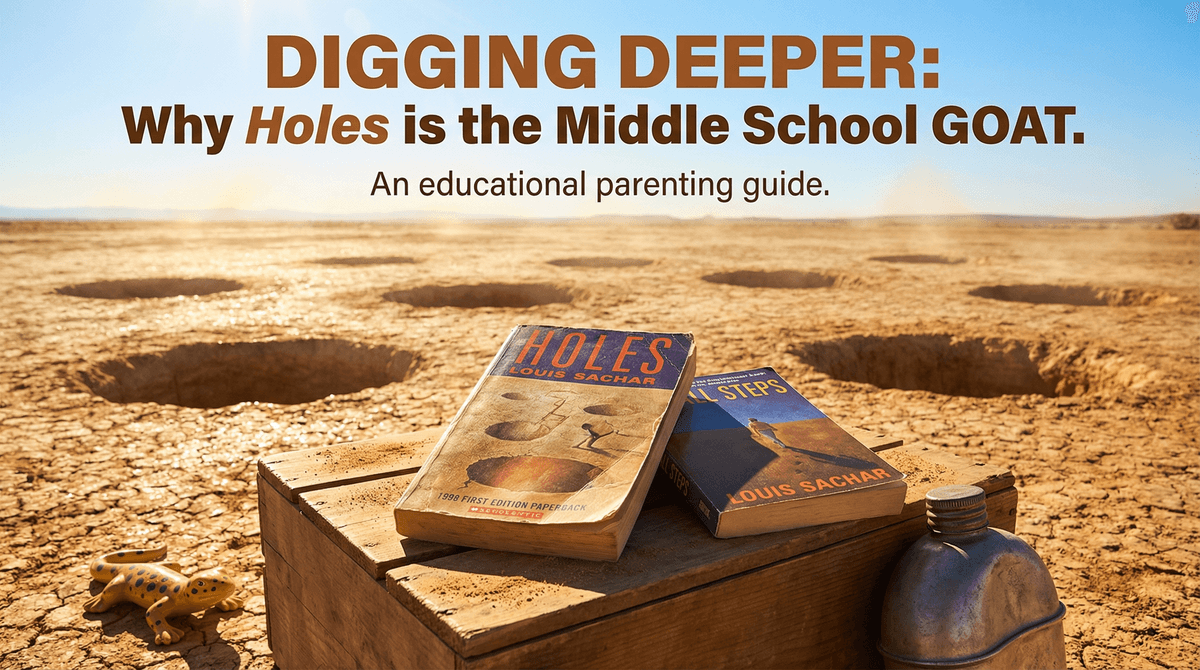
It’s a desert wasteland where juvenile delinquents are forced to dig one hole every day—five feet deep and five feet wide—to "build character." Of course, the Warden isn't interested in their character; she’s looking for buried treasure linked to a 19th-century outlaw named Kissin’ Kate Barlow.
The book weaves three separate timelines together: Stanley’s time at the camp, his great-great-grandfather’s saga in Latvia, and the tragic history of the town of Green Lake 110 years prior. By the end, every single "random" detail clicks into place like a perfectly engineered puzzle.
Kids are smarter than we give them credit for. They can smell a "message book" from a mile away. You know the ones—the books where a kid learns a lesson about sharing or bullying in a way that feels like a lecture from a guidance counselor.
Holes isn't that. It’s a mystery. It’s a survival story. It’s got "deadly" yellow-spotted lizards and a kid nicknamed Zero who is way more than he seems.
It also taps into a very specific middle-school anxiety: the feeling that the system is rigged against you. Whether it’s a teacher who has it out for them or the general absurdity of social hierarchies, kids relate to Stanley’s struggle against a nonsensical, authoritarian regime. Digging holes in the heat is basically the physical manifestation of a boring Tuesday in double-period math.
Let’s be real: a lot of "classic" middle school literature is actually kind of terrible to read as a modern kid. Bridge to Terabithia is a trauma-trap designed to make sixth graders cry, and The Pearl is about as exciting as watching paint dry in a philosophy class.
Holes holds up because Louis Sachar is a phenomenal writer who treats his audience like adults. He tackles heavy themes—systemic racism, the failures of the juvenile justice system, homelessness, and the weight of poverty—without ever slowing down the plot.
It’s also surprisingly funny. The dry humor and the absurdity of the camp staff (Mr. Sir and Mr. Pendanski) provide a necessary relief from the heat of the desert. It’s a book that teaches empathy not by telling you to be kind, but by showing you the humanity of kids the rest of the world has written off as "bad."
Usually, when a book is this good, the movie is a disaster. (We don't talk about the Percy Jackson movies in this house—though the new Disney+ show is a massive improvement).
However, the Holes movie from 2003 is actually great. Louis Sachar wrote the screenplay himself, which explains why it stays so close to the source material. It stars a very young Shia LaBeouf and features Sigourney Weaver as the Warden. If your kid finishes the book, a family movie night with this one is a guaranteed win. It’s one of the few times where the visual of the "holes" actually matches what everyone pictured in their heads.
If your kid vibed with the mystery and the "kid vs. the world" energy of Holes, they might like these:
- This is the "sequel," though it focuses on Armpit and X-Ray after they leave Camp Green Lake. It deals with some more mature themes (like celebrity culture and making mistakes as a teen), so it’s great for the 12-14 crowd.
- The ultimate survival story. If they liked the "how do I stay alive in the middle of nowhere" aspect of Stanley and Zero’s journey, this is the gold standard.
- For kids who are starting to question the "rules" of society. It’s a bit more philosophical but has that same "wait, the adults are lying to us" energy.
- Like Holes, this book weaves together multiple storylines across different time periods with a touch of magical realism. It’s a bit longer but very rewarding.
Get more personalized book recommendations for middle schoolers
Recommended Ages: 9-13
- Violence: There is some "Western-style" violence in the flashbacks (a murder and a house being burned down) and some physical altercations between the boys at the camp. It’s handled with weight, not as cartoonish action.
- Language: Very mild. You might get a "damn" or "hell," but it’s nothing you haven't heard on a PG-rated sitcom.
- Intensity: The threat of the yellow-spotted lizards (which are fictional, by the way) and the dehydration of the boys can be tense for more sensitive readers.
One of the best things about Holes is that it provides a very low-stakes way to talk about high-stakes topics. Stanley is innocent, yet he’s in a detention center. Zero is "homeless" before he arrives at camp. The history of Kissin’ Kate Barlow involves a Black man (Sam) being killed for kissing a white woman.
These aren't just plot points; they are reflections of real-world history and current events. If your kid is asking questions about why things are "unfair," this book is a great jumping-off point.
Learn how to talk to your kids about social justice through media
If you want to move beyond "Did you finish your reading log?", try these questions:
- The Palindrome: Why do you think the author made Stanley’s name a palindrome? Does he feel like he’s stuck in a loop he can’t escape?
- The "Bad Kids": Who is the real "villain" of the story? Is it the boys digging the holes, or the people running the camp?
- Fate vs. Choice: Stanley blames his "no-good-dirty-rotten-pig-stealing-great-great-grandfather" for everything. By the end, does he still believe in the curse, or does he think he changed his own luck?
- The Warden: Why do you think the Warden is so obsessed with the treasure? Is she any different from a kid obsessed with getting "rare" items in Roblox?
Holes is a masterpiece. It’s one of the few books that actually earns its place on the "required reading" list. It’s fast-paced enough for the YouTube generation but deep enough to stick with them long after they’ve put it down.
If you haven't read it since you were a kid, it’s worth a re-read. You’ll probably find that the themes of justice and friendship hit a lot harder now that you’re the one trying to navigate the "holes" of adulthood.
- Grab a copy of Holes from the library or your favorite local bookstore.
- Once they finish, queue up the Holes movie for a Friday night.
- If they’re looking for more ways to engage with stories, check out our guide on podcasts for middle schoolers like Mars Patel, which has a very similar "kids solving a mystery" vibe.