

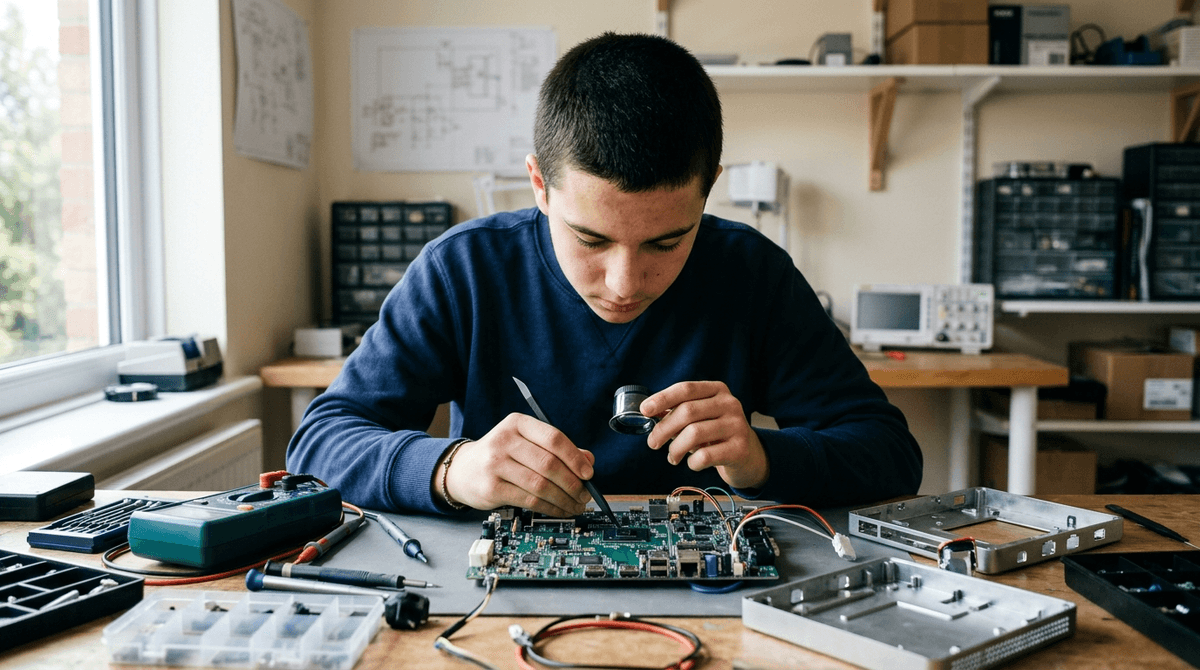
Future-proofing a tech career requires looking beneath the software and into the physical chips that power the world.
A nine-year evaluation of an elite engineering program proves that the most valuable tech education focuses on deconstructing physical hardware through an annually updated curriculum rather than static software theory.
Most parents direct their kids toward "coding," but the software market is becoming increasingly crowded and automated. Hardware security—the ability to take apart a computer chip and verify its safety—is a high-stakes, high-paying niche with massive talent shortages.
Understanding the "guts" of electronics provides a level of job security that software-only skills can no longer guarantee. As global supply chains become more politically charged, the people who can verify the physical integrity of hardware are becoming essential to national security and corporate safety.
We are living through a "hardware black box" era where almost no one knows how the chips in our phones, cars, or medical devices actually function. Most computer science degrees have neglected the physical layer for decades, focusing instead on high-level app development.
Researchers at a major European university recognized this gap and spent nearly a decade building a blueprint to teach students "hardware reverse engineering" (HRE). Their goal was to create a repeatable way to train students to deconstruct integrated circuits, ensuring that the next generation of engineers can audit the hardware we rely on every day.
Instruction must be "live" to be effective in high-tech domains. The researchers found that a static syllabus is essentially useless in hardware security; they had to rebuild the course every single year between 2017 and 2025 to keep pace with how chips are manufactured. Other key findings include:
- Hands-on beats textbooks. The program shifted away from abstract logic toward "circuit extraction," where students physically analyze actual integrated circuits to find vulnerabilities.
- Employment is immediate. A significant number of graduates bypassed entry-level generalist roles and moved directly into specialized hardware security positions.
- Cognitive load is the primary barrier. This is "deep tech" that requires intense analytical reasoning. The study found that managing the sheer technical density and workload was the biggest challenge for both students and instructors.
This research isn't just about engineering; it’s a warning about the fragility of our tech infrastructure. If we stop training people to understand the physical reality of chips, we lose the ability to trust our own devices.
The findings imply that "true" tech literacy for the next decade isn't about using an app or even writing one—it's about understanding the physical hardware that the app runs on. For a student, being the person who knows how the physical machine works provides a "moat" around their career that AI-driven coding tools cannot easily cross.
The findings are based on a case study of a single course at one elite European research university. These results may not be easily replicated at schools with fewer resources or different student demographics. Additionally, the paper is a preprint and has not yet undergone formal peer review. The data relies heavily on instructor reflections and alumni career tracking rather than a controlled, comparative study of student learning outcomes.
- If your child is naturally curious about taking things apart... encourage them to explore electrical engineering or hardware hacking kits like Arduino or Raspberry Pi rather than just screen-based coding languages.
- If you are vetting university engineering programs... ask the admissions office how often they update their curriculum and whether it includes hands-on labs for "hardware security" or "integrated circuit design."
- If your teen is worried about AI taking over tech jobs... point them toward hardware-centric roles, as the physical deconstruction and verification of electronics remain much harder for AI to automate than writing standard code.
- If your student is struggling with a high-intensity tech course... check if the "workload management" is the issue rather than their aptitude, as even elite students in this study found the technical density of hardware engineering overwhelming.
As software becomes more automated and "black-boxed," the real power users of the next decade will be the ones who can deconstruct and secure the physical hardware. Prioritizing physical engineering and hardware literacy is the smartest move for a tech-bound student today.
Zehra Karadağ, René Walendy, Carina Wiesen et al. (2026). Designing a Hardware Reverse Engineering Course: Lessons from Eight Years in a Rapidly Evolving Tech Domain. arXiv (preprint). — arxiv.org