

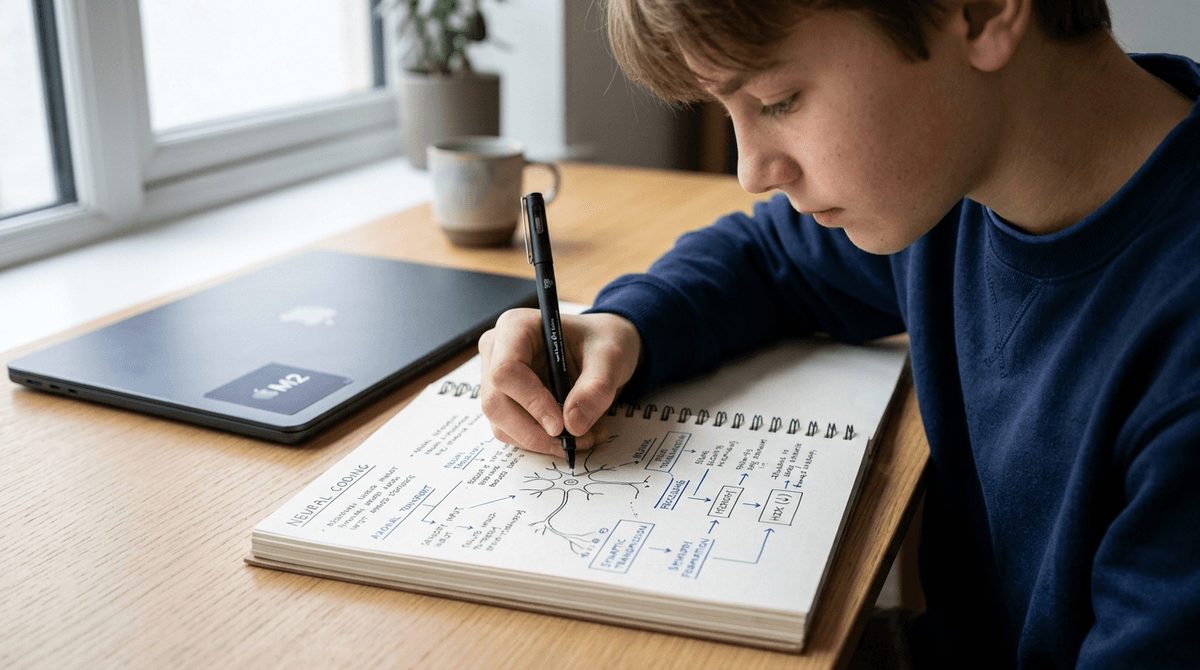
Writing by hand creates unique neural pathways for learning that the repetitive motion of typing simply cannot replicate.
Handwriting and drawing activate brain wave patterns essential for memory and learning, while typing on a keyboard fails to produce the same neurological engagement. The sensory-motor integration required to shape letters manually provides the brain with more "hooks" to hang memories on.
Schools are rapidly ditching paper for iPads and laptops, assuming the tool doesn't change the learning outcome. This research suggests that swapping a pen for a keyboard isn't just a change in technology—it is a change in how a child's brain processes information.
If we move entirely to digital input, we risk losing the biological shortcuts children need to actually retain what they are taught. For a parent, this means that while typing is a vital "output" skill for productivity, handwriting remains a vital "input" skill for deep comprehension.
Educators and researchers have watched the digital shift for a decade, often prioritizing the speed and volume of typing over the physical act of writing. The authors wanted to see if the brain actually distinguishes between the complex, fine-motor movements of cursive and the mechanical, repetitive tap of a key. As more classrooms go "paperless," understanding the neurological cost of that efficiency has become a matter of developmental urgency.
Handwriting is not just about the letters; it is about the brain’s electrical synchronization. Using 256-channel high-density EEG to track brain activity, researchers found distinct differences in how 12-year-olds and adults process information based on the tool they use.
- Cursive triggers "learning" waves. Cursive handwriting triggered synchronized theta waves in the brain’s parietal and central regions. This specific neural state is known to facilitate the encoding of new information.
- Drawing is a cognitive equivalent. Drawing produced nearly identical brain activation patterns to handwriting. This suggests that any task requiring the precise manual shaping of a figure is a high-level cognitive workout that benefits learning.
- Typing is neurologically "flat." Typewriting resulted in desynchronized brain activity in those same regions. The researchers noted that the repetitive motion of hitting a key provides very little feedback to the brain, leading to a weaker relationship to learning.
- Children need the "hooks." The study found that children showed the same beneficial brain wave patterns as adults when writing by hand. The physical effort of moving the pen gives the brain more sensory "hooks" to anchor new concepts.
The speed of typing might actually be its downfall for learning. Because writing is slower and requires more physical effort, it forces the brain to stay engaged with the content for a longer duration.
Typing allows for "transcription" without "processing"—a student can type every word a teacher says without actually thinking about any of them. Handwriting acts as a natural speed bump that requires the brain to summarize and map information in real-time. This suggests that the "efficiency" of a laptop in a classroom may actually be an obstacle to long-term retention.
The sample size for this study is very small, consisting of only 12 children and 12 adults in Norway. While the high-density EEG technology used is sophisticated, the small number of participants means these findings should be viewed as a strong signal rather than a definitive proof for all children.
Additionally, the children were recruited from a Waldorf school, an environment that emphasizes handwriting and drawing more than typical schools. This means their brains might be more "tuned" to these activities than a child who has been using a tablet since preschool. Finally, the study measured brain activity during the task but did not follow up to test how much information the participants actually remembered the next day.
- If your child is studying for a test on complex new concepts, have them write their study notes by hand or draw a mind map rather than typing them into a document to build stronger memory hooks.
- If your child is struggling to grasp a new idea in science or math, encourage them to draw a diagram of the concept; the study shows drawing engages the same deep-learning networks as writing.
- If your child's school is moving to a 1-to-1 laptop program, ensure they still have a physical notebook for "first-pass" learning and use the laptop primarily for final drafts and research.
- If you are choosing between a digital and physical planner for your child, opt for the paper version; the act of manually writing down tasks can help the brain better "see" and remember the schedule.
The physical connection between the hand and the page is a biological shortcut to better learning. While typing is a necessary life skill for modern productivity, it is a poor substitute for the cognitive heavy lifting required when a child is first encountering new ideas. Use the pen to learn and the keyboard to produce.
Ose Askvik, Eva, van der Weel, F. R. (Ruud), van der Meer, Audrey L. H. (2020). The Importance of Cursive Handwriting Over Typewriting for Learning in the Classroom: A High-Density EEG Study of 12-Year-Old Children and Young Adults. Frontiers in Psychology. doi:10.3389/fpsyg.2020.01810 — frontiersin.org