

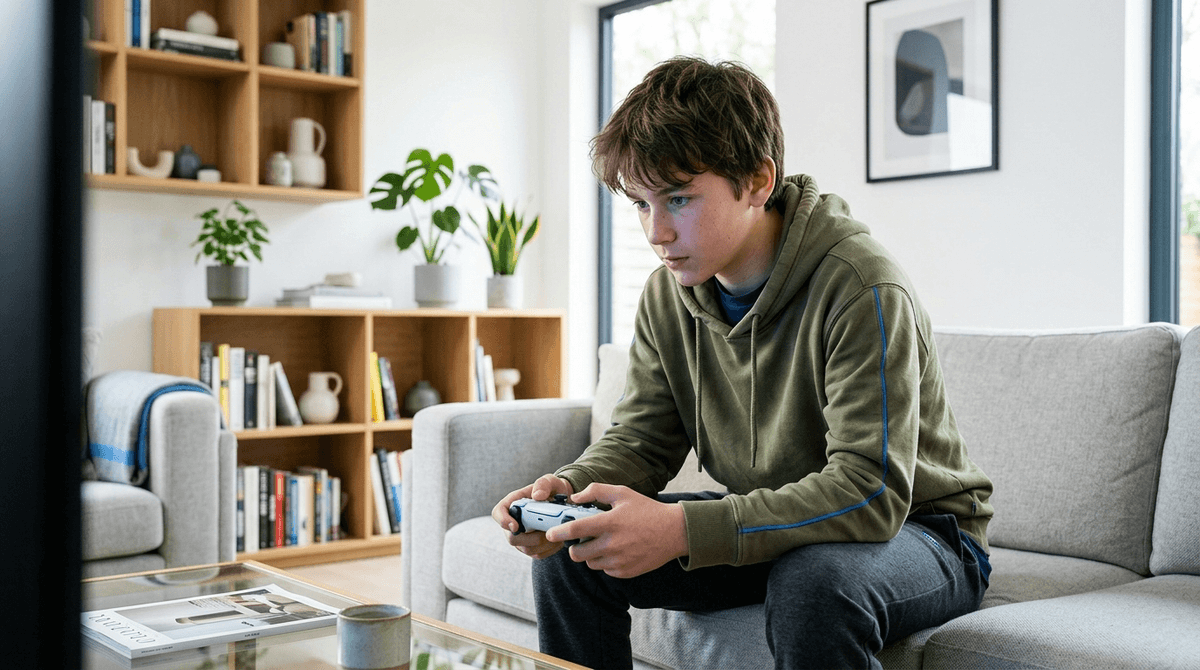
Ten percent of children and adolescents worldwide are struggling with a clinical addiction to gaming. This is no longer a niche concern or a parental hunch; it is a documented mental health reality for one out of every ten youth across the globe.
Roughly one in ten children and teens meets the clinical criteria for Internet Gaming Disorder (IGD), though your local risk fluctuates between 1% and 25% depending on your region and culture.
This finding moves the conversation from "too much screen time" to a recognized mental health condition. For parents, this means the focus must shift from counting hours to monitoring behavior. If your child is part of the 10% who meet the clinical threshold, a simple "digital detox" or taking the power cord away likely won't solve the underlying problem.
Understanding this 10% baseline helps you calibrate your level of concern. It confirms that while the vast majority of children play games as a healthy hobby, a significant minority—millions of children worldwide—suffer from functional impairment that requires professional intervention, not just better household rules.
Researchers conducted this massive meta-analysis because "gaming addiction" has finally moved from a debated concept to a standardized diagnosis. With both the DSM-5 and the World Health Organization's ICD-11 providing clear diagnostic criteria, scientists can finally look at 251,037 participants across the globe and see who actually qualifies for the disorder.
The goal was to move past small, alarmist studies and create a reliable global "prevalence" map. As gaming becomes the dominant form of entertainment for Gen Alpha and Gen Z, health systems need to know exactly how many kids are falling through the cracks of recreational play into clinical dependency.
About one in ten children are clinically addicted to gaming. The study pooled data from 19 major global studies to find a 10% average prevalence rate, but that number is far from uniform.
- Geography is the biggest variable: In some European populations, the rate of gaming disorder was as low as 1%. In parts of the Middle East and Latin America, it spiked to over 25%.
- Case counts are high: Using strict diagnostic criteria, the researchers identified 26,868 clinical cases within the study group.
- Study size matters: The meta-analysis revealed that smaller, less robust studies often reported significantly higher rates of addiction, while larger, more rigorous samples tended to settle closer to the 10% mark.
- Standardization works: By using the DSM-5 and ICD-11 frameworks, researchers could distinguish between "heavy players" and those with a genuine disorder.
The "10% global average" is a useful anchor, but the extreme variation (the "heterogeneity") suggests that gaming addiction isn't just about the software. It’s about the environment. The massive spike in certain regions—reaching one in four kids—suggests that where social outlets are limited or where gaming is the primary way to connect with peers, the risk of disorder skyrockets.
The study also implies that we may have been over-relying on "scare headline" data. Because smaller studies showed higher rates and were more likely to be published, the public perception of gaming addiction has often been more alarmist than the reality for the average kid. However, 10% is still a staggering number when applied to the global population of youth.
The data is observational, meaning it tells us how many kids are struggling but not why they are. We can't say if gaming causes mental health issues or if kids with pre-existing anxiety or depression are more likely to use gaming as a maladaptive coping mechanism.
Furthermore, the "10%" figure should be viewed as a midpoint. Because the statistical variation between countries was so high (I² = 99.7%), a parent in London faces a very different statistical reality than a parent in Mexico City or Riyadh. The "global average" is a starting point, not a local certainty.
- If your child is choosing gaming over basic hygiene, sleep, or schoolwork... stop focusing on the "game" and start looking at the clinical criteria for IGD. Treat it as a health issue that may require a therapist who specializes in the ICD-11 framework.
- If you are worried because your child plays for several hours on weekends but still maintains grades and friendships... take a breath. The 10% figure is reserved for those with "functional impairment," not just those with an intense hobby.
- If you live in a region with high prevalence rates (like Latin America or the Middle East)... be more proactive about diversifying your child's social outlets early, as your local environment may contribute to a higher statistical risk of habituation.
- If your child is under age 10... realize that early identification is the key. While the study covers ages 6–18, establishing healthy "analog" habits now is the best defense against becoming part of that 10% statistic in adolescence.
Gaming addiction is a legitimate clinical reality for a significant minority of children, but it is not the norm for most. While one in ten kids will need professional help to manage their relationship with the screen, the other nine are likely navigating a high-tech childhood without crossing the line into a disorder. Monitor for behavioral "red flags"—withdrawal, loss of control, and functional decline—rather than just the ticking of the clock.
Barboza JJ, Bonilla Asalde C, Rivera-Lozada O et al. (2026). Global prevalence of internet gaming disorder in children and adolescents: a systematic review and meta-analysis. Child and adolescent psychiatry and mental health. doi:10.1186/s13034-026-01083-8 — https://pubmed.ncbi.nlm.nih.gov/42071239/