

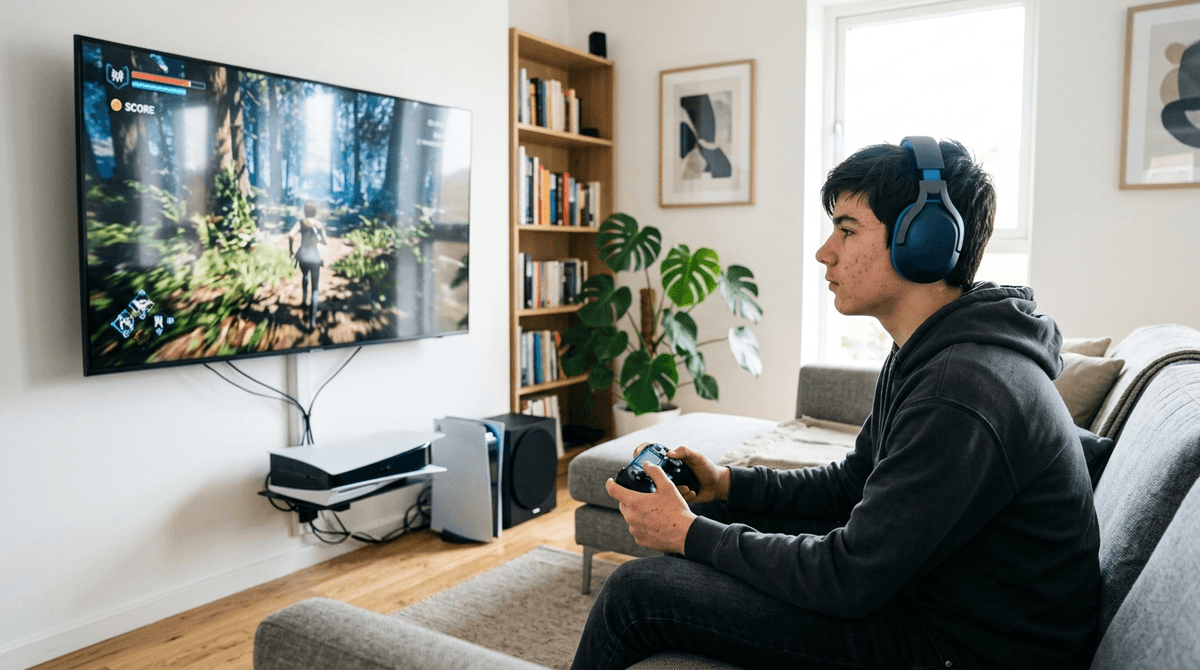
Telling a teenager that gaming is a "waste of time" or "bad for their brain" will not stop them from developing a gaming addiction. New data reveals that adolescents only start to believe gaming has negative consequences after they have already begun to experience the symptoms of addiction, not before.
A child’s beliefs about the benefits or costs of gaming do not predict whether they will develop a gaming addiction over the next year. Instead, addiction symptoms drive a later awareness of the hobby's downsides, suggesting that teens are experiential learners who only recognize the "cost" of gaming once the damage is already being done.
Lectures don't work as prevention. If you are trying to talk your child out of a heavy gaming habit by highlighting how it might hurt their grades or social life, you are likely missing the mark. This research suggests that a teenager's internal cost-benefit analysis is essentially blind to future risks; they don't see the "cost" until they are already in the thick of a problem.
This shifts the parenting burden from "convincing" to "structuring." Because a child's mindset doesn't act as a shield against addiction, parents cannot rely on a child’s "digital literacy" or "awareness" to keep them safe. Prevention must be behavioral—enforcing physical limits and schedules—rather than cognitive or conversational.
Researchers wanted to see if a child’s attitude toward gaming—specifically whether they viewed it as more beneficial (stress relief, social connection) or more costly (wasted time, health issues)—could predict their risk of Internet Gaming Disorder (IGD). The goal was to determine if "pro-gaming" beliefs lead to addiction, or if the addiction itself changes how a child thinks. By following over 1,000 students for a full year, they were able to see which came first: the belief or the behavior.
Experience shapes belief, but belief does not prevent addiction. The study followed 1,032 high schoolers and found a distinct "one-way street" in how kids process the impact of their gaming habits.
- Mindset is not a predictor. A student who thought gaming was "bad" at the start of the year was just as likely to develop an addiction by the end of the year as a student who thought it was "good."
- Addiction drives realization. Kids who developed addiction symptoms showed a significant increase in their awareness of gaming's "costs" one year later. They had to feel the negative effects to believe they existed.
- The "recovery" rate is notable. While about 6% of students showed persistent addiction symptoms over the year, nearly 9% saw their symptoms naturally remit, suggesting that for some, the realization of "costs" eventually leads to a change in behavior.
- Vulnerability is uneven. Boys and students from families with lower socioeconomic or educational status were at a significantly higher risk for developing problematic gaming habits.
This research essentially debunks the idea that we can "educate" our way out of gaming addiction. In many areas of parenting, we assume that if a child understands the risks, they will make better choices. But with gaming, the neurological pull of the reward system appears to bypass the child's rational evaluation of the hobby. The "cost" of gaming remains an abstract concept to a healthy teen; it only becomes a concrete reality once it starts interfering with their daily life.
The findings are based on a sample of students in central China, where the academic pressure and gaming culture may differ from other regions. The researchers also relied on self-reported data and used very simple, single-item questions to ask kids about "costs" and "benefits." This may not capture the full nuance of how a teenager weighs the social status gained in a game against the loss of sleep or study time. Additionally, the study did not account for underlying conditions like ADHD or anxiety, which are often the primary drivers of problematic gaming.
- If you are relying on "logic" to prevent a gaming habit... shift your strategy to behavioral boundaries like physical device docking stations and hard-coded router shut-off times, as a child's understanding of the risks will not protect them from the habit.
- If your child is already showing signs of addiction and denies there is a "problem"... understand that this is the standard trajectory. They likely won't agree that the gaming is "costly" until they have lived with the consequences for several more months.
- If you have a son or are navigating a high-stress environment... prioritize more frequent "tech-free" intervals, as these demographics showed a higher vulnerability to symptoms regardless of their initial attitude toward gaming.
- If you are debating the "pros and cons" of a specific game with your teen... stop the debate and focus on the schedule. Since their perception of benefits doesn't drive the addiction, the "value" of the game is irrelevant to the risk of them losing control over the habit.
Stop trying to win the argument about whether gaming is "bad" for your child; their brain isn't currently wired to use that information as a defense mechanism. Focus on maintaining physical limits and structured routines, because by the time a teenager finally agrees with you that their gaming has a "cost," the addiction has already taken hold.
Yang X, Wang X, Ramos MR (2026). Longitudinal associations between perceived benefits and costs of internet gaming and internet gaming disorder in adolescent gamers: A cross‑lagged structural equation model. PloS one. doi:10.1371/journal.pone.0351550 — pubmed.ncbi.nlm.nih.gov