

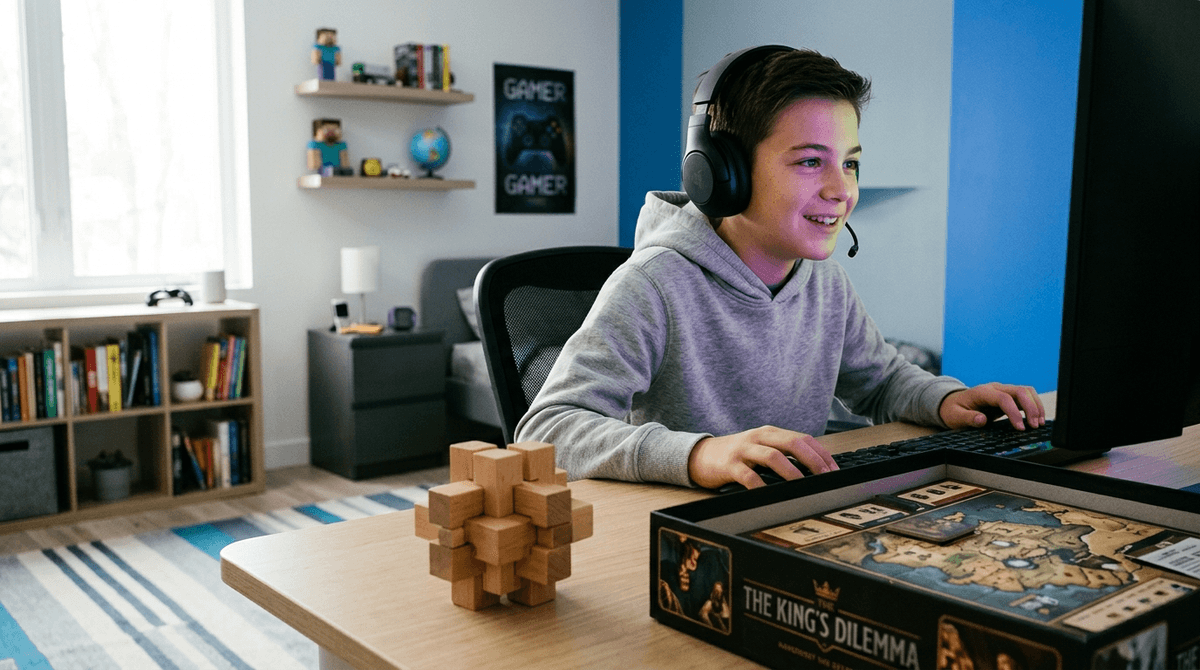
Middle schoolers who spend excessive time gaming may be trading away their ability to solve complex problems and think creatively, particularly if physical health issues limit their other play options. While high gaming hours don't necessarily tank a child's mood or happiness, they correlate with a "cognitive rut" that makes real-world hurdles harder to navigate.
Excessive video gaming in middle schoolers correlates with weaker creative problem-solving skills, especially for children with heart conditions who rely on screens for social outlet, though it does not appear to directly lower their overall sense of well-being.
Most parents worry about gaming's effect on a child's mood or social life, but the real cost may be cognitive flexibility. If a child uses gaming as their primary environment—especially if physical limitations keep them off the sports field—they may miss out on developing "computational thinking." This is the ability to break big, messy problems into small, manageable steps.
When gaming moves from a hobby to a dependency, the brain gets used to the predictable, programmed rewards of a software environment. This can make the unpredictable, unprogrammed challenges of the real world feel overwhelming. For kids who already face physical hurdles, like structural heart disease, this digital reliance can double the difficulty of building the perseverance needed for adulthood.
Researchers wanted to understand the specific impact of digital habits on children who are often forced into sedentary lifestyles. Children with congenital heart disease frequently face physical activity restrictions, making digital games a primary social and recreational outlet. The study aimed to see if this increased screen reliance created a "brain drain" on the specific types of thinking—like logic and creativity—that these children need to navigate their unique health challenges.
The study found a clear tension between hours spent in front of a console and the ability to think outside the box. Lead findings include:
- Creativity takes a hit. Among children with heart conditions, high digital game addiction scores were moderately linked to lower creativity and lower overall computational thinking skills.
- The "Addiction" paradox. Surprisingly, digital game addiction showed no statistically significant association with overall well-being. Children who were heavily engaged with games weren't necessarily "unhappier" than their peers, suggesting that games might be serving as an effective, if limited, coping mechanism.
- Perseverance is the link. Higher computational thinking skills—the ability to stick with a problem until it's solved—correlated with better social connectedness and higher levels of grit in both healthy children and those with heart disease.
- Physical limits drive digital use. About three out of four children in the heart disease group reported physical activity restrictions. For these kids, screens aren't just a choice; they are the default environment for play.
The lack of a link between gaming and "well-being" is the most revealing part of the data. It suggests that for many middle schoolers, gaming is a survival strategy that provides a sense of mastery and connection they aren't finding elsewhere. However, the drop in creativity scores suggests this strategy comes at a high price. They may be "happy" in the moment because the game is providing the dopamine, but they are losing the mental "muscle" required to solve problems that don't have a "start" button or a clear tutorial.
The sample size is very small, involving only 55 children total. This makes the findings exploratory rather than definitive. Additionally, the study is "correlational," meaning it cannot prove that gaming causes lower thinking skills. It is just as likely that children who already struggle with complex thinking or social anxiety are more drawn to the predictable, repetitive patterns of gaming. There was also a significant gender imbalance; 80% of the clinical group were boys, while the healthy control group was more evenly split, which likely influenced the addiction data.
- If your child has physical limitations that restrict sports, introduce "strategic" digital activities like coding, complex building simulators, or logic-based puzzle games to ensure they are practicing problem-solving rather than just reactive, "twitch" gaming.
- If you are worried about your child's gaming habits, look at their "computational thinking" rather than just their mood. If they can still break down a complex chore or a difficult homework assignment into steps without giving up, their gaming is likely not interfering with their cognitive development.
- If your child seems "happy" while gaming but frustrated by real-world tasks, use digital games as a bridge. Ask them to explain the logic or strategy of the game to you; forcing them to verbalize the "why" behind their digital moves can help translate game-logic into real-world communication skills.
- If you see signs of withdrawal when the console is off, prioritize activities that build "social connectedness" and "perseverance" in the physical world, as these were the two traits most negatively impacted by heavy gaming in the study.
Don't just count the hours your child spends gaming; look at what those hours are doing to their ability to think. While gaming might not be making your child "miserable," it can crowd out the mental growth required to tackle life's complex problems. Protect their creativity by ensuring their digital play is as strategic and varied as their physical play.
Akkaş Baysal E, Karaca NH, Pektaş A (2026). The Relationship Between Digital Game Addiction, Computational Thinking Skills, and Well-Being of Middle School Children With and Without Congenital Heart Disease. Children (Basel, Switzerland). doi:10.3390/children13050686 — pubmed.ncbi.nlm.nih.gov