

Here's the thing about this age group: they're not babies anymore, but they're also not ready for the stuff their older siblings are playing. Five to eight is this sweet spot where kids are developing reading skills, learning to problem-solve, and starting to care about "winning" but still need games that don't punish failure too harshly.
The best games for this age aren't necessarily the most popular ones. They're games that teach patience, encourage creativity, don't require lightning-fast reflexes, and—this is key—don't have chat features or online strangers.
We're talking about first video games, cozy creative experiences, and games that let them feel accomplished without needing a PhD in button combos.
Kids 5-8 are in wildly different places developmentally. A kindergartener and a third grader might as well be different species sometimes. Your 5-year-old might still be learning to use a controller, while your 8-year-old is asking why they can't play Fortnite like their cousin.
Plus, this is the age where gaming can actually build skills—hand-eye coordination, reading comprehension, spatial reasoning, basic coding concepts. But it's also the age where bad habits can form around screen time expectations and "just one more level" negotiations.
The good news? There are legitimately great games for this age that aren't just educational slop disguised as fun.
Creative & Cozy Games
Minecraft (Ages 6+)
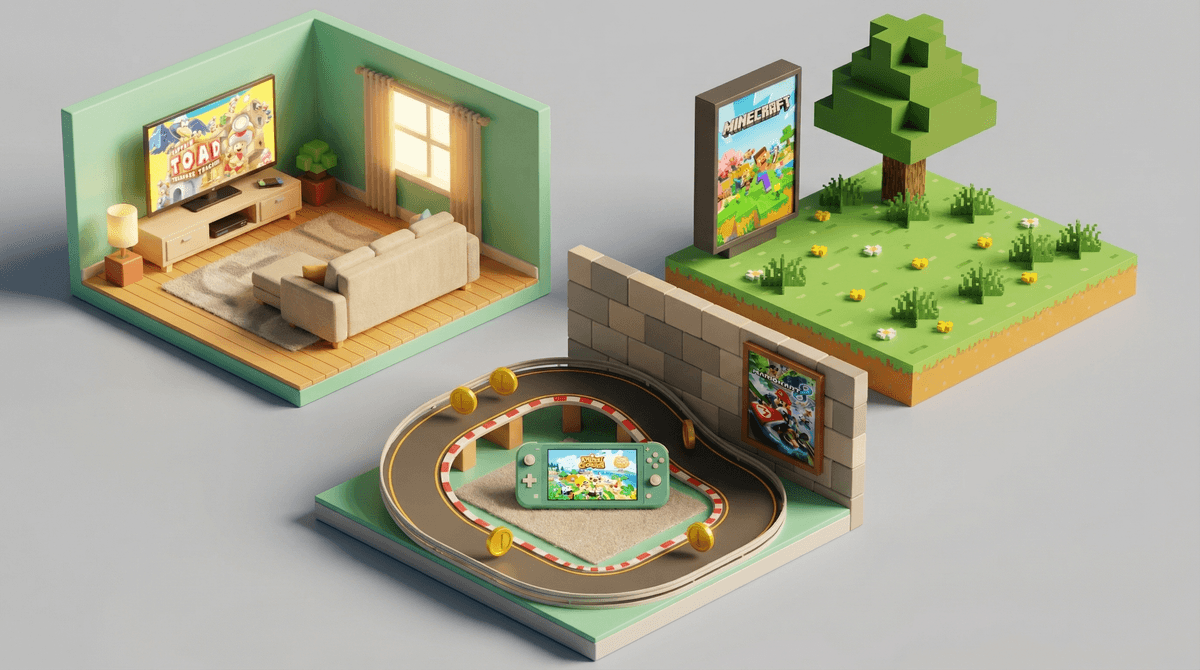
Yeah, I know—everyone recommends Minecraft. But there's a reason. In Creative Mode, it's basically digital LEGOs with infinite pieces. No monsters, no dying, just building whatever their brain can imagine. The learning curve is real though, so expect to sit with them for the first few sessions. And keep it offline—multiplayer Minecraft is a whole different beast.
Animal Crossing: New Horizons (Ages 5+)
This is the ultimate cozy game. You catch bugs, decorate your house, make friends with cartoon animals. There's no way to lose, no timer, no stress. The reading level is perfect for emerging readers, and honestly? It's so chill that you might find yourself playing it after they go to bed. Requires a Nintendo Switch though.
Sago Mini World (Ages 2-5, but some 6-year-olds still love it)
If your kid is on the younger end or still developing motor skills, this app is pure gold. Tons of mini-games, zero ads, zero pressure. It's a subscription, but it's one of the few apps actually worth paying for.
Puzzle & Problem-Solving Games
Captain Toad: Treasure Tracker (Ages 5+)
A puzzle game where you rotate 3D levels to find hidden gems and paths. It's from Nintendo, so it's polished and charming, and it teaches spatial reasoning without feeling like homework. Plus, it's genuinely challenging without being frustrating.
Unpacking (Ages 6+)
This is a weird one to recommend, but hear me out. You unpack boxes in different homes throughout someone's life. That's it. But it's meditative, teaches organization, and has this quiet storytelling that even young kids can appreciate. Super calming, no fail states.
LEGO games (Ages 6+)
Pick literally any LEGO game based on what your kid is into—Star Wars, Harry Potter, Marvel, whatever. They're all basically the same formula: simple combat, lots of collecting, co-op friendly, and genuinely funny. They're perfect first "action" games because you can't actually die—you just lose some LEGO studs and respawn.
Active & Party Games
Just Dance (Ages 5+)
Gets them moving, burns energy, and the kids' mode has age-appropriate songs. Fair warning: you will hear "The Gummy Bear Song" 47 times in one day.
Mario Kart 8 Deluxe (Ages 5+)
With the "smart steering" option turned on, even 5-year-olds can stay on the track and have fun. It's a great family game, teaches good sportsmanship (or reveals who needs to work on it), and the races are short enough that you're not locked in for 45 minutes.
Learning Games That Don't Suck
Osmo (Ages 5-8)
Technically it's physical pieces + iPad, but it's brilliant. Kids manipulate real objects that interact with the screen. The coding and pizza business games are genuinely engaging, not just "educational."
Prodigy Math (Ages 6+)
If your kid needs math practice, this is the least painful way to do it. It's basically Pokémon but you solve math problems to battle. The free version is fine; the paid version is aggressive about upselling, which is annoying.
Real talk: most free mobile games for kids are garbage. They're either loaded with ads, designed to push in-app purchases, or they're so overstimulating that your kid turns into a gremlin after 10 minutes.
If you're going mobile, stick to paid apps with no ads or subscription services like Apple Arcade that have actual quality control. Toca Boca games are solid for the younger end of this range.
- Chat features: Even "kid-friendly" chat can expose them to strangers or mean kids. Just no.
- In-app purchases: If your kid can accidentally spend $100 on gems/coins/whatever, that's a problem. Lock down those parental controls.
- Loot boxes: Basically gambling for kids. Hard pass for this age.
- Fast-paced shooters: Their brains aren't ready for the stress, and the content is usually too mature anyway.
The AAP recommends 1 hour of quality screen time per day for ages 6+, but let's be honest—that's not always realistic, especially on weekends or sick days. The key word is "quality." Minecraft in Creative Mode where they're building a replica of your house? That's different from mindlessly watching someone else play games on YouTube.
What matters more than the exact minutes is: Are they still doing other things? Playing outside, reading, engaging with family, sleeping enough? If gaming is crowding out everything else, that's your signal to pull back.
The best games for kids 5-8 are ones that let them explore, create, and problem-solve without the pressure of online competition or exposure to strangers. Think cozy, creative, and cooperative.
Your kid doesn't need the latest viral game. They need games that meet them where they are developmentally and build skills without building bad habits.
And if you're feeling overwhelmed by all the options and trying to figure out what actually makes sense for your specific kid? That's literally what Screenwise is for—personalized recommendations based on your family's values and your kid's interests, not just what's trending.
- Set up parental controls before handing over any device. Here's how to do it on every major platform.
- Play together for the first few sessions of any new game. You'll spot issues early and it's actually fun bonding time.
- Check the ratings, but know that ESRB ratings are guidelines, not gospel. You know your kid better than a rating board does.
- Create a family media plan so everyone knows the expectations around when, where, and how long gaming happens.
And remember: you're not raising a gamer. You're raising a human who sometimes plays games. There's a difference.