

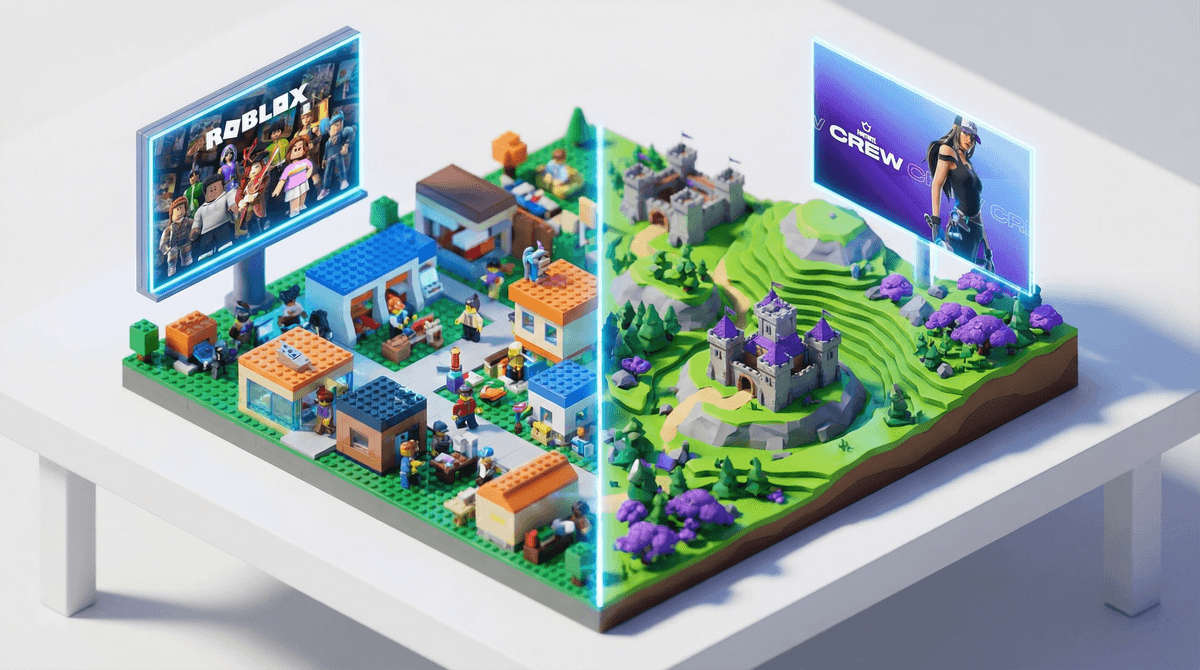
Let's start with the basics, because if you're reading this, there's a good chance your kid has asked for one (or both) of these games, and you're trying to figure out what you're actually saying yes to.
Fortnite is a battle royale shooter where 100 players drop onto an island and fight until one person (or team) remains standing. Players build structures, collect weapons, and yes—shoot each other. It's cartoonish, not gory, but it's definitely combat-focused. The game is free to play, but there's a massive ecosystem of cosmetic purchases (skins, emotes, battle passes) that can add up fast.
Screenwise Parents
See allRoblox is harder to describe because it's not really a single game—it's a platform where users create and play millions of different games. Think of it as YouTube meets Minecraft meets a game creation engine. Your kid might be playing a horror game one minute, a pet simulator the next, and then building a virtual pizza shop. It's also free to play, with an in-game currency called Robux that's used for everything from avatar clothes to game passes.
Here's what the data tells us: only 25% of families in our community report no Roblox usage at all, while 60% of kids are playing on public servers with strangers. Meanwhile, Fortnite has lower overall adoption—70% report no usage—but among those who do play, 12% play with friends only and 8% play with everyone.
Both games have cracked the code on what makes kids come back every single day, and it's not just the gameplay.
Fortnite is a social hub disguised as a shooter. Kids aren't just playing—they're hanging out. The game has evolved beyond battle royale into concerts, movie screenings, and creative modes where combat is optional. When your kid says they're "playing Fortnite," they might actually be sitting in a virtual lounge chatting with friends while building random structures. The game also updates constantly with new content, collaborations with Marvel or Star Wars, and limited-time events that create serious FOMO.
Roblox offers something different: creative control and entrepreneurship. Kids can design their own games, monetize them, and actually earn real money (converted from Robux). It's also incredibly social—most kids are playing with friends, chatting via text or voice, and participating in virtual economies. The variety is endless, which means it never gets old. Bored of one game? There are literally millions of others to try.
The cultural currency of both games cannot be overstated. These aren't just games—they're where kids' social lives happen. Not playing means missing out on inside jokes, friend group activities, and shared experiences.
The Money Situation
Both games are "free to play" in the same way that a casino is free to enter. The business model is built on microtransactions, and kids are the target market.
In Fortnite, everything costs V-Bucks (purchased with real money). Skins can run $8-20. The Battle Pass is $10 per season and unlocks challenges and rewards. Learn more about how these in-game currencies work . The game is designed to make you feel like everyone else has cool skins and you're the only default character. It's effective.
In Roblox, Robux is the currency, and it's even more complex because kids can spend it across thousands of different games. Some games are pay-to-win. Some require Robux just to access. And yes, Robux is absolutely real money—kids just don't always understand the conversion rate. The platform also has a subscription service (Roblox Premium) that gives monthly Robux and other perks.
Bottom line: Set spending limits from day one. Use parental controls to require approval for purchases. Have explicit conversations about the difference between cosmetic items and gameplay advantages.
The Safety Concerns
Fortnite's main safety issue is voice chat. Your kid will be in lobbies with strangers, and voice chat is enabled by default. You'll hear swearing, trash talk, and occasionally worse. The game does have text and voice chat moderation, but it's imperfect. You can disable voice chat entirely or limit it to friends only in settings. Here's how to set up Fortnite parental controls.
Roblox has more complex safety challenges because it's a platform with user-generated content. Kids are chatting with strangers constantly—via text in most games, and via voice chat if they're 13+ with ID verification. The content moderation is decent but not perfect. Inappropriate games slip through. Predatory behavior happens. Scams are common (promises of free Robux, phishing for account credentials). The good news: Roblox has robust parental controls that let you restrict who can chat with your kid, what games they can access, and whether they can use voice chat. Set up Roblox parental controls here.
The Screen Time Trap
Both games are designed to be endless. There's no natural stopping point. Fortnite matches last about 20 minutes, and there's always "just one more game." Roblox has no matches at all—kids can play for hours without realizing time has passed.
55% of families in our community report gaming usage, meaning this is the norm, not the exception. But that doesn't mean unlimited access is healthy. Set clear time limits, use timers, and give warnings before time is up. Both games have built-in time management tools in their parental control settings.
Fortnite is rated T for Teen (13+) by the ESRB. That said, plenty of younger kids play it. The violence is cartoonish—no blood, no gore—but it's still combat-focused. If your kid is sensitive to competition, losing, or conflict, Fortnite might be stressful rather than fun. The social dynamics can also be intense (trash talk, exclusion from squads, pressure to spend money on skins).
Roblox is rated E10+ (Everyone 10 and up), but the reality is that kids as young as 6 are playing. The platform itself isn't the issue—it's the specific games and who your kid is interacting with. Younger kids should stick to curated games and friends-only chat. Older kids can handle more freedom, but you still need to monitor.
Here's the thing: Fortnite and Roblox aren't going anywhere, and trying to ban them entirely might just mean your kid plays at a friend's house without any guardrails.
Instead, approach both games as opportunities to teach digital literacy, financial responsibility, online safety, and self-regulation. Play with your kid. Ask about their favorite games. Understand why they love these platforms. Set boundaries, yes—but also engage.
Both games have legitimate upsides. Fortnite teaches teamwork, strategy, and quick decision-making. Roblox teaches creativity, problem-solving, and even basic coding and economics. The question isn't whether these games are "good" or "bad"—it's whether you're setting your kid up to engage with them safely and healthily.
- Set up parental controls on both platforms before your kid starts playing. Don't wait.
- Have the money conversation early. Decide on spending limits and stick to them.
- Check in regularly. Ask who they're playing with, what games they're into, and whether they've seen anything that made them uncomfortable.
- Set time limits and enforce them consistently. Use built-in tools or external screen time management apps.
- Play with them at least once. You'll learn more in 20 minutes of gameplay than you will from reading a dozen articles.
Both games can be part of a healthy digital life—but only if you're actively involved. And hey, you might actually have fun. (Or at least understand why your kid won't stop doing that weird floss dance.)