

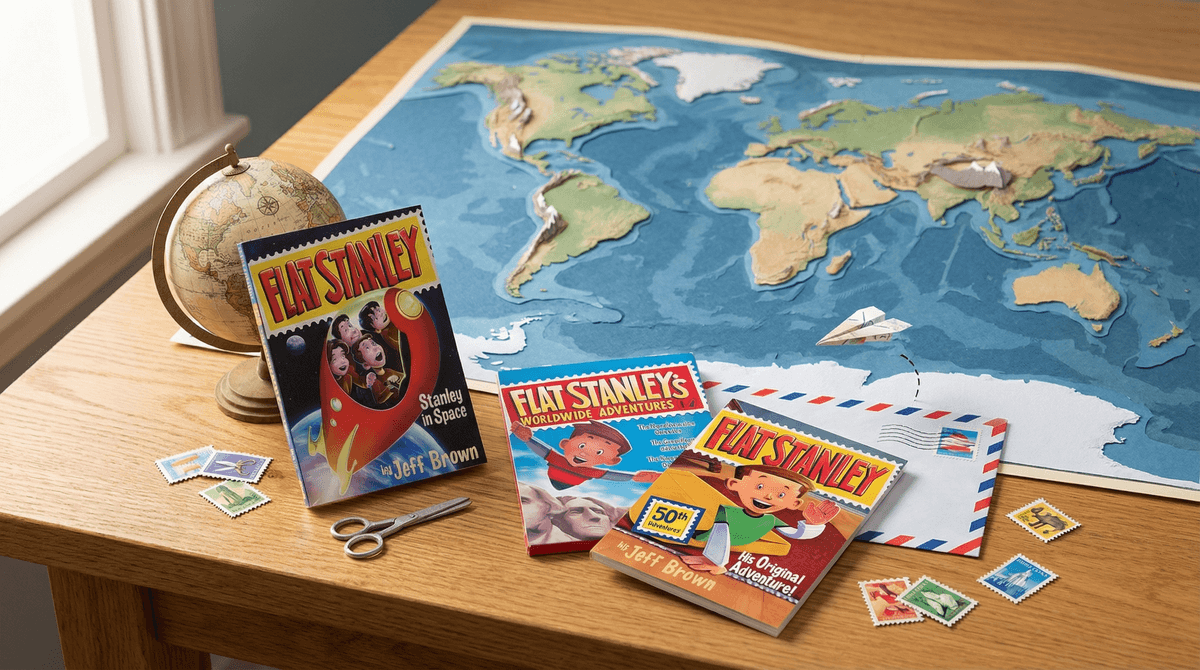
Flat Stanley is a children's book series that started with a single story by Jeff Brown in 1964. The premise is delightfully absurd: a bulletin board falls on a boy named Stanley Lambchop while he's sleeping, and he wakes up completely flat—just half an inch thick. Instead of being traumatized, Stanley embraces his new form and discovers all the advantages of being paper-thin: he can slide under doors, fly like a kite, and even be mailed in an envelope to visit friends.
But here's where it gets really interesting for parents: in 1995, a Canadian teacher named Dale Hubert had a brilliant idea. He created the Flat Stanley Project, where kids make paper versions of Stanley, mail him to friends and family around the world, and those recipients send back photos and stories of Stanley's adventures. It's become a global classroom phenomenon that's introduced millions of kids to geography, letter writing, and the concept that real connection can happen through physical mail.
In our age of instant DMs and FaceTime, Flat Stanley offers something genuinely countercultural: anticipation, patience, and the tangible joy of receiving something in your actual mailbox.
The book itself is genuinely funny and imaginative—kids love the idea of being flat and all the possibilities it opens up. But the Flat Stanley Project is what's made this a classroom staple for nearly 30 years.
Here's what makes it work:
It's hands-on and creative. Kids get to draw, color, and personalize their own Stanley. There's something deeply satisfying about creating a physical thing that will actually travel somewhere.
It makes geography real. When your Stanley goes to Tokyo or Texas or Toronto, suddenly those aren't just dots on a map. Kids are checking time zones, looking up landmarks, and asking questions about what life is like in different places.
It teaches delayed gratification. In a world where kids can video chat with grandparents instantly, waiting 2-3 weeks for Stanley to arrive and return creates genuine excitement. That anticipation is actually a feature, not a bug.
It connects generations. Grandparents and older relatives often LOVE participating in Flat Stanley projects. It's an accessible way for them to engage with kids that doesn't require downloading TikTok or figuring out Roblox.
The original Flat Stanley book is perfect for ages 4-8, with simple vocabulary and charming illustrations. Kids in this age range can handle the slightly surreal premise without getting too literal about the physics of being flat.
The Flat Stanley Project typically happens in 1st through 4th grade classrooms (ages 6-10), though I've seen kindergarteners and 5th graders participate too. The sweet spot is around 2nd-3rd grade, when kids are:
- Developing writing skills and can compose simple letters
- Starting to understand geography beyond their immediate neighborhood
- Old enough to understand the concept of mailing something but young enough to find it magical
There are also chapter book sequels for slightly older readers (ages 7-10) where Stanley has additional adventures, though the original remains the most beloved.
This is a screen-free win. If your kid's teacher assigns a Flat Stanley project, embrace it fully. This is one of those rare school activities that gets kids OFF devices and engaged with the physical world.
You'll need to help facilitate. Your child will need addresses, envelopes, stamps, and probably some parental support with the actual mailing process. Consider this quality time, not a chore. Learn more about involving extended family in screen-free activities .
.
Set expectations about responses. Not everyone will respond, and that's okay. Build in multiple destinations so your child isn't devastated if Aunt Linda forgets to send Stanley back. This is actually a gentle lesson in managing expectations—something our kids need practice with.
The digital version exists but misses the point. There are apps and digital Flat Stanley projects, but honestly? They defeat the purpose. The magic is in the physical creation, the real stamps, the actual mailbox checking. Don't digitize this one.
It's a conversation starter about communication. Use this project to talk about different ways we stay connected—texts, calls, video chats, and yes, good old-fashioned mail. Each has its place. Maybe even compare how long it takes Stanley to arrive versus how long it takes a text message to send.
Even if your kid's school doesn't do Flat Stanley, you can create your own version:
Summer travel project. Make a flat family mascot and photograph them at each destination. Kids love being the "photographer" responsible for remembering to include Flat Bear or Flat Unicorn in vacation pics.
Pen pal program. Use Stanley as a gateway to regular letter writing with cousins, family friends, or through formal pen pal programs. The structure of "sending someone somewhere" makes that first letter less intimidating.
Geography exploration. Read the book, then pull up a map and let your kid pick places they'd want to send Stanley. Research those places together—what would Stanley see there? What would he eat? This is way more engaging than abstract geography lessons.
In a digital world where everything is instant and ephemeral, Flat Stanley offers something increasingly rare: a project that requires patience, creativity, and real-world connection. It teaches kids that distance can be bridged not just through screens, but through imagination, effort, and the simple act of putting something in the mail.
Is it old-fashioned? Absolutely. Is that exactly why it still matters? Also absolutely.
The book is charming, the project is meaningful, and the lessons—about geography, communication, and the joy of receiving something tangible—are ones our kids genuinely need. Plus, watching your child sprint to the mailbox every day hoping Stanley has returned is pretty much the cutest thing ever.
- Read the original book together before any project starts—it's short and genuinely enjoyable
- Make a list of potential Stanley destinations with your child (grandparents, family friends, your college roommate who moved to Seattle)
- Create a tracking system—a map with pins or a simple chart showing where Stanley went and when he returned
- Document the journey with photos of your child creating Stanley, mailing him, and reuniting with him
- Consider making it an annual tradition—send Stanley somewhere new each summer or school year
If you want to explore more screen-free activities that teach patience and creativity, check out our guide to balancing digital and analog play.